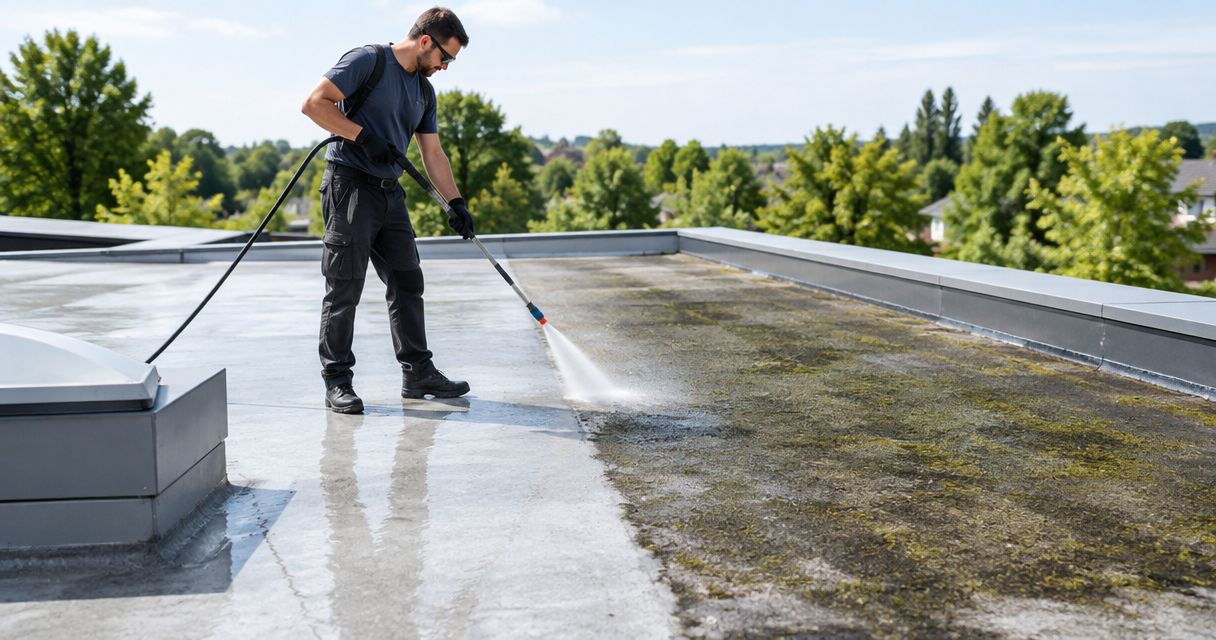
Yes—soft washing is safe for a flat roof when the roof manufacturer permits the cleaning method, the membrane is sound, and the cleaner controls chemical exposure and drainage. Low pressure alone does not make the job safe: an unsuitable solution, damaged seam, or blocked drain still creates risk. For a 2026 cleaning appointment, confirm the roof material and its maintenance instructions before approving treatment.
- Is soft washing safe for flat roofs? Yes, when membrane compatibility, roof condition, and drainage are checked first.
- Low pressure reduces mechanical force; it does not make every roof-cleaning solution suitable for every membrane.
- Repair leaking seams and investigate standing water before scheduling roof cleaning.
- Socalemm provides roof soft washing for homeowners and businesses in Newport Beach and Orange County; confirm flat-roof suitability before booking.
Why this matters
A flat roof is a waterproofing system, not a surface to scrub until it looks new. Its seams, flashing, drains, and protective finish matter as much as the visible dirt. Cleaning should preserve those parts rather than trade their condition for a brighter appearance.
Socalemm provides roof soft washing and other exterior cleaning services in Newport Beach and Orange County. Before requesting work on a flat roof, identify its membrane or coating; the service name alone does not establish compatibility with your particular roof.
Is soft washing safe for flat roofs?
Soft washing is appropriate only when the complete cleaning process matches the roof—not simply when the equipment uses low pressure. The process includes the cleaning product, dilution, application, contact time, rinsing, foot traffic, and wastewater handling.
Use this comparison to decide what information you need before approving work. These are screening questions, not permission to apply a particular chemical.
| Roof surface | Best for | Main cleaning concern | Decision before washing |
|---|---|---|---|
| TPO membrane | Owners checking a TPO-specific cleaning plan | Unsuitable chemicals, damaged seams, or excessive abrasion | Obtain the membrane manufacturer's cleaning instructions |
| PVC membrane | Owners checking a PVC-specific cleaning plan | Chemical compatibility and seam condition | Confirm the proposed product and rinse method are permitted |
| EPDM rubber | Owners checking an EPDM-specific cleaning plan | Incompatible cleaners, especially products the manufacturer prohibits | Verify compatibility rather than borrowing another roof's recipe |
| Modified bitumen | Owners assessing an asphalt-based roof | Surface wear, exposed reinforcement, and damage around laps | Check the roof's condition and approved maintenance method |
| Coated roof | Owners maintaining an existing roof coating | Cleaner compatibility and fragile or peeling coating | Identify the coating before selecting a treatment |
Each surface has a practical limitation: its general material name does not identify every formulation, repair, or coating already on the roof. A previous owner might have added a coating that changes the cleaning instructions. If the surface cannot be identified, pause chemical treatment.
For a broader method comparison, read soft washing versus pressure washing for roofs. A preference for lower pressure does not replace the material-specific checks below.
What should happen before a flat roof is soft washed?
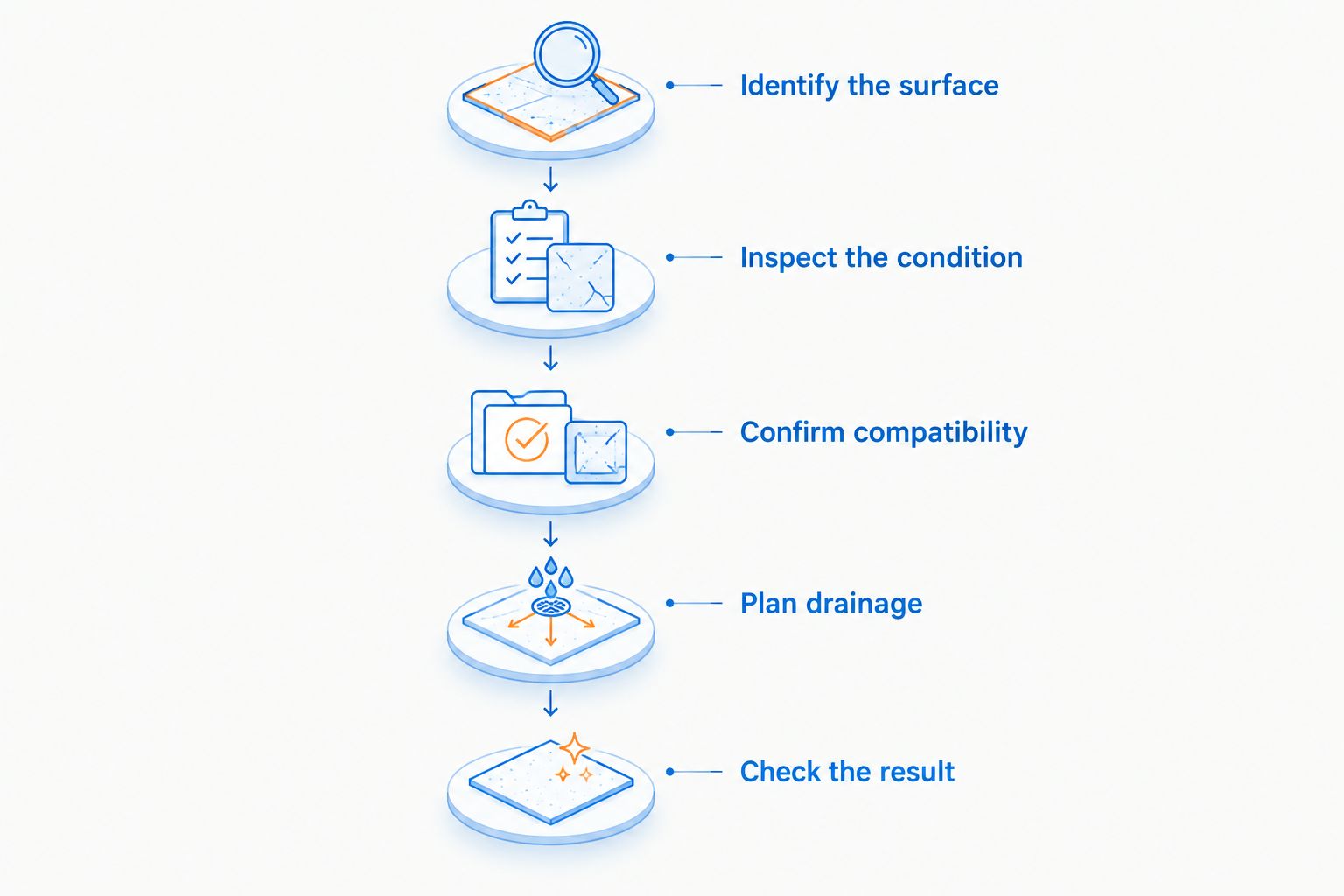
A sound 2026 cleaning plan starts with documentation and inspection, not a stronger solution. Ask the contractor to explain these steps in plain language.
- Identify the surface. Find the roof installation records, membrane name, coating information, and previous repair details. If records are unavailable, have a qualified roofing professional identify the assembly before chemical cleaning.
- Inspect the condition. Check seams, flashing, penetrations, patches, and drain areas. Active leaks, open seams, loose flashing, or peeling coatings belong in a repair discussion before a cleaning discussion.
- Confirm compatibility. Compare the proposed cleaning product and application method with the roof manufacturer's maintenance instructions. A product label that permits roof use is not proof that every roof membrane permits that product.
- Plan drainage. Establish where rinse water will travel, how debris will be kept out of drains, and how surrounding property will be protected. Do not assume that an unobstructed-looking drain proves the entire drainage route works.
- Check the result. Where the instructions call for it, test an inconspicuous area before broader treatment. After cleaning, inspect the surface and drainage areas without adding unnecessary roof traffic.
The advantage of this sequence is that it catches reasons to stop before treatment begins. Its limitation is equally important: a visual cleaning inspection does not establish that the roof is watertight or replace a roofing assessment.
Why flat-roof soft-washing safety varies
The same equipment does not produce the same risk on every roof. These factors determine whether cleaning should proceed and what the plan needs to address:
- Membrane and coating compatibility. A cleaner suitable for one surface is not automatically suitable for another. Include existing coatings and repair materials in the compatibility check.
- Existing damage. Open seams, punctures, and deteriorated flashing provide routes for water entry. Cleaning does not repair them, regardless of the application pressure.
- Drainage condition. Debris and blocked outlets interfere with water leaving the roof. Investigate persistent standing water rather than treating it as a stain-removal problem.
- Chemical exposure. Product strength, contact time, temperature restrictions, and rinsing requirements belong to the approved instructions. Do not substitute a generic roof-cleaning recipe.
- Access and runoff. Roof edges, skylights, equipment, landscaping, and discharge routes affect the work plan. A low-pressure hose does not remove fall hazards or wastewater responsibilities.
Low pressure helps, but it is not the whole safety plan
Lower-pressure application reduces reliance on force to remove organic buildup. That is its practical benefit. Its limitation is that cleaning chemistry still contacts the membrane, seams, adjacent metal, and anything reached by runoff.
A contractor should be able to describe how those surfaces will be protected. Answers such as using the same mix on every roof leave the central compatibility question unresolved.
Do not approve a universal pressure setting or chemical concentration for an unidentified flat roof. Equipment settings, nozzle choice, distance, and application technique work together; an isolated pressure figure does not establish a safe process.
For your 2026 scope of work, ask for the proposed method rather than just the label “soft wash.” The useful answer identifies the surface, permitted treatment, application limits, rinse requirements, and stop conditions.
When should you postpone flat-roof cleaning?
Postpone cleaning when you have an active leak, an open seam, loose flashing, exposed reinforcement, or a coating that is lifting away. Ask a roofing professional to assess those defects first. Washing over them does not turn maintenance into repair.
Persistent ponding also needs attention before a cosmetic cleaning job. A dirty low spot and a drainage defect are different problems, even when they appear together. Cleaning can remove surface contamination; it cannot correct roof slope or rebuild a damaged drain connection.
Unknown material is another reason to wait. If nobody can identify the membrane or coating, the contractor cannot meaningfully confirm chemical compatibility. A delayed wash is preferable to an unidentified treatment on your waterproofing.
You should also postpone work when safe access, weather conditions, or wastewater handling remain unresolved. These are planning requirements, not details to sort out after the cleaning solution reaches the roof.
What should a homeowner ask before booking?
For a home in Newport Beach or elsewhere in Orange County, keep the conversation focused on your roof and the property below it. Ask how the contractor will protect landscaping, outdoor furniture, walls, windows, and areas where people or pets pass.
Request a written scope that answers these questions:
- What membrane or coating is being cleaned?
- Which maintenance instructions support the proposed treatment?
- What visible defects would stop the work?
- How will drains and runoff be managed?
- What rinsing or follow-up inspection does the method require?
- Which stains or discoloration are outside the cleaning scope?
Photos help describe the job, but do not climb onto the roof to obtain them. Send existing records and safely taken ground-level photos instead. Tell the contractor about past leaks and repairs, even if the interior currently looks dry.
Socalemm roof soft washing is best suited to homeowners seeking local exterior cleaning in Newport Beach and Orange County. For a flat roof, confirm that the proposed service fits the identified roof system before agreeing to the work.
Request a roof-cleaning quote
Describe your flat-roof material, visible buildup, and any known leaks or drainage concerns.
What changes for a commercial flat roof?
For a commercial property, separate the roof-maintenance scope from storefront, walkway, or other exterior cleaning. Those surfaces have different materials, access needs, and drainage considerations. A single cleaning specification should not cover them by default.
Coordinate roof access with the person responsible for the building. Identify rooftop equipment, skylights, service routes, occupied areas below, and any existing roof-maintenance requirements. Make clear who approves work and who responds if a leak or defect is discovered.
A 2026 commercial work order should distinguish cleaning from repairs and identify any areas excluded from treatment. If a roofing contractor maintains the roof, share the proposed cleaning method before scheduling. That avoids conflicting instructions between the cleaning crew and the roof-maintenance provider.
Can you soft wash a flat roof yourself?
Do not treat a flat roof as an ordinary DIY pressure-washing surface. Low slope does not eliminate falls, slippery footing, fragile skylights, or damage from walking across vulnerable areas.
The practical homeowner role is to collect roof records, report leaks, and document concerns from a safe location. Leave access, material assessment, and treatment decisions to appropriately qualified professionals. Buying low-pressure equipment does not answer the compatibility or drainage questions.
Does soft washing fix standing water or roof leaks?
Soft washing does not fix roof leaks or correct standing water caused by drainage or slope defects. It is a cleaning process, not a waterproofing repair.
Debris removal and cleaning can be part of roof maintenance, but persistent ponding needs its own assessment. If discoloration returns around the same wet area, investigate why water remains there instead of repeatedly increasing treatment strength.
FAQ
Is soft washing safe for flat roofs in 2026?
Soft washing is safe for a flat roof when the identified roof system permits the treatment and the membrane, seams, and drainage are suitable for cleaning. For a 2026 appointment, check current manufacturer instructions instead of relying on a generic roof-cleaning recipe.
Can bleach damage a flat-roof membrane?
A bleach-based solution is not automatically compatible with every flat-roof membrane or coating. Confirm whether the roof manufacturer permits the proposed product, dilution, contact time, and rinse method before treatment.
Is pressure washing better than soft washing for a flat roof?
Pressure washing is not automatically better for a flat roof, and higher force is not a substitute for a compatible cleaning method. Follow the roof manufacturer's permitted process rather than choosing equipment by cleaning speed.
Can a flat roof be cleaned if it already leaks?
An actively leaking flat roof should be assessed and repaired before washing. Low-pressure application does not close open seams, repair flashing, or prevent water from entering existing defects.
How often should I soft wash my flat roof?
Set the cleaning schedule from the roof manufacturer's maintenance guidance and the roof's observed condition, not a universal calendar. Review debris, drainage, and visible buildup during planned maintenance, and clean only when the approved method is appropriate.
Will soft washing make my flat roof look new?
Soft washing does not guarantee a like-new appearance. Weathering, old repairs, coating differences, and permanent discoloration can remain after removable buildup is cleaned away.
Does Socalemm offer roof soft washing in Orange County?
Socalemm provides roof soft washing and related exterior cleaning services in Newport Beach and Orange County. Describe your flat-roof material and condition when requesting a quote so the proposed scope can address suitability.
One last thing
Do not use roof brightness as your acceptance test. A cleaner-looking surface does not establish that seams, flashing, or drainage are sound, and remaining discoloration does not automatically justify stronger chemicals.
Before closing out a 2026 cleaning job, ask what was cleaned, what was left untreated, and whether any defects need a roofing professional's attention. Keep that record with the roof's maintenance documents. It is more useful for the next appointment than a before-and-after photo alone.