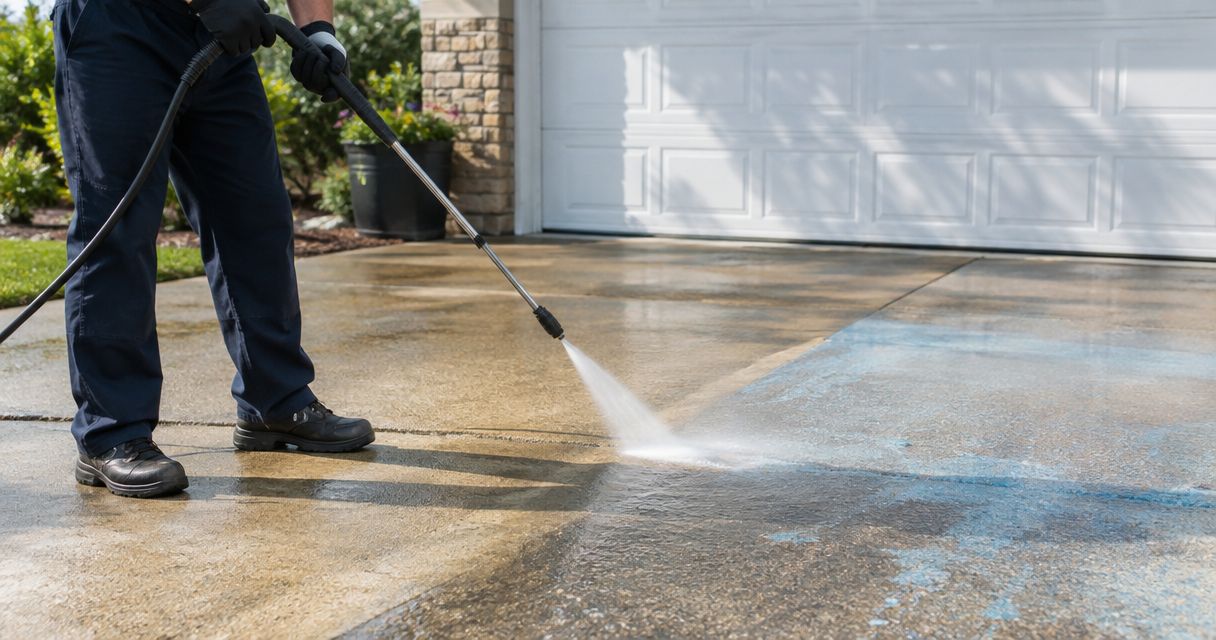
Yes—pressure washing can remove some paint overspray from a driveway, but water alone does not reliably remove cured paint bonded to the surface. The result depends on the paint, the driveway material, and any existing sealer; increasing pressure to chase remaining specks can damage the driveway before the paint comes off.
- Can pressure washing remove paint overspray driveway stains? Sometimes; cured paint often needs a surface-compatible treatment before rinsing.
- Socalemm serves Newport Beach and Orange County homeowners seeking pressure washing; paint removal requires a separate surface assessment.
- Test an inconspicuous area and inspect it dry before treating the entire driveway.
- Stop if cleaning changes the driveway’s texture, color, coating, or joint material.
Can pressure washing remove paint overspray from a driveway?
Pressure washing removes paint overspray when the water can separate the droplets from the driveway without damaging the material underneath. Loose surface deposits and firmly bonded paint require different approaches. A driveway that looks clean while wet can still show paint specks or treatment marks after drying.
For local driveway pressure washing, Socalemm serves homeowners in Newport Beach and Orange County. Describe the problem as paint overspray rather than ordinary dirt so the discussion starts with the right scope.
| Approach | Best for | Main advantage | Main limitation |
|---|---|---|---|
| Controlled pressure washing | Loose deposits on sound, compatible surfaces | Removes material without automatically introducing a paint remover | Bonded paint can remain; excessive pressure can mark the surface |
| Compatible pretreatment followed by rinsing | Adhered paint where product instructions permit the application | Addresses paint adhesion before rinsing | Treatment can affect sealers, color, nearby materials, and runoff handling |
| Specialist removal assessment | Sensitive finishes, uncertain coatings, or unsuccessful test areas | Evaluates alternatives before additional damage occurs | Requires a separate assessment; complete removal is not assured |
Choose the least aggressive approach that removes paint without changing the driveway. A stronger machine is not a substitute for identifying the surface and testing the treatment.
Why this matters
Paint overspray is not the same cleaning problem as dirt. Paint forms a film, while a driveway can have pores, texture, coatings, or joints that complicate removal. A method that lifts paint from one surface can strip the intended finish from another.
For a 2026 driveway cleanup, define success before work starts: remove the unwanted paint while preserving the existing surface. Removing every visible speck is not a successful result if the treatment leaves exposed aggregate, pale patches, or damaged sealer.
Take photographs before trying anything. Include a wider view showing the affected area and close-ups showing individual droplets, surface texture, and any existing wear.
Unsealed concrete: check paint adhesion and surface condition
Unsealed concrete has pores and texture that can hold paint below the most exposed surface. Pressure washing can remove material sitting loosely on top, but it does not guarantee removal from small recesses.
Best for an initial controlled test: sound concrete with a known history and no visible coating. Even then, inspect for crumbling edges, surface scaling, previous repairs, or existing wash marks before starting.
A test area should answer more than whether the paint disappears. Check whether the concrete becomes rougher, whether sand or aggregate comes loose, and whether the treated area looks different after drying.
If the paint remains while the concrete starts changing, stop. Repeated passes over the same spot can turn a paint-removal problem into a surface-repair problem.
Sealed or decorative concrete: protect the finish first
Sealed, colored, and stamped concrete needs a finish-specific approach. A paint-removal product can affect the protective coating as well as the unwanted paint, and concentrated water pressure can create an uneven appearance.
Best for preserving a decorative driveway: identify the coating and consult its care instructions before selecting a treatment. If you do not know what was applied, look for installation records or ask the installer rather than assuming the surface is bare concrete.
Check the test area from different angles after it dries. Changes in sheen, color, or water absorption can reveal an affected coating even when the paint is gone.
Do not assume that applying more sealer will hide a removal mark. Cleaning, coating removal, and resealing are separate decisions that depend on the existing finish.
Pavers and asphalt: do not use a concrete-only method
Pavers introduce joints as well as individual paving units. Strong water flow can disturb joint material, while a remover can change the appearance of the paver or its coating.
Asphalt requires separate compatibility checks. Solvents can affect asphalt binders, and aggressive washing can disturb a weathered surface.
Best for either surface: use care instructions specific to the material and any coating. A product labeled for concrete is not automatically suitable for pavers, asphalt, or the materials between paving units.
If paint extends across different driveway materials, assess each section separately. One successful test does not establish compatibility everywhere.
Why paint overspray removal varies
These factors explain why the same washing approach produces different results:
- Paint type: Water-based and solvent-based coatings have different cleanup instructions. Keep the paint container or product details when available.
- Cure condition: Wet paint, dried paint, and fully cured paint do not respond identically. Follow the coating manufacturer’s cleanup guidance rather than assuming dried paint remains water-soluble.
- Surface texture: Rough concrete and textured pavers hold droplets differently from smoother finishes. Paint lodged in recesses is harder to reach without affecting surrounding material.
- Existing protection: Sealers and decorative coatings introduce another layer that the cleaning method must preserve.
- Application pattern: Fine scattered specks and thick deposits require different attention. A heavy drip should not automatically receive the same treatment as light misting.
- Driveway condition: Weak concrete, deteriorating joints, repairs, and worn coatings limit how aggressively you can clean.
Record these details in your 2026 cleanup notes. They are more useful for planning than the pressure washer’s maximum rating alone.
How should you approach paint overspray removal?
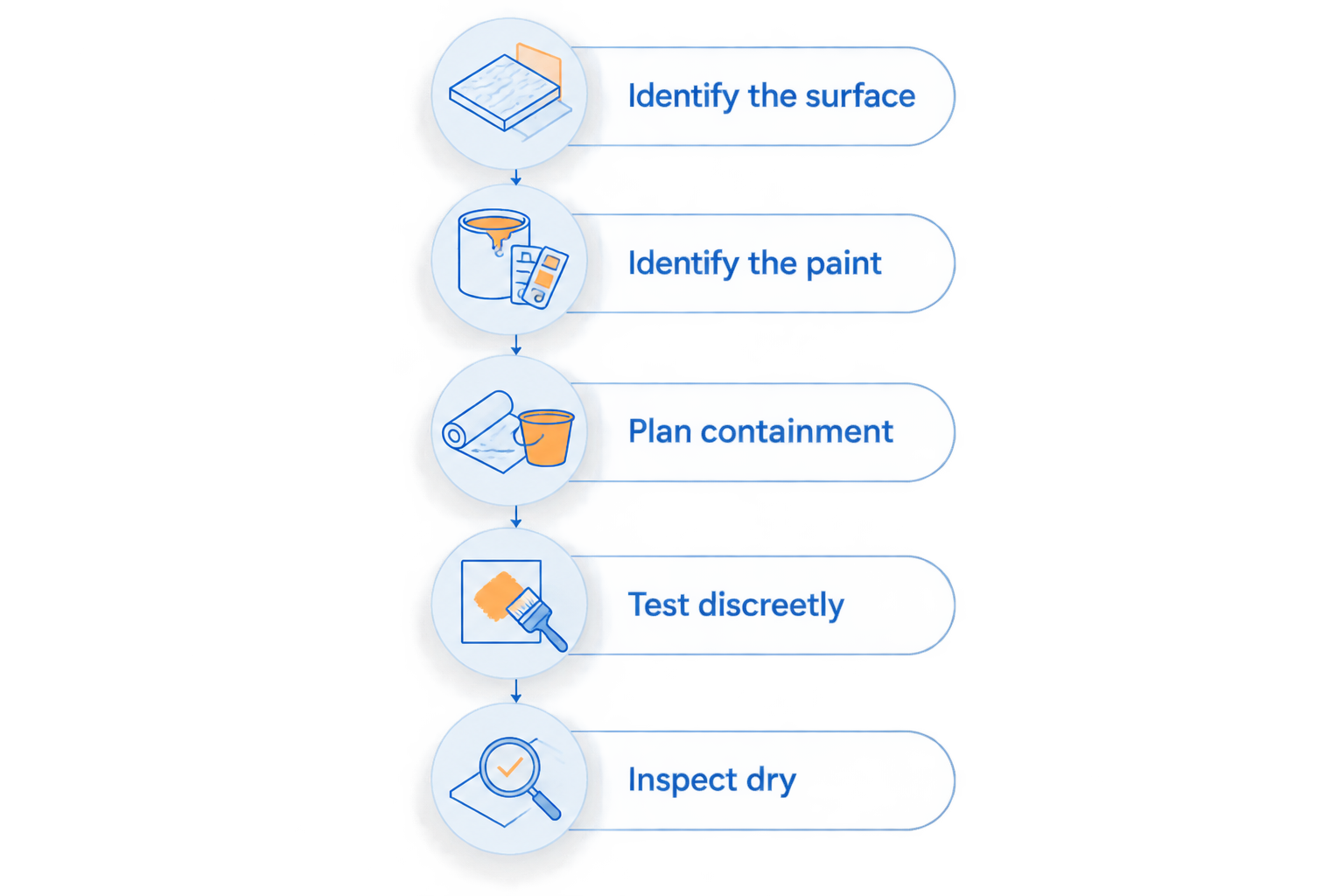
Use this sequence before treating the full driveway. The goal is to establish compatibility, not to find the highest pressure the surface will tolerate.
1. Identify the surface
Determine whether you have unsealed concrete, sealed concrete, decorative concrete, pavers, or asphalt. Note repairs and any areas where the finish already looks different.
Do not rely only on appearance to identify a sealer. Installation records and maintenance information are better starting points.
2. Identify the paint
Save the paint name, product label, and application details if available. Ask the painter what was sprayed and when the overspray occurred.
Do not assume that all white specks are paint or that all exterior paints use the same cleanup method. Unknown material calls for assessment before chemical treatment.
3. Plan containment
Move vehicles and loose items out of the work area. Protect nearby surfaces according to the treatment instructions, and decide how paint debris and wash water will be collected.
Do not rinse paint residue toward the street, a storm drain, landscaping, or a neighboring property. Check applicable local disposal requirements before starting.
4. Test discreetly
Choose an inconspicuous area that represents the affected surface. Follow the cleaning product’s instructions, including compatibility, protective equipment, application, rinsing, and disposal requirements.
Avoid improvised chemical mixtures. If a proposed method has no clear instructions for your driveway material, do not use the driveway to discover what happens.
5. Inspect dry
Allow the test area to dry before deciding whether to continue. Compare paint removal, color, sheen, texture, and joint condition with the surrounding area.
A test passes only when the paint improves without unacceptable surface change. If you see damage or an obvious treatment patch, stop and reconsider the method.
What should you send when requesting a quote?
Send clear photographs, the driveway material, the paint details you have, and a description of anything already attempted. Include whether a sealer is present and whether the overspray affects nearby walls, doors, vehicles, or landscaping.
For a 2026 service request, distinguish between routine driveway washing and a request to assess bonded paint. Ask whether the proposed work includes a test area, paint-specific treatment, and collection of loosened residue.
Socalemm is best suited to Newport Beach and Orange County homeowners seeking local pressure washing. A request about paint overspray should still establish the treatment scope rather than assume ordinary washing includes paint restoration.
You can request a quote with those details. Ask what result is expected, what risks apply to the existing finish, and what happens if the test area does not produce an acceptable result.
Will pressure washing remove dried spray paint from concrete?
Pressure washing does not reliably remove dried spray paint from concrete by itself. Adhesion, concrete texture, and coating condition determine whether water can lift the paint without harming the surface.
A compatible paint-removal treatment can be part of the process, but it needs its own test. Do not keep narrowing the spray or moving closer simply because the first pass leaves paint behind.
Can you remove overspray without removing driveway sealer?
Sometimes, but preserving driveway sealer depends on the coating and the removal method. A remover that attacks unwanted paint can also affect the coating you want to keep.
Check the sealer manufacturer’s instructions and inspect a dry test area for dullness, whitening, softening, or uneven appearance. If the sealer changes, stop rather than treating the whole driveway.
Should you try a household solvent first?
Do not choose a household solvent solely because it removes paint from another object. Driveway materials, coatings, surrounding surfaces, and disposal requirements introduce different risks.
Use only a product whose instructions support the intended application. Keep incompatible products separate, follow protective-equipment requirements, and arrange suitable collection of the resulting residue.
FAQ
Can a regular driveway wash remove paint overspray?
A regular driveway wash can remove loose overspray, but it does not reliably remove bonded paint. Identify paint removal as a separate concern when discussing the work.
Will a stronger pressure washer get all the paint off?
A stronger pressure washer does not guarantee complete paint removal. Excessive pressure can damage the driveway while leaving paint in pores or recesses.
Can I use paint thinner on a sealed driveway?
Do not use paint thinner on a sealed driveway without confirmed compatibility. The solvent can affect the sealer as well as the paint, so follow the relevant product instructions and test discreetly.
Should I inspect the driveway while it is still wet?
Inspect the driveway both during treatment and after it dries. Wet surfaces can make remaining specks and changes in appearance harder to judge.
What information should I send Socalemm in 2026?
Send Socalemm photos, the driveway material, available paint details, and a description of previous removal attempts. Include any known sealer information so the pressure washing request clearly identifies the overspray concern.
Can I wash paint residue into the gutter?
Do not wash paint residue into the gutter or a storm drain. Plan collection and check applicable local disposal requirements before cleaning.
Does successful paint removal mean the driveway will look uniform?
Successful paint removal does not guarantee a uniform appearance. Existing weathering, repairs, coating differences, and cleaning marks can remain visible after the paint is gone.
One last thing
Removing the paint and matching the surrounding driveway are different goals. A small, freshly cleaned patch can stand out against an otherwise dirty driveway even when the treatment has not damaged it.
Before approving a full 2026 cleanup, inspect the dry test patch in context. Decide whether the remaining difference is paint, ordinary dirt, an altered coating, or a changed surface; each calls for a different next step.