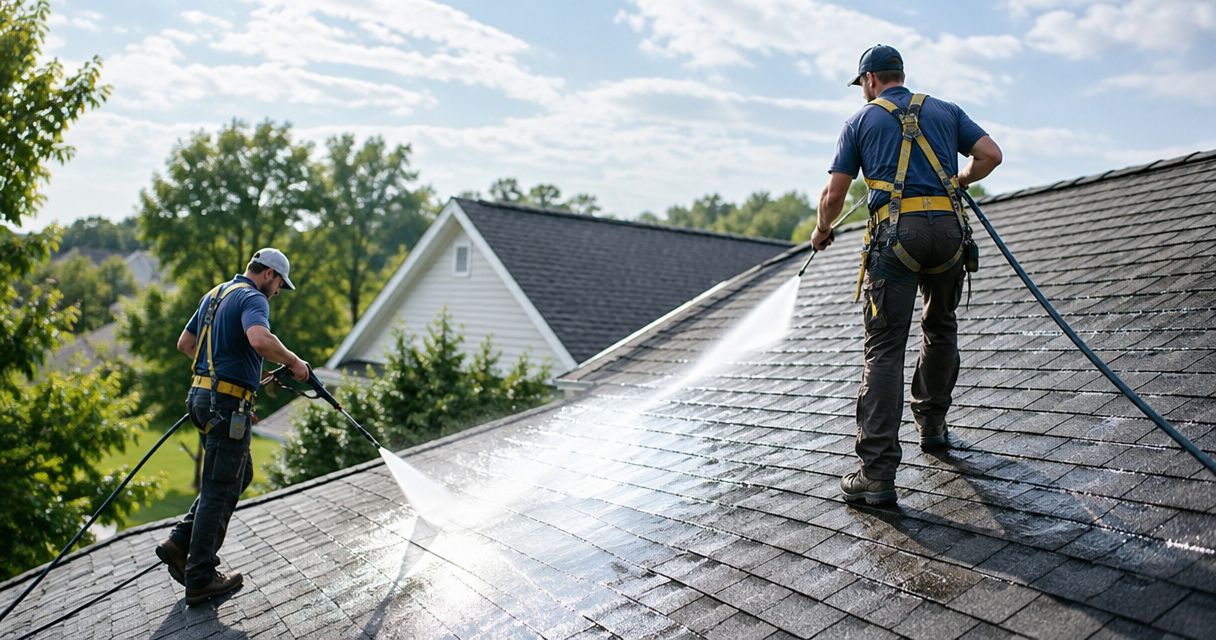
Yes—soft washing is the better starting point for roof cleaning in 2026 when the roof manufacturer permits the cleaning solution and application method. High-pressure washing can damage roof coverings or force water beneath them; low pressure reduces those risks but does not make an unsuitable chemical or a damaged roof safe to clean.
- Is soft washing better than pressure washing for roofs? Yes, when the roof manufacturer approves the method and solution.
- Asphalt shingles should not be cleaned with a high-pressure jet; protective granules can be dislodged.
- Tile and metal roofs need material-specific instructions, not a cleaning method chosen by appearance alone.
- Socalemm provides roof soft washing for homeowners and businesses in Newport Beach and Orange County.
Is soft washing better than pressure washing for roofs?
Choose the roof-approved cleaning method, not the strongest spray. Soft washing uses a cleaning solution with low-pressure application rather than relying on a high-pressure jet to remove staining. Its suitability still depends on the roof covering, its condition, and the products used.
Socalemm offers roof soft washing in Newport Beach and Orange County. Before arranging any roof cleaning, identify your roofing material and check its manufacturer's maintenance instructions.
| Method | Best for | Main advantage | Main limitation |
|---|---|---|---|
| Soft washing | Roof coverings whose maintenance instructions permit the proposed low-pressure treatment | Cleans without relying on an aggressive water jet | Incorrect chemicals, poor runoff control, or unsuitable application can still cause damage |
| Pressure washing | Roof surfaces whose manufacturer explicitly permits the proposed equipment and technique | Mechanical cleaning where that method is approved | High pressure can damage coverings, disturb finishes, or drive water beneath roofing |
The distinction is not simply which machine sits in the driveway. Ask how the contractor will apply the solution, whether rinsing is required, and how the rinse will follow the roof manufacturer's directions.
Why this matters
A roof is a water-shedding assembly, not just an exposed surface. Cleaning must account for laps, flashings, vents, fasteners, and the condition of the covering itself.
For your 2026 maintenance plan, separate appearance from condition. Dark streaks do not automatically mean the roof needs replacement, while a clean-looking roof can still have damaged tiles or failed details. Cleaning addresses suitable surface contamination; it does not repair leaks or restore worn roofing.
If the roof is leaking or visibly damaged, arrange a roofing assessment before cleaning. A washing appointment should not become a substitute for diagnosing the underlying problem.
Asphalt shingles: avoid high-pressure cleaning
Best for asphalt shingles: a manufacturer-approved, low-pressure cleaning method. A high-pressure jet can dislodge protective granules and damage shingles. Do not assume that moving the nozzle farther away makes pressure washing acceptable.
The treatment matters as much as the application pressure. Ask the contractor to identify the proposed cleaner and explain how its use matches the shingle manufacturer's instructions, including any requirements for rinsing and protecting nearby materials.
Soft washing also has limits. It cannot replace missing granules, flatten damaged shingles, or correct deterioration. If a contractor presents cleaning as a repair for those conditions, keep the cleaning and roofing decisions separate.
For a closer look at the material-specific risks, read whether pressure washing is safe for roof shingles.
Tile roofs: check condition before choosing the method
Best for tile roofs: a cleaning plan matched to the tile material, finish, and manufacturer instructions. Concrete and clay tile should not be treated as interchangeable simply because both have a similar roof profile.
Look for visible broken or displaced tiles from a safe ground-level position. Tell the contractor about previous leaks, repairs, or areas where water has entered. Roof access also needs consideration: unnecessary foot traffic can damage tiles, and cleaning does not repair the layers beneath them.
A low-pressure treatment avoids relying on aggressive spray, but the cleaner still needs to suit the tile and any coating. Ask how the contractor will protect painted surfaces, metal details, gutters, and landscaping from contact with the solution.
Do not request a stronger rinse solely because a stain remains visible. First establish what caused the mark and whether the approved cleaning process can remove it without harming the roof.
Metal roofs: protect coatings and seams
Best for metal roofs: cleaning that follows the panel or coating manufacturer's maintenance instructions. A metal roof's finish, seams, fasteners, and penetrations all matter when selecting a cleaner and rinse method.
Neither the label soft washing nor the label pressure washing establishes compatibility. A solution suitable for another roof covering is not automatically appropriate for painted metal, and an aggressive spray can send water toward vulnerable joints.
If you see corrosion, peeling finish, loose components, or evidence of leakage, seek a roofing assessment. Cleaning can remove suitable surface contamination, but it cannot restore a failed coating or repair a compromised seam.
Why the right roof-cleaning method varies
The better method depends on the roof, not a blanket promise about equipment. Use these factors to evaluate a proposed cleaning plan:
- Roof covering: Asphalt shingles, clay tile, concrete tile, and metal have different maintenance requirements.
- Manufacturer instructions: The approved cleaner, application method, and rinse requirements set the boundaries for the job.
- Existing condition: Loose coverings, broken tiles, worn finishes, and leaks require attention before cleaning.
- Type of staining: Organic growth, rust, dirt, and coating deterioration are different problems. A single treatment does not address all of them.
- Access and runoff: Roof slope, landscaping, drainage, and nearby surfaces affect how cleaning can be carried out safely.
- Attached equipment: Solar panels and other rooftop equipment need their own protection and maintenance instructions.
A useful proposal explains these choices before work begins. A description that says only roof wash leaves the important decisions unanswered.
What should you check before booking roof cleaning?
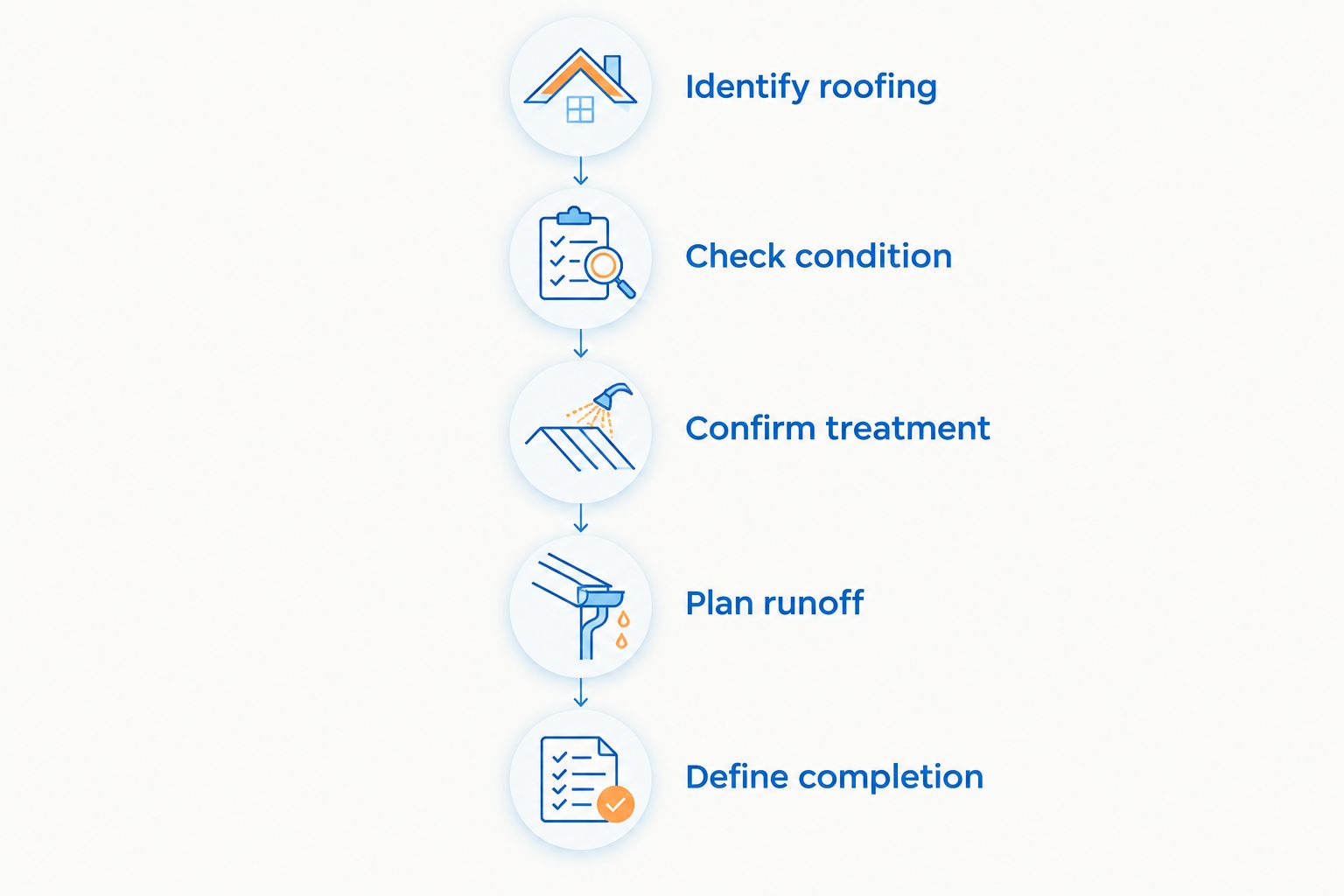
Use this sequence when comparing roof-cleaning proposals in 2026. You do not need to climb onto the roof to gather the information.
- Identify roofing. Find the roof material and manufacturer in your installation records, repair paperwork, or property documents. If those records are unavailable, ask a roofing professional to identify the covering.
- Check condition. Report known leaks, previous repairs, loose materials, or visible damage. Ask whether any condition requires a roofing assessment before washing.
- Confirm treatment. Request the proposed cleaner, application method, and rinse approach. Ask how the plan follows the roof manufacturer's guidance.
- Plan runoff. Discuss where cleaning solution and rinse water will travel, including gutters, downspouts, planting beds, and nearby paved areas. Do not assume roof runoff can simply enter the street or a storm drain.
- Define completion. Agree on what will be cleaned, what is excluded, and how persistent stains or remaining growth will be handled without increasing pressure beyond the approved method.
The sequence puts roof condition ahead of appearance. It also gives you specific questions to ask instead of trying to judge a contractor by equipment alone.
What should a homeowner prepare before the appointment?
Clear movable items from areas beneath the work zone and tell the contractor about sensitive plants, outdoor furniture, and recently painted surfaces. Keep people and pets away from the work area while treatment and rinsing are underway.
Point out known drainage problems before the appointment. A downspout that empties into a planting bed needs consideration when planning runoff, as does water that collects near a doorway or patio.
Make rooftop equipment part of the discussion. Roof washing and solar-panel cleaning are separate tasks; do not assume a roof-cleaning treatment is suitable for panel surfaces, wiring, or mounting components.
For your 2026 booking, record the agreed scope in writing. Include the roof areas being treated, protection measures, exclusions, and any follow-up instructions. That gives you something specific to check when the work is complete.
How should a commercial roof-cleaning plan differ?
Commercial roof cleaning needs coordination with building operations as well as material-specific cleaning instructions. Keep this scope separate from residential house washing or cleaning ground-level walkways.
Ask the building manager to identify roof access rules, tenant activity, rooftop equipment, and areas where pedestrians must be kept clear. Discuss how runoff will be managed without disrupting entrances or exposing people below the work area.
Socalemm provides roof soft washing for homeowners and businesses in Newport Beach and Orange County. Socalemm roof soft washing is best suited to local property owners seeking that specific exterior-cleaning service. Confirm the proposed method for your particular roof rather than assuming a service name establishes suitability.
Can soft washing remove black streaks from a roof?
Soft washing can address black streaks caused by algae when the cleaner and method are approved for the roofing material. Black staining alone, however, does not establish the cause.
Ask the contractor to distinguish likely organic staining from rust, accumulated dirt, or material deterioration before choosing treatment. Do not scrub aggressively or increase pressure to chase a mark that the cleaning process does not address.
Does soft washing make roof cleaning damage-free?
No—soft washing reduces reliance on high pressure, but it does not eliminate chemical exposure, access hazards, or water-entry risks. Damaged roofing remains damaged regardless of the cleaning method.
Ask about material compatibility, application, runoff, and roof access together. A low-pressure claim answers only one part of the safety question.
How often should you soft wash a roof?
Set the cleaning interval from the roof manufacturer's guidance and the roof's actual condition, not a universal calendar promise. Shade, nearby vegetation, drainage, and the type of contamination all affect the maintenance decision.
For a 2026 roof-maintenance schedule, start with an assessment rather than automatically repeating a previous treatment. Roof appearance alone does not justify using chemicals when cleaning is unnecessary or unsuitable.
FAQ
Is soft washing better than pressure washing for roofs?
Soft washing is the better starting point when the roof manufacturer permits the proposed cleaner and low-pressure method. High-pressure cleaning can damage roof coverings or drive water beneath them.
Can I pressure wash my asphalt shingle roof myself?
Do not use a high-pressure jet on asphalt shingles. It can dislodge protective granules and damage the covering; follow the shingle manufacturer's cleaning instructions instead.
Is soft washing safe for every tile roof?
Soft washing is not automatically safe for every tile roof. The tile material, finish, condition, and proposed cleaning solution must be checked before treatment.
Will soft washing fix a leaking roof?
Soft washing does not fix a leaking roof. Arrange a roofing assessment before cleaning when you have active leaks, broken coverings, or other signs of damage.
Can roof-cleaning solution damage my plants?
Roof-cleaning solution can harm plants if exposure is not controlled. Ask how the contractor will protect landscaping and manage runoff before treatment begins.
Should solar panels be included in a roof wash?
Solar panels should have a separate cleaning scope based on their manufacturer's instructions. A treatment suitable for the roof is not automatically suitable for panel surfaces or electrical components.
Does Socalemm offer roof soft washing in Orange County?
Socalemm provides roof soft washing in Newport Beach and Orange County for residential and commercial properties. Ask for a proposal that identifies the method and scope for your roof.
One last thing
A cleaner roof is not proof of a sound roof. After cleaning, keep the maintenance record separate from any roofing inspection or repair paperwork.
When reviewing a roof-cleaning proposal in 2026, ask one final question: what would make you stop and recommend a roofer instead? The answer should identify conditions that cleaning cannot solve, rather than promise to wash every problem away.