Yes, pressure washing can remove water-soluble salt residue from a driveway when fresh water dissolves the salt and the rinse carries it away. It does not repair salt-related surface damage, and a white patch is not automatically salt. Start with a gentle fresh-water test before deciding whether the driveway needs pressure washing or a different treatment.
- Can pressure washing remove salt residue from driveway surfaces? Yes, when the deposit dissolves and rinse water carries it away.
- White driveway deposits can be salt, efflorescence, mineral scale, or a coating problem; appearance alone does not identify them.
- Socalemm provides pressure washing in Newport Beach and Orange County; request an assessment before treating an unidentified white deposit.
- Use the least aggressive effective method, control runoff, and judge the result after the driveway dries.
Can pressure washing remove salt residue from driveways?
Pressure washing removes soluble salt deposits; it does not remove every cause of white discoloration. Water does the dissolving. The washing equipment helps loosen surface dirt and move contaminated water away, but additional pressure is not a substitute for identifying the deposit.
If the white material returns after drying, compare the symptoms with this guide to removing efflorescence from concrete. Recurring deposits need a different assessment from loose salt sitting on the surface.
| Deposit or condition | Best for | What cleaning can accomplish | Main limitation |
|---|---|---|---|
| Loose, water-soluble salt | Gentle fresh-water rinsing first | Dissolves and carries away accessible surface residue | Salt can return with renewed exposure |
| Salt mixed with dirt | Controlled pressure washing on a suitable surface | Removes dirt while rinsing dissolved residue | Excessive pressure can damage the finish |
| Recurring efflorescence | Identifying the moisture source and deposit | Removes some surface material when the method suits the deposit | Washing alone does not stop moisture transporting more salts |
| Hard mineral crust | Material-specific assessment | Establishes whether a suitable mineral treatment is needed | Pressure alone is not a reliable treatment |
| Flaking concrete or cloudy coating | Surface or coating assessment | Separates a cleaning problem from a repair problem | Washing cannot restore missing concrete or failed coating |
Treat these descriptions as clues, not a diagnosis from appearance. A driveway can have dirt, mineral deposits, and an aging coating in the same area.
Why this matters for Orange County homeowners
On a coastal property, airborne sea spray is one possible source of salt on outdoor surfaces. Irrigation water, moisture moving through masonry, and surface coatings can also leave pale marks. The important distinction is whether you are removing material from the driveway or looking at a change in the driveway itself.
For your 2026 maintenance plan, separate appearance from condition. A white film that rinses away is a different job from concrete that feels rough, sheds grains, or has small pieces breaking loose. Scrubbing or washing harder can turn an uncertain cleaning problem into visible surface damage.
A clean-looking wet driveway is not proof that the deposit is gone. Water temporarily changes how concrete and coatings look, so inspect the test area again after it dries.
How to assess and clean salt residue without chasing stains
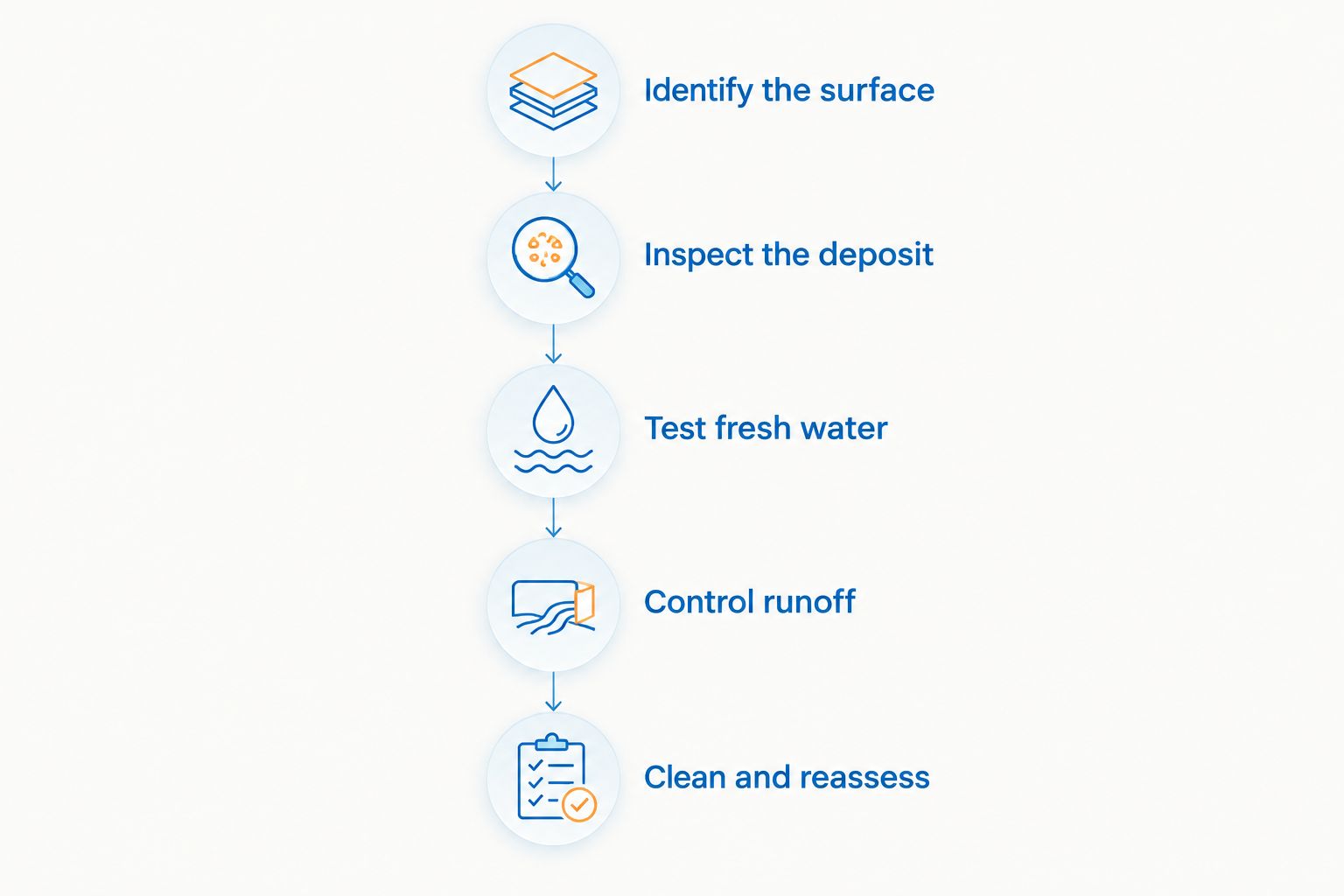
Use this sequence before cleaning the whole driveway. Your goal is to establish what responds to water, whether the surface tolerates cleaning, and where the wash water will go.
Identify the surface
Check whether you have bare concrete, concrete pavers, natural stone, asphalt, or a coated surface. Look for exposed aggregate, decorative coloring, loose joints, peeling material, and existing damage. A method suitable for sound plain concrete is not automatically suitable for every driveway finish.
If you know which sealer or coating was applied, follow its cleaning instructions. If you do not know, avoid choosing a chemical treatment based only on the color of the stain. Photograph the dry surface before wetting it so you can compare the same patch afterward.
Inspect the deposit
Look at where the white material collects. Broad exposure across an open area suggests a different source from a line beneath an irrigation spray pattern or deposits concentrated along joints.
Check its texture without grinding it into the finish. Loose powder, a hard crust, and a cloudy layer beneath a coating are different observations to report. Do not assume that all pale material is ocean salt simply because the home is near the coast.
Test fresh water
Choose an inconspicuous area and try gentle fresh-water rinsing with a surface-compatible brush if needed. Let the area dry before comparing it with the untreated section. If the film clears without aggressive washing, that is a reason to keep the method gentle.
A successful water test shows that the tested material responds to that method; it does not identify every substance present. If the patch remains chalky, crusted, or cloudy, stop escalating and reassess the deposit.
Control runoff
Move vehicles and loose belongings, keep people away from the work area, and plan where water will collect. Keep contaminated wash water out of storm drains and check local requirements before washing. Do not use a landscaped bed as a disposal area for salty water.
Removing salt from concrete only to move it onto plants or neighboring property is not a successful cleanup. If the driveway slopes directly toward a drain, ask how the water will be contained or collected before work starts.
Clean and reassess
For a sound surface that tolerates washing, use a suitable cleaning method and keep the spray moving. Follow the equipment and surface manufacturer's directions rather than selecting a universal pressure setting. Avoid concentrating the jet on cracks, edges, joints, or an existing damaged patch.
Rinse loosened material away rather than pushing it repeatedly across the driveway. Once the surface dries, check for remaining deposits, changes in texture, disturbed joint material, and uneven appearance. For a 2026 cleaning appointment, ask that the expected result be discussed in terms of the dry surface—not just the wet appearance.
Why salt-residue removal results vary
The amount of visible improvement depends on the deposit and the driveway, not just the machine. Review these factors before repeating a treatment that has not worked:
- Deposit solubility: Readily soluble salts respond to fresh water; a hard mineral crust needs a different assessment.
- Surface condition: Sound concrete and a flaking surface do not tolerate the same cleaning approach. Existing damage limits what cleaning can safely accomplish.
- Coatings and sealers: A white appearance can involve the coating rather than loose material above it. Follow the coating manufacturer's instructions.
- Moisture movement: Water moving through concrete or masonry can transport salts back to the surface after cleaning.
- Continued exposure: Sea spray, irrigation, or another ongoing source can deposit material again. Cleaning removes the current residue, not the source.
- Rinsing and drainage: Dissolving salt is only part of the job. The contaminated water must leave the cleaned area without creating another problem.
When comparing proposals in 2026, ask what the contractor believes the deposit is and what observation supports that assessment. A clear explanation of the method and its limits is more useful than a promise to remove every white mark.
Does a white driveway stain mean salt damage?
No. A white driveway stain describes an appearance, not a confirmed cause or a measure of damage. You need to distinguish removable residue from changes in concrete, stone, joint material, or a surface coating.
Efflorescence develops when moisture carries dissolved salts through porous material and leaves deposits as it evaporates. Some deposits rinse away readily; others remain attached and need a material-specific approach. Reappearance after cleaning is a reason to investigate moisture movement rather than repeatedly increase pressure.
Physical damage is a separate concern. Missing paste, loose aggregate, flaking, and a changed surface texture cannot be washed back into place. If the surface is deteriorating, pause the cleaning and get the condition assessed before applying another treatment.
Do not promise yourself a uniform finish just because the residue is removable. Once dirt and deposits are gone, existing wear or previous cleaning marks can remain visible. Cleaning exposes the underlying condition; it does not resurface the driveway.
Should you use vinegar or acid on driveway salt residue?
Do not start with vinegar or an acid cleaner when you have not identified the deposit and the surface. Water-soluble salt does not require acid simply because it looks white. Acid can react with cement-based materials and damage some stone, finishes, and nearby metals.
A product intended for a particular mineral deposit still needs to match the driveway material, coating, and application instructions. Spot testing matters, but a small test does not excuse using a product that the surface manufacturer prohibits.
For a 2026 homeowner cleaning kit, keep unknown chemical mixtures out of the process. Never mix cleaning products, especially acids and chlorine bleach. If fresh water does not work, the next move is identification—not a stronger household mixture.
Is rinsing enough, or should you hire a pressure-washing service?
Gentle rinsing is best for loose, soluble residue on a surface that tolerates water. Its advantage is simplicity; its limitation is that it will not address bonded deposits, embedded dirt, or an underlying coating problem. Stop if the surface changes texture or the water has nowhere suitable to go.
Socalemm pressure washing is best for homeowners in Newport Beach and Orange County seeking a local exterior-cleaning service. The service is relevant when driveway residue accompanies dirt or broader exterior-cleaning needs. The limit is equally important: a pressure-washing service is not a substitute for concrete repair or coating diagnosis.
Before you request a quote, gather a dry close-up, a wider view, and any information about past sealing or cleaning. Describe whether fresh water changes the mark and whether it returns after drying. Ask Socalemm to discuss the proposed driveway-cleaning method, runoff handling, and expected limitations before work begins.
A useful scope separates removable residue from permanent discoloration or surface damage. It should also distinguish driveway work from house washing or roof cleaning; those surfaces need their own assessment rather than a single method applied everywhere.
How do you stop salt residue from returning?
Start with the source you can actually identify. Redirecting overspray away from a driveway addresses a different problem from managing repeated coastal exposure. If deposits follow joints or reappear after moisture rises through the surface, investigate that pattern before choosing another cleaning treatment.
Keep a simple record during 2026: photograph the dry area after cleaning and again when the marks return. Note whether the change follows irrigation, wet weather, or another visible event. The pattern gives you better information than a schedule based only on how many days have passed.
Do not treat sealing as an automatic cure. A sealer must suit the material and moisture conditions, and applying it over unresolved deposits can complicate the problem. Discuss sealing separately from residue removal, especially when the existing coating is unknown.
FAQ
Can pressure washing remove salt residue from my driveway completely?
Pressure washing can remove accessible, water-soluble salt residue when fresh water dissolves it and rinsing carries it away. Complete removal of every white mark is not assured because mineral crust, coating problems, and surface damage are different conditions.
Will a garden hose remove salt from concrete?
A garden hose can remove loose, water-soluble salt from concrete when the rinse carries the dissolved material away. Test a small area, manage the runoff, and inspect the concrete after it dries.
Why does the white residue return after I wash my driveway?
White residue returns when material is deposited again or moisture transports more salts to the surface. Check exposure, irrigation patterns, joints, and recurring damp areas before repeating the same cleaning method.
Is ocean salt the same as efflorescence on a driveway?
Ocean salt deposited on a driveway and efflorescence are not the same process. Efflorescence forms when moisture transports salts through porous material and leaves them at the surface as it evaporates.
Can I use vinegar to remove white driveway deposits?
Do not use vinegar on an unidentified driveway deposit without confirming compatibility with the surface and coating. Acid can react with cement-based materials and damage some finishes; soluble salt responds to fresh water without requiring acid.
Can pressure washing repair concrete damaged by salt?
Pressure washing cannot repair concrete that has flaked, lost material, or otherwise deteriorated. Cleaning removes deposits and dirt; damaged concrete needs a separate condition assessment.
Should I seal my driveway immediately after removing salt?
Do not seal a driveway until the deposit, moisture conditions, surface preparation, and product requirements have been addressed. Follow the chosen sealer manufacturer's instructions rather than applying a universal waiting period.
One last thing
The most useful inspection happens after the water is gone. A driveway can look even while wet and reveal the same pale patches once dry, so take the comparison photo under similar lighting and from the same position.
For your next driveway cleaning in 2026, make the dry test patch the decision point. If gentle rinsing removes the residue without changing the surface, keep that approach. If the mark persists or returns, identify the cause before adding pressure, chemicals, or a new coating.