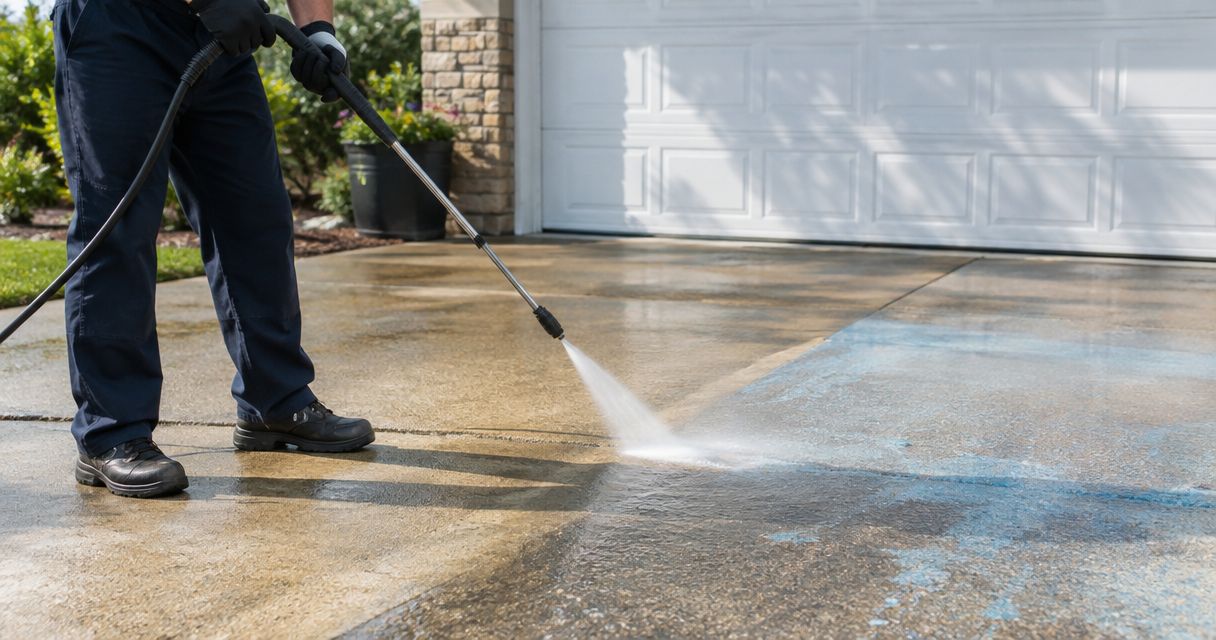
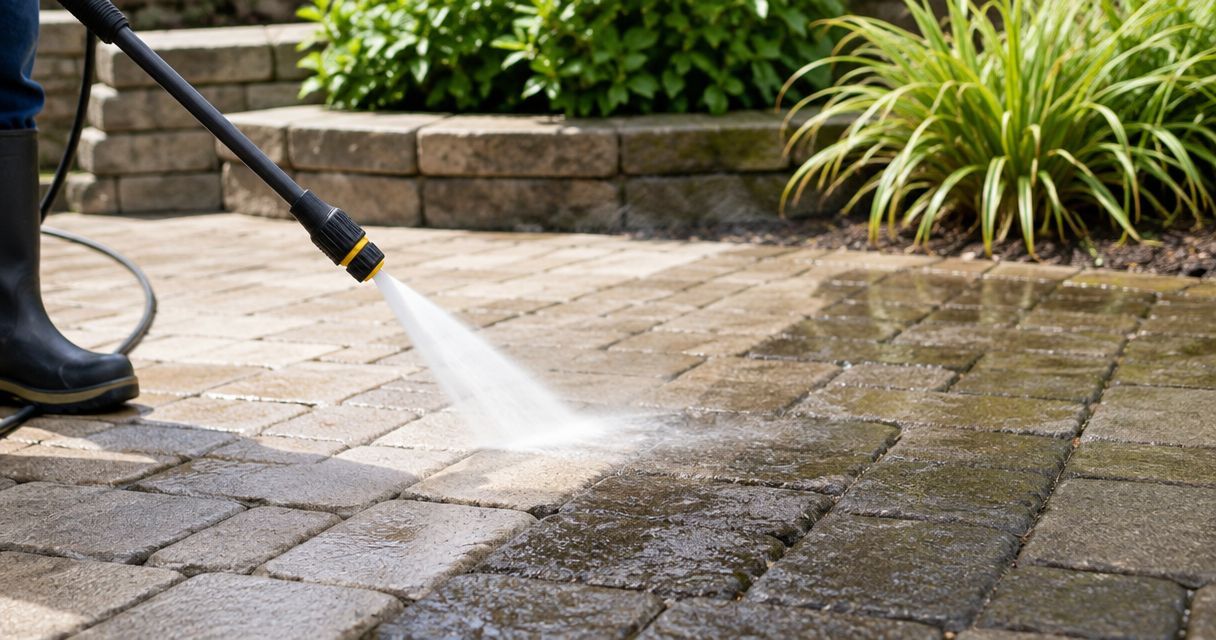
Yes, pressure washing can damage pavers by eroding the surface, washing out joint sand, and damaging some sealers. Cleaning also exposes existing wear that dirt previously hid, so a changed appearance does not always mean the washing caused it. For your 2026 cleaning project, match the method to the paver material, joint condition, and manufacturer’s care instructions—not the machine’s maximum pressure.
- Can pressure washing damage pavers? Yes—concentrated spray can erode surfaces, disturb joint sand, and damage some sealers.
- Start paver cleaning with a material check and an inconspicuous test patch; do not chase stains with stronger pressure.
- Socalemm provides exterior cleaning for Newport Beach and Orange County homeowners; discuss paver condition before requesting a cleaning quote.
- Inspect joints after cleaning, and follow the jointing material manufacturer’s instructions before replacing sand or reopening the area.
Why this matters
A paver driveway is not the same cleaning surface as a continuous concrete slab. The joints, individual units, and any applied finish all need attention. A clean surface with depleted joints is not a finished maintenance job.
Before planning your 2026 wash, decide what happens after the dirt comes off. The guide to keeping a driveway clean longer after pressure washing covers the maintenance side; this guide explains how to avoid creating damage during cleaning.
Can pressure washing damage pavers?
Yes. The main risks are surface erosion, joint-sand loss, and damage to an existing finish. Those risks increase when a concentrated stream stays close to the surface or repeatedly targets the same spot.
Use the symptoms below to distinguish cleaning problems from conditions that need a different response.
| What you notice | What it can mean | What to do next |
|---|---|---|
| A rougher patch or newly exposed aggregate | Surface material has worn away or been removed | Stop and compare the dry test area with an untreated area |
| Narrow lines or sweeping marks | Uneven cleaning or surface damage | Do not repeat the same aggressive pass |
| Sand collecting outside the joints | Joint material has been displaced | Inspect joint depth and identify the existing material |
| Patchy gloss or peeling film | An existing coating needs assessment | Identify the sealer before further cleaning |
| A paver rocks underfoot | An installation or support problem needs attention | Stop washing that area and arrange an assessment |
Water temporarily darkens many paving materials and changes how a finish looks. Judge the test area after it dries, not while it is wet and freshly rinsed. Compare texture as well as color.
Concrete pavers: protect the surface texture
Concrete pavers can have different textures, finishes, and exposed aggregates. Treat the manufacturer’s cleaning instructions as the starting point. A method suited to one concrete product is not automatically suitable for another.
Look for flaking, crumbling edges, and visible wear before cleaning. Repeatedly blasting a stubborn spot can remove surface material rather than remove the stain. Once the face is eroded, another wash cannot put it back.
Use cleaning to remove contamination, not to grind the paver into a uniform color. If a test patch changes the texture, stop and change the approach.
Clay and natural-stone pavers: identify the material first
Clay paving brick and natural stone should not be treated as interchangeable with concrete pavers. Their cleaning requirements depend on the specific material and condition. An unfamiliar surface is a reason to identify it, not a reason to try a stronger setting.
Cleaner compatibility matters too. Acidic products can etch acid-sensitive stone, including limestone and marble. A cleaner labeled for concrete is not automatically appropriate for every paved patio.
Ask the supplier or installer for the product name and care guidance when available. If you cannot identify the surface, avoid aggressive pressure and unfamiliar chemicals until you can confirm a suitable method.
Sealed pavers: assess the finish before washing
Sealed pavers add another variable: the condition and type of sealer. Cleaning can make existing differences in wear more visible, and an unsuitable method can damage a coating. Do not assume every glossy, darkened, or patchy area needs another pressure-washing pass.
Check for peeling, worn traffic lanes, and uneven appearance before starting. Photograph those areas while dry. These records help separate pre-existing conditions from changes during the wash.
Do not promise yourself an even finish simply by washing harder. If the coating is failing, cleaning and coating repair are separate decisions.
Why the risk of paver damage varies
The machine’s pressure rating is only part of the decision. These factors determine how cautiously you need to work:
- Paver material: Concrete, clay, and different stones require material-specific care.
- Existing condition: Crumbling edges, flaking faces, and loose units need assessment before washing.
- Spray concentration: A narrow stream puts the cleaning force into a smaller area.
- Distance and movement: Close, stationary spraying concentrates the force on one spot.
- Joint condition: Loose or depleted joint material needs attention beyond surface cleaning.
- Sealer and stain type: A coating problem or mineral deposit needs a different response from ordinary loose dirt.
A broad spray is not permission to work without testing. Surface-cleaning attachments also require appropriate settings and technique; the attachment alone does not establish that the method is safe.
Which cleaning approach should you choose?
Start with the least aggressive method that suits the contamination and the material. Pressure washing is an option, not a requirement for every dirty patio.
| Approach | Best for | Main advantage | Main limitation |
|---|---|---|---|
| Sweeping and gentle rinsing | Loose debris and routine upkeep | Avoids concentrated high-pressure spray | Does not address every attached deposit or stain |
| Compatible cleaner and gentle agitation | Contamination addressed by the cleaner’s label | Lets the cleaning product do more of the work | Requires correct material compatibility and runoff handling |
| Controlled pressure washing | Suitable, sound pavers after a successful test | Removes surface buildup through mechanical cleaning | Can erode surfaces or displace joint material if misused |
Choose the method by the surface and the dirt, not by the equipment you already own. If a gentle approach does not work, identify what remains before escalating. Oil staining, mineral deposits, and worn sealer are not the same problem.
Low pressure does not make every chemical safe either. Follow the cleaner’s label for application, protective equipment, nearby planting, and disposal precautions.
How should you prepare pavers for cleaning in 2026?
Use this sequence before committing to the whole driveway or patio. Each step gives you a chance to stop before a small problem becomes a larger one.
1. Identify the surface
Find the paver manufacturer, material, and care instructions if possible. Check whether the surface has a sealer and whether the joints contain conventional sand, polymeric sand, or another jointing product. Do not select replacement material by color alone.
2. Inspect the joints
Look for recessed joints, loose material, damaged edges, and pavers that move. Take dry photos of worn or stained areas. Loose units and failed edges need assessment rather than stronger cleaning.
3. Plan the runoff
Move furniture and loose objects, and identify where rinse water will travel. Keep dirty wash water and cleaning chemicals out of storm drains; confirm the applicable local requirements before work begins. Do not treat the street gutter as a disposal route.
4. Test discreetly
Choose an inconspicuous area and use the manufacturer-approved approach. Keep the spray moving and avoid directing concentrated water into joints. Let the patch dry, then inspect the texture, color, finish, and surrounding joint material.
5. Review the result
Proceed only if the test result is acceptable. Stop if the surface becomes rougher, the finish changes unexpectedly, or joint material comes out readily. After cleaning, inspect the joints again and follow the jointing product’s instructions for any necessary restoration.
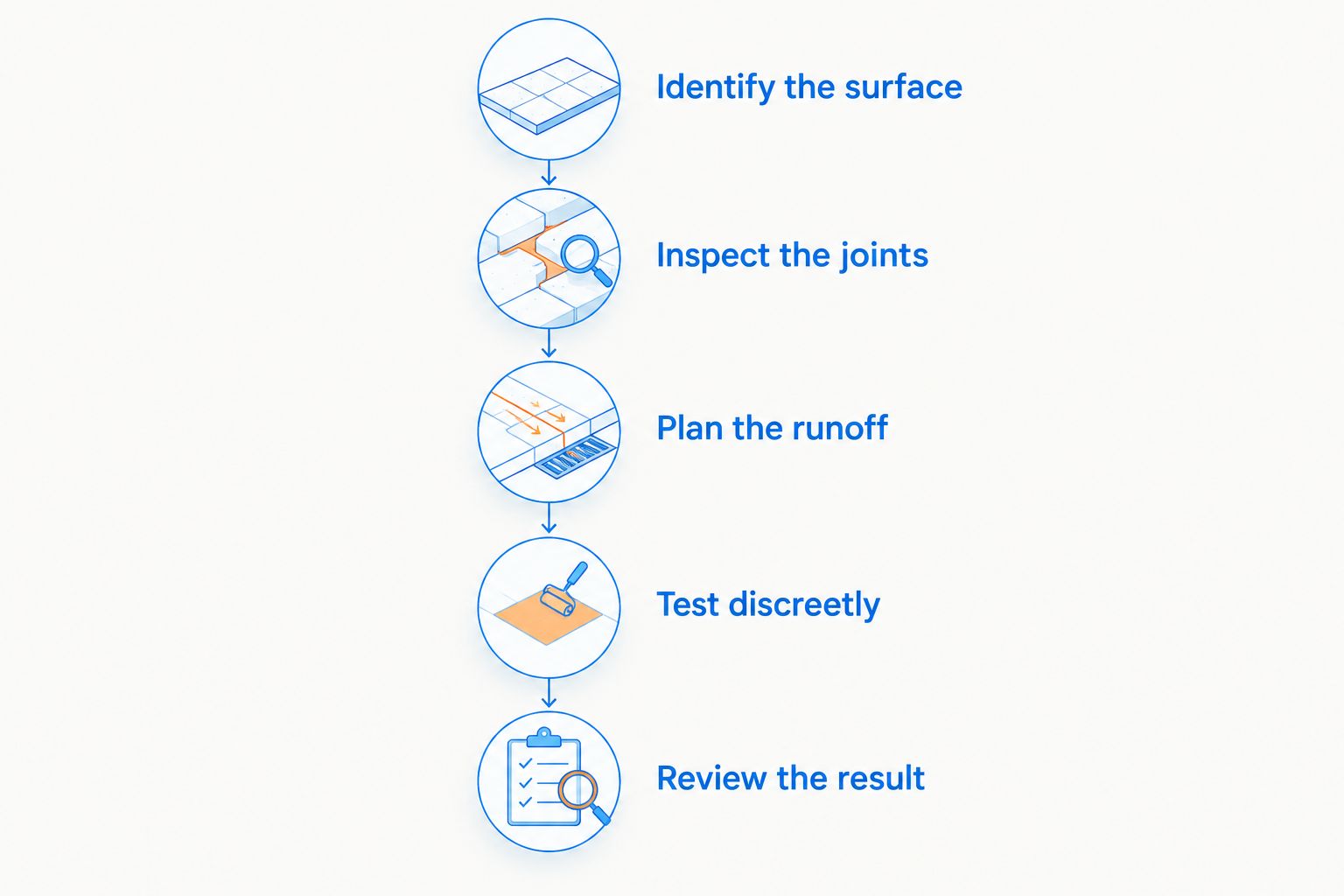
Do not use an inconspicuous test as a formality. Its purpose is to change the plan when the result is wrong. A visible texture change is a stop signal, even if the patch looks cleaner.
Will pressure washing remove polymeric sand?
Pressure washing can dislodge polymeric sand, particularly where joints are already deteriorated or the spray targets them directly. Polymeric sand is not a reason to ignore spray direction or assume the joints need no inspection.
If joint material comes out during cleaning, identify the existing product before replacing it. Follow its instructions for joint preparation, installation, activation, and curing. Do not leave loose replacement sand on the paver faces or improvise the activation process.
Restoring joints is also not a cure for a failing base. If pavers rock or settle, have the underlying problem assessed rather than repeatedly topping up the gaps.
Should you seal pavers immediately after pressure washing?
Do not seal pavers immediately just because washing is finished. The surface must meet the sealer manufacturer’s cleanliness, dryness, compatibility, and application requirements.
An existing coating complicates that decision. Adding a new product over an unidentified or failing finish is not a substitute for assessing it. If joint restoration is needed, coordinate that work with the instructions for both the jointing material and the sealer.
For a 2026 cleaning appointment, agree in advance whether the scope ends at washing or includes any follow-up assessment. Do not assume joint restoration or sealing is included in an exterior-cleaning quote.
When should you stop and request an assessment?
Stop if the test patch changes texture, a coating starts lifting, joints empty rapidly, or pavers move. These signs call for a different plan. More pressure is not the next diagnostic step.
Socalemm is a fit for Newport Beach and Orange County homeowners seeking local exterior cleaning. For a paver-cleaning inquiry, describe the material, existing finish, loose joints, and stains before discussing the method.
A useful exterior-cleaning quote request includes wide photos of the area and close photos of the problems. Ask Socalemm which preparation and follow-up tasks are included; cleaning alone does not replace paver repairs or resolve an unidentified coating problem.
Request an exterior-cleaning quote
Share photos of the pavers, joint condition, and stains so the cleaning scope can be discussed.
FAQ
Can I pressure wash my paver patio myself?
You can clean suitable pavers yourself if you follow the material manufacturer’s instructions and get an acceptable dry test result. Stop if the surface texture changes, the finish lifts, or joint material washes out readily.
What pressure should I use to clean pavers?
Use the paver manufacturer’s cleaning guidance rather than a universal pressure setting. Material, surface condition, nozzle, working distance, and technique all affect the risk of damage.
Is a surface cleaner safe for pavers?
A surface cleaner is not automatically safe for pavers. It still needs suitable settings, correct operation, and a successful test on the specific surface.
Do I need to replace sand after pressure washing pavers?
Replace or restore joint material when inspection shows it is needed, not automatically after every wash. Identify the existing jointing product and follow its preparation and installation instructions.
Why do my pavers look patchy after pressure washing?
Patchiness can come from uneven cleaning, moisture differences, existing wear, or changes to a sealer. Let the surface dry and compare its texture and finish before attempting another pass.
Can pressure washing remove white deposits from pavers?
Pressure washing is not a universal treatment for white deposits on pavers. Identify the deposit and paver material before selecting a cleaner; stronger pressure does not address every cause.
Can Socalemm help with an exterior-cleaning request in Orange County?
Socalemm provides residential and commercial exterior cleaning in Newport Beach and Orange County. For a residential paver inquiry, share photos and discuss the surface condition and proposed scope before scheduling.
One last thing
For your 2026 project, keep a dry, untreated reference area beside the test patch until you approve the method. A wet paver often looks different from a dry one. Compare dry against dry, and check texture—not just brightness—before calling the cleaning successful.