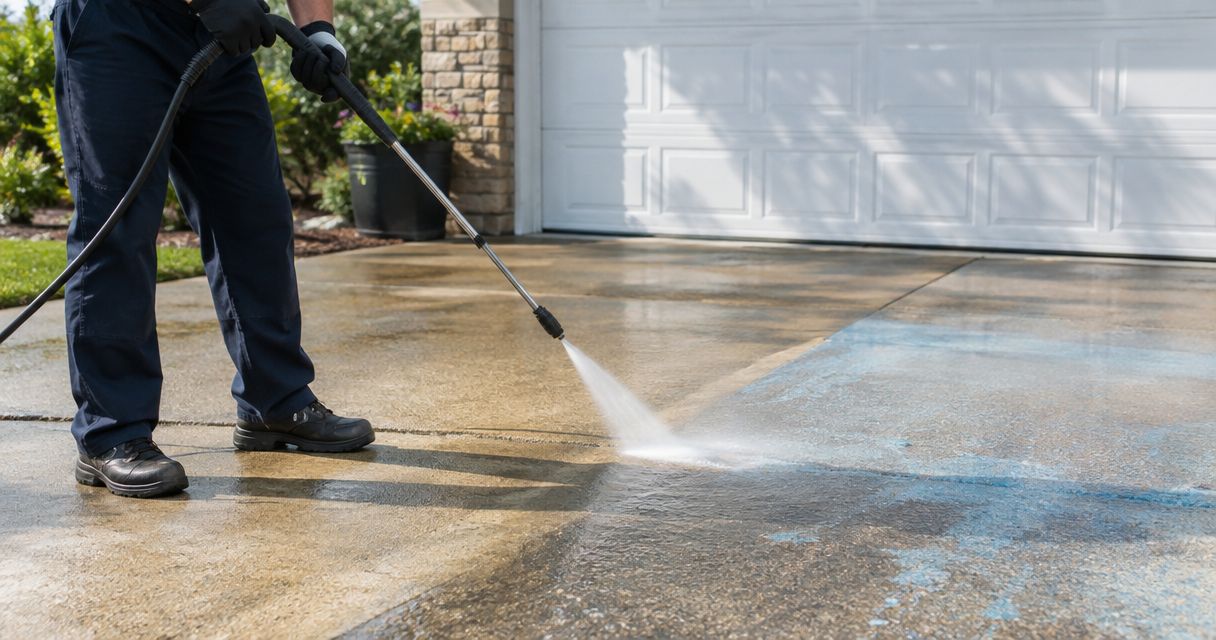
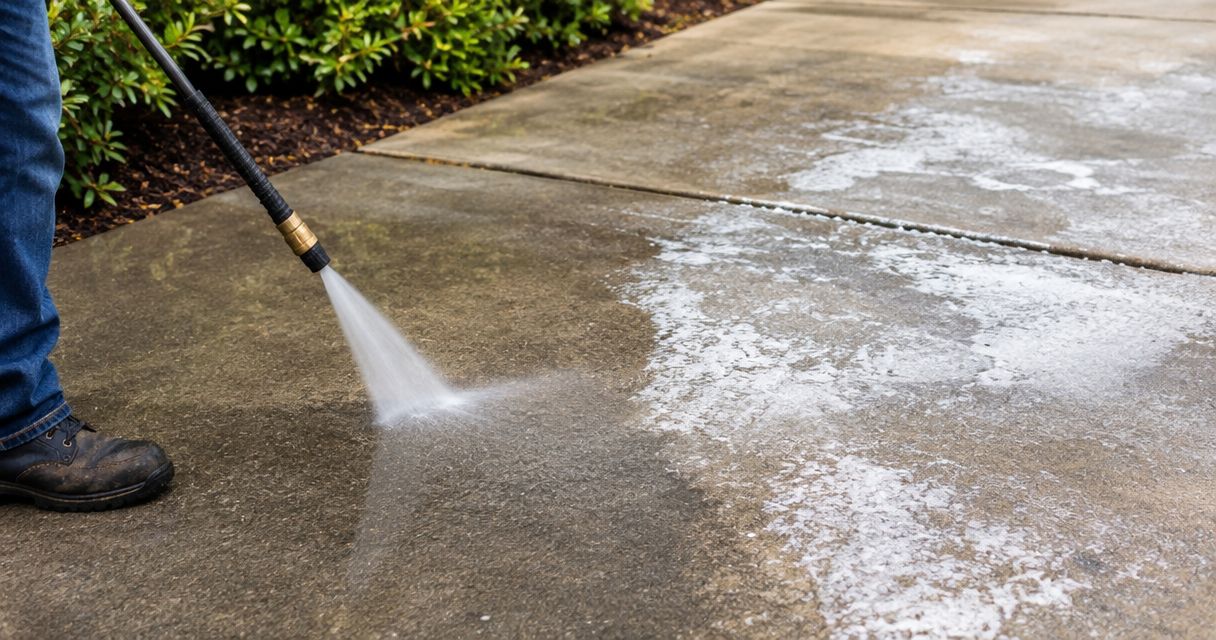
Pressure washing can remove loose efflorescence from concrete, but it does not stop the moisture movement that brings dissolved salts to the surface. Hard mineral deposits often need a concrete-compatible treatment rather than more pressure, and the white residue can return if the moisture source remains.
- Can pressure washing remove efflorescence from concrete? Yes, partly; washing removes surface deposits, not the underlying moisture source.
- Socalemm provides residential pressure washing for homeowners in Newport Beach and Orange County.
- Dry brushing suits loose powder; stubborn deposits need a surface-compatible treatment and a test patch.
- Judge the result after the concrete dries, not while water temporarily hides the white residue.
Can pressure washing remove efflorescence from concrete?
Pressure washing helps with loose surface salts, but it is not a permanent cure for efflorescence. Water moves through concrete, carries dissolved salts, and evaporates at the surface. The salts stay behind as a pale deposit.
Cleaning removes that deposit. It does not automatically correct irrigation overspray, poor drainage, a leak, or moisture moving through the slab. Before choosing equipment for a 2026 cleaning project, review how to choose pressure washing PSI for concrete vs. stucco. Pressure alone is not a treatment plan.
| Approach | Best for | What it does | Main limitation |
|---|---|---|---|
| Dry brushing | Loose, powdery deposits | Removes loose material without adding water | Does not remove firmly bonded crust |
| Controlled pressure washing | Loose residue on sound, compatible concrete | Rinses away surface material and dirt | Adds water and can damage the finish if used aggressively |
| Concrete-compatible efflorescence treatment | Stubborn mineral deposits | Treats deposits according to the product instructions | Can alter the surface if incompatible or misused |
| Moisture-source correction | Recurring efflorescence | Addresses the water carrying salts through the concrete | Does not remove existing visible deposits |
These approaches are not interchangeable. A slab with loose powder needs a different starting point from decorative concrete covered with a hard white crust.
Why this matters
A wet driveway can look clean before it is actually clean. Water temporarily changes the appearance of pale residue, so an immediate before-and-after comparison can hide deposits that become visible again as the surface dries.
Repeated aggressive washing creates a separate problem: surface wear. If a white patch remains while the surrounding concrete becomes rougher, stop trying to erase the patch with the nozzle. Preserving the concrete finish matters more than making every mark disappear during one cleaning.
For a homeowner planning exterior maintenance in 2026, the useful question is not just whether the stain comes off. It is whether the cleaning method removes the deposit without damaging the surface—and whether the water source still needs attention.
Loose powder: start with dry removal
Loose efflorescence often looks dusty or chalky. On dry concrete, a stiff nonmetallic brush can help determine whether the material lifts away without chemical treatment.
Collect the loosened residue rather than immediately washing everything toward the street or landscaping. Dry removal reduces the amount of material you need to rinse and gives you a clearer view of what remains.
Check the exposed surface before continuing. Flaking, crumbling, or loose cement paste is not simply a cleaning problem; further pressure can remove more material. If the surface itself is breaking down, get the concrete assessed before washing it again.
Best for loose powder: begin with brushing, not a stronger spray. This approach is limited when deposits are firmly bonded, but it avoids adding water unnecessarily.
Hard crust: choose treatment before pressure
A hard white deposit that resists brushing needs closer identification. Efflorescence, hard-water scale, coating haze, and damaged concrete can look similar from a distance, but they do not respond to the same treatment.
Do not assume every pale patch needs acid. Acidic cleaners can attack cement paste, change color, damage nearby materials, and leave an etched area that looks different from the surrounding slab.
If a cleaner is appropriate, use one explicitly labeled for the deposit and the particular concrete finish. Follow its directions for dilution, protective equipment, application, rinsing, and any required neutralization. Never mix cleaning chemicals.
Best for bonded mineral deposits: identify the deposit and test a compatible treatment. A chemical treatment has its own risks; it is not automatically safer than pressure washing.
Why efflorescence removal results vary
The same cleaning method will not produce the same result on every driveway or patio. These factors determine whether simple removal is enough or whether the project needs a different approach:
- Deposit condition: Loose powder brushes away more readily than a firmly bonded mineral crust.
- Moisture source: Irrigation, leaks, runoff, and moisture within or beneath the slab can supply water that transports salts.
- Surface condition: Weak, flaking, or previously damaged concrete tolerates cleaning differently from a sound surface.
- Concrete finish: Colored, stamped, coated, or sealed concrete needs a method compatible with that finish.
- Cleaning method: Nozzle choice, working distance, spray movement, and chemical compatibility affect the result and the risk of damage.
- Drying conditions: A wet surface can conceal remaining residue, so the final appearance needs to be checked after drying.
These are inspection points, not reasons to assume the worst. Start with the visible deposit and the condition of the concrete, then choose the least aggressive effective method.
How should you clean suspected efflorescence safely?
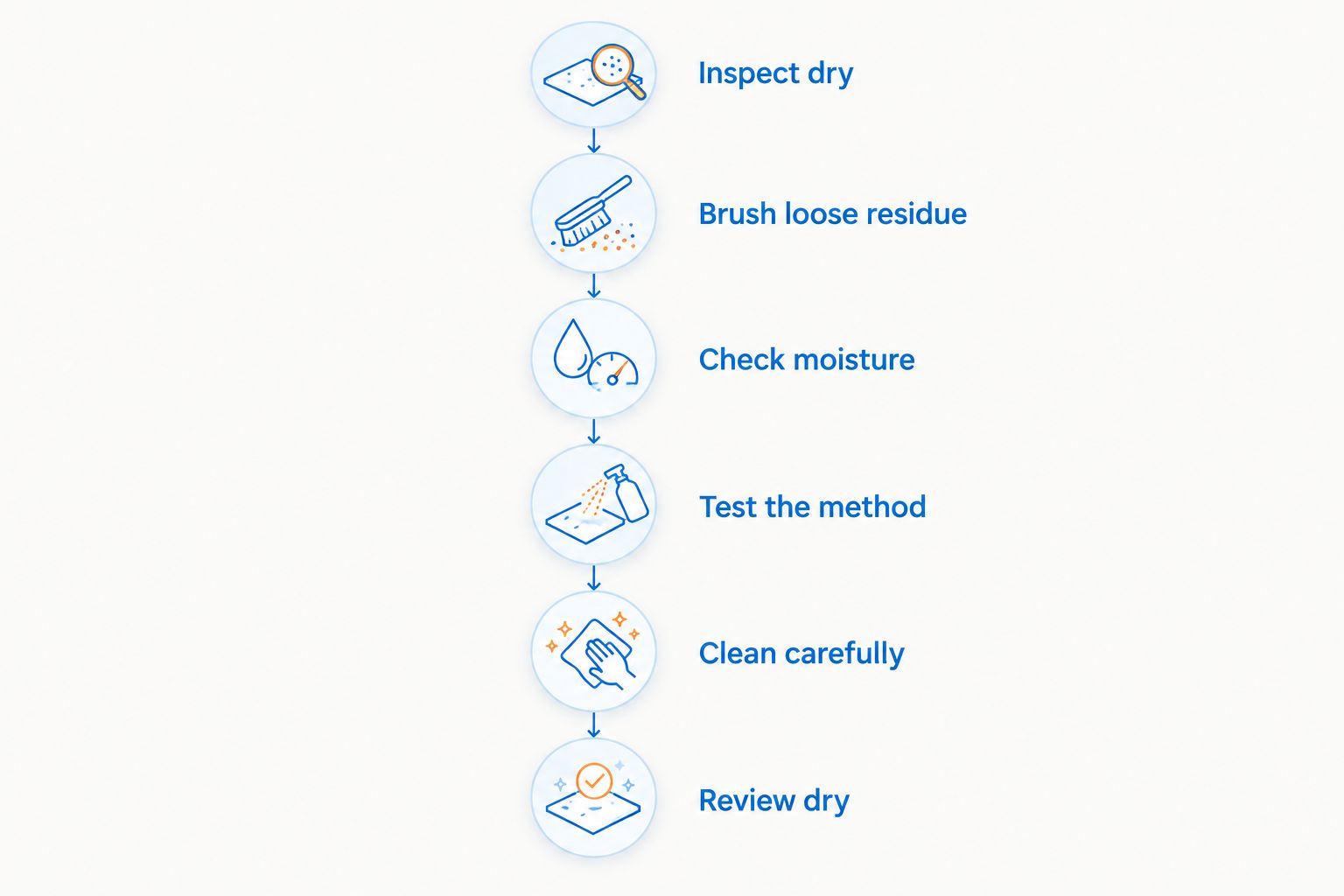
Use the following sequence for a 2026 driveway or patio cleaning plan. It keeps stain identification, cleaning, and follow-up separate so you do not mistake a temporary wet appearance for a finished result.
- Inspect dry. Photograph the area when it is dry. Look for powder, crust, flaking, coatings, and patterns near sprinklers, joints, edges, or downspouts.
- Brush loose residue. Try a nonmetallic brush on a small area. Check whether the white material lifts off or the concrete itself begins to crumble.
- Check moisture. Look for irrigation overspray, puddling, leaks, or runoff crossing the affected area. Correct accessible water problems before repeating cosmetic cleaning.
- Test the method. Choose an inconspicuous patch. Confirm that the proposed washing method or cleaner suits the finish, then inspect the test area after it dries.
- Clean carefully. Protect adjacent materials and landscaping. Follow equipment and cleaner instructions, keep the spray controlled, and plan for wash-water collection or disposal as required locally.
- Review dry. Compare the dry result with the original photographs. If residue returns, investigate the moisture pattern instead of automatically increasing pressure.
A test patch is useful only if you let it dry before approving the method for the rest of the surface. Check both deposit removal and changes in texture or color.
For a local service rather than an equipment purchase, Socalemm is for Newport Beach and Orange County homeowners seeking residential pressure washing. Describe the white deposit when you request a quote, and explain whether it has returned after previous cleaning. A pressure-washing request alone does not establish that every deposit can be removed.
Can pressure washing make efflorescence return?
Pressure washing introduces water, and water can dissolve and transport salts within concrete. That means the surface can develop visible deposits again as it dries; recurrence does not, by itself, prove that the cleaning caused damage.
The more useful distinction is between residue that was never fully removed and new residue deposited after cleaning. Photographs of the fully dry surface help you compare the affected areas rather than relying on how the slab looked while wet.
For recurring patches, check where water enters or collects. Do not respond to every return of white residue with another aggressive wash.
Is efflorescence the same as hard-water staining?
Efflorescence comes from salts carried through a porous material, while hard-water staining comes from minerals left by water deposited on the surface. Sprinkler water can contribute to surface mineral buildup and also keep concrete wet, so location alone does not settle the diagnosis.
Look at the pattern and the material. A pale patch beneath repeated sprinkler spray deserves a different investigation from powder appearing along a damp slab edge. Neither observation is a substitute for checking the surface before treatment.
If sprinkler-pattern deposits are your main concern, see the guide to removing hard-water stains from pool decks. Avoid treating an unidentified white mark as ordinary dirt.
Should you seal concrete after removing efflorescence?
Sealing is not a substitute for correcting an active moisture problem. Applying an incompatible coating or sealing before the substrate meets the product's moisture requirements can create appearance or adhesion problems.
For a 2026 sealing project, identify any existing coating and follow the proposed sealer's preparation and moisture requirements. The surface needs more than a clean appearance; it needs to meet the conditions specified for that product.
Do not assume that a clear finish will hide white residue. Address the deposit first, inspect the dry concrete, and choose a sealer only after checking compatibility and the moisture conditions.
What should you tell a cleaning contractor?
Give a residential cleaner the history of the surface, not just a photograph of the whitest patch. For a Socalemm pressure washing inquiry, useful details include whether the concrete is colored or sealed, what you have already applied, and whether nearby irrigation regularly wets the area.
Ask these questions before approving the work:
- How will you distinguish loose salts from a hard deposit or coating problem?
- Will you test the proposed method and inspect it after drying?
- What changes in color or texture would make you stop?
- How will you protect nearby finishes, plants, and drainage areas?
- What happens if the deposit remains or returns?
For a commercial property, keep the request separate from a homeowner cleaning request. Explain pedestrian access, affected entrances, business operations, and wash-water constraints. Those details concern site management; they do not change the need to identify the deposit first.
FAQ
Can pressure washing completely remove efflorescence from my concrete driveway?
Pressure washing can remove loose efflorescence, but it does not reliably remove every bonded deposit or prevent recurrence. Identify the deposit, test the cleaning method, and address the moisture source.
Why does the white powder come back after I wash my patio?
White powder can return when moisture carries more dissolved salts to the concrete surface. Check irrigation, drainage, leaks, and recurring damp areas rather than repeatedly increasing washing pressure.
Should I use bleach on white concrete deposits?
Bleach is not the appropriate default treatment for mineral efflorescence. Confirm what the deposit is and choose a product labeled for that deposit and the concrete finish.
Can I use vinegar or acid to remove efflorescence?
Do not use vinegar or acid as an untested general treatment for concrete. Acid can etch cement-based surfaces; a suitable cleaner still requires label compliance and a dried test patch.
How much pressure should I use on concrete with efflorescence?
There is no single pressure setting that is safe for every concrete surface. Surface condition, finish, nozzle, working distance, and equipment instructions all affect the appropriate method.
Is efflorescence proof that my concrete is structurally damaged?
Efflorescence alone does not establish structural damage. Cracking, flaking, crumbling, or persistent water problems need separate assessment rather than a cosmetic cleaning diagnosis.
Can Socalemm help with a residential pressure washing request?
Socalemm provides residential pressure washing and exterior cleaning in Newport Beach and Orange County. Describe the deposit, surface finish, moisture pattern, and previous treatments when requesting a quote.
One last thing
Take the final photograph when the concrete is dry. That simple step makes your 2026 maintenance record more useful: it shows remaining deposits and surface changes that water can temporarily hide.
Keep the original photograph, the dried test-patch photograph, and a note of the method used. If the white residue returns, you have a record to guide the next inspection instead of starting over with a stronger cleaner.