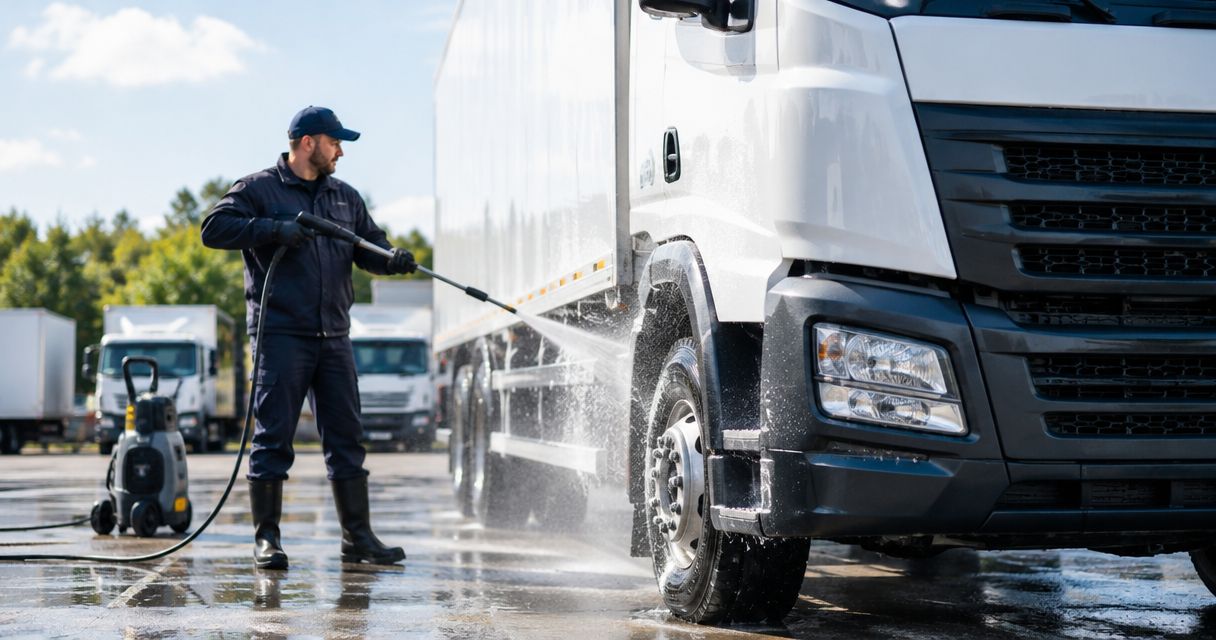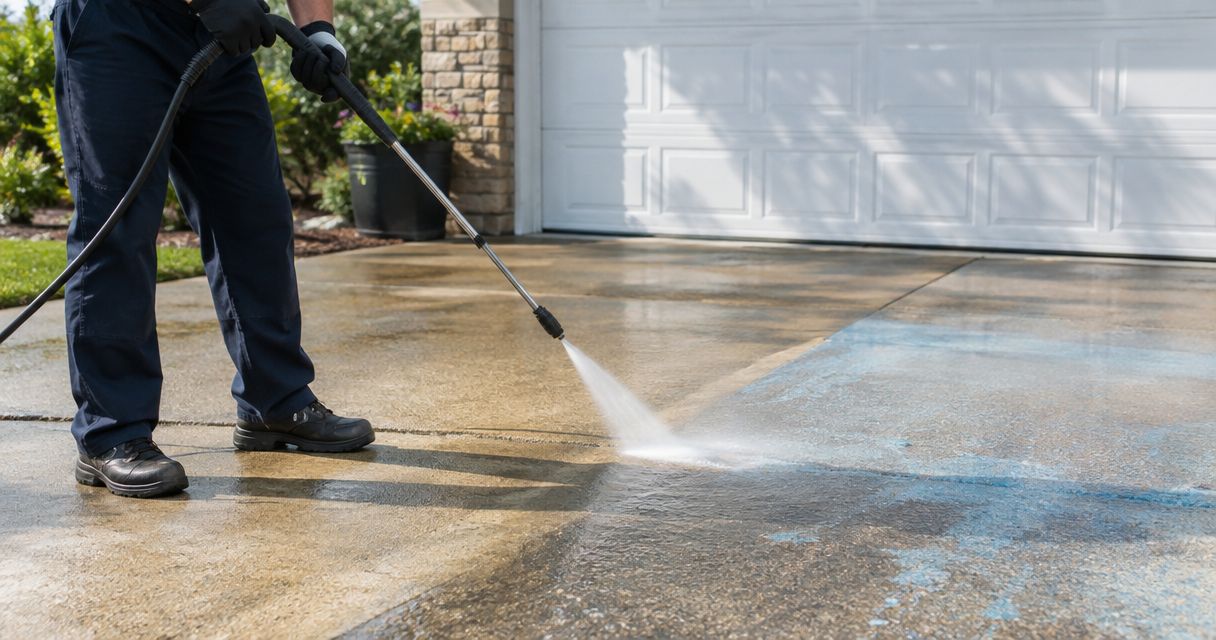
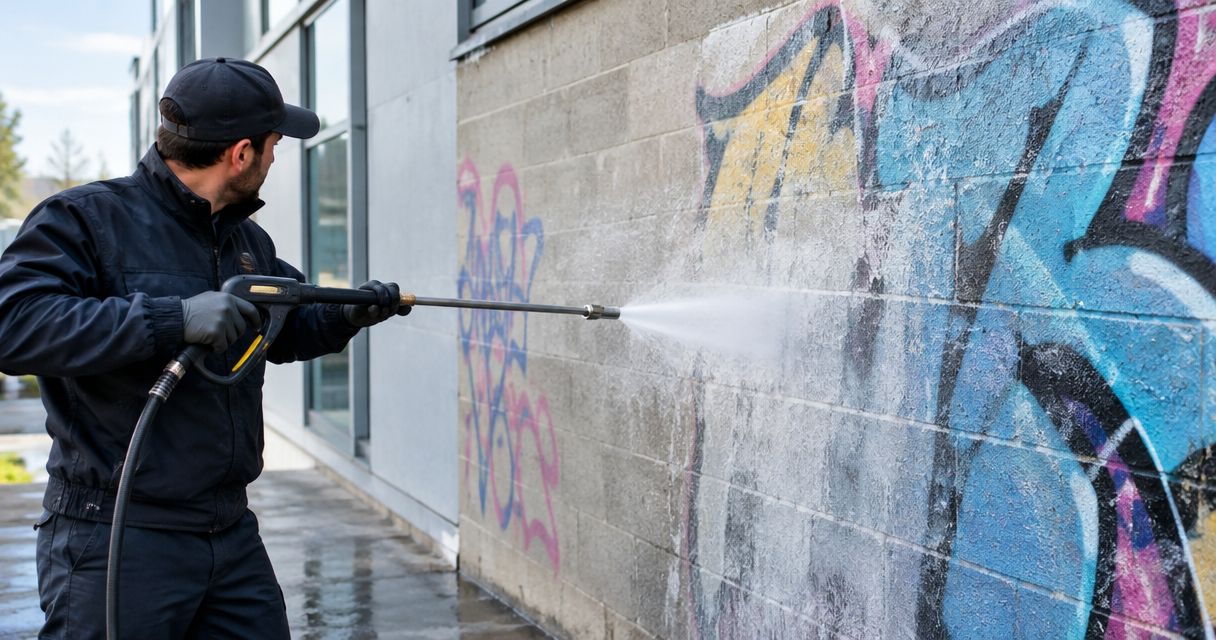
Yes, pressure washing can remove graffiti from commercial buildings, but water pressure alone is not a reliable treatment for every surface or paint. The right approach depends on the wall material, its existing finish, and the graffiti itself. For a 2026 cleanup, require a small test area and a wastewater plan before approving the full job; removing the mark should not mean stripping the wall underneath.
- Can pressure washing remove graffiti from commercial buildings? Yes, but surface testing must determine the cleaning method.
- Painted walls and stucco need special care because cleaning can remove the original finish.
- Socalemm provides commercial exterior cleaning in Newport Beach and Orange County; confirm graffiti-specific scope before booking.
- Approve a dry test patch and wastewater collection plan before treating the full wall.
Can pressure washing remove graffiti from commercial buildings?
Pressure washing can rinse away loosened graffiti, but successful removal often requires a surface-compatible treatment first. Increasing pressure is not a substitute for selecting the right cleaning method. If the treatment removes the building's paint along with the graffiti, the wall still needs restoration.
For local commercial exterior cleaning, Socalemm serves businesses in Newport Beach and Orange County. Ask whether the specific graffiti, wall material, and cleanup requirements fit the proposed service before authorizing work.
Use this comparison to frame the inspection, not as permission to pressure wash an unidentified surface.
| Approach | Best for | Main advantage | Main limitation |
|---|---|---|---|
| Surface-compatible graffiti treatment followed by controlled rinsing | Sound surfaces after a successful test | Targets the unwanted coating before rinsing | Treatment can affect the underlying finish or leave residue |
| Pressure washing without a graffiti remover | Marks that release during a controlled test | Avoids adding a chemical treatment | Does not reliably remove bonded paint and can damage the surface |
| Coating-specific cleaning | Walls with an identified protective coating | Allows cleaning to follow the coating manufacturer's instructions | Depends on identifying the coating and its condition |
| Repainting after suitable preparation | Painted walls where selective removal fails | Covers residual marks without repeated aggressive washing | Requires finish matching and does not preserve the original paint |
Choose the least aggressive method that removes the graffiti without changing the wall. A cleaner-looking patch is not a successful result if it exposes aggregate, strips paint, or leaves a different texture.
Why this matters
A commercial facade includes more than the tagged section. Cleaning also affects nearby windows, door seals, signs, landscaping, public walkways, and the people using the entrance. Plan the work around those features rather than treating the wall as an isolated target.
Your 2026 maintenance brief should separate graffiti removal from ordinary exterior washing. A quote for washing dirt from a storefront does not, by itself, define the treatment needed to remove spray paint or marker.
Ask for a clear stopping point. If the test shows finish loss, spreading pigment, or surface damage, stop and reassess instead of approving another pass at higher pressure.
Concrete and brick: watch for absorbed pigment
Unpainted concrete and brick can hold pigment within their pores. Removing paint from the surface does not always remove the shadow underneath. That remaining outline is often called ghosting.
The practical advantage of cleaning sound, unpainted masonry is that there is no decorative paint layer to preserve. The limitation is that the masonry itself can still be damaged. Mortar joints, weathered brick faces, and deteriorated concrete require particular care.
Ask the contractor to test the actual tagged material, including a representative joint where relevant. A successful result on a concrete column does not establish that adjacent brick or mortar will tolerate the same treatment.
Best for sound, unpainted masonry: a tested removal treatment with controlled rinsing. Do not accept a promise that pressure alone will erase every trace. If a shadow remains, compare further treatment against the risk of changing the surface.
Painted walls and stucco: protect the original finish
On a painted wall, the graffiti and the finish you want to keep are both coatings. A remover that attacks the unwanted paint can also soften, discolor, or strip the original finish. Pressure can then lift that weakened layer.
Stucco adds another concern: cracks, loose areas, and vulnerable openings need attention before washing. The objective is not simply to remove the mark; it is to avoid creating a repair around it. The guide to whether pressure washing can damage stucco explains the surface risks in more detail.
Best for painted walls: selective cleaning only when the test preserves the finish. If the original coating comes off, discuss repainting rather than repeatedly treating the same spot. Repainting has its own limitation: a small patch can remain visible when its color or sheen differs from the surrounding wall.
Record the existing finish condition before work. Peeling paint, faded sections, and earlier touch-ups should not become disagreements after the cleaning is complete.
Coated walls and metal panels: identify the finish first
A protective coating can change the removal process, but its presence is not permission to use any cleaner. Some anti-graffiti systems require renewal after cleaning; others have specific treatment restrictions. Identify the product and follow its maintenance instructions.
Painted metal panels also need finish-specific care. A panel that looks durable can still have a coating that reacts poorly to a remover. Joints and edges deserve attention because cleaning must not force water into the assembly.
Best for an identified coated surface: the coating manufacturer's cleaning method. The advantage is a defined maintenance procedure. The limitation is that an unknown coating, damaged finish, or missing maintenance record leaves important questions unresolved.
If your property file contains facade specifications, provide them before the test. A product name and maintenance sheet are more useful than a guess based on appearance.
Why graffiti removal results vary
No single pressure setting answers every graffiti problem. These factors determine what needs testing and what belongs in the written scope:
- Wall material: Porous masonry behaves differently from a smooth coated panel. The cleaning method must suit the actual substrate.
- Existing finish: Paint, sealers, and protective coatings can react to the removal treatment. Preserving them changes the acceptable method.
- Graffiti material: Spray paint, marker, and other substances do not necessarily respond to the same cleaner. Identify what you can without guessing.
- Surface condition: Cracks, loose paint, weak mortar, and previous repairs limit how aggressively the area can be cleaned.
- Treatment compatibility: Cleaner selection, contact time, agitation, and rinsing must follow the product instructions and test results.
- Site access and drainage: Nearby entrances, landscaping, drains, and pedestrian routes affect how the job must be contained and scheduled.
For a 2026 work order, describe these conditions rather than specifying a pressure number copied from another property. Equipment pressure alone does not describe the force reaching the wall or establish that a method is safe.
How should you plan commercial graffiti removal?
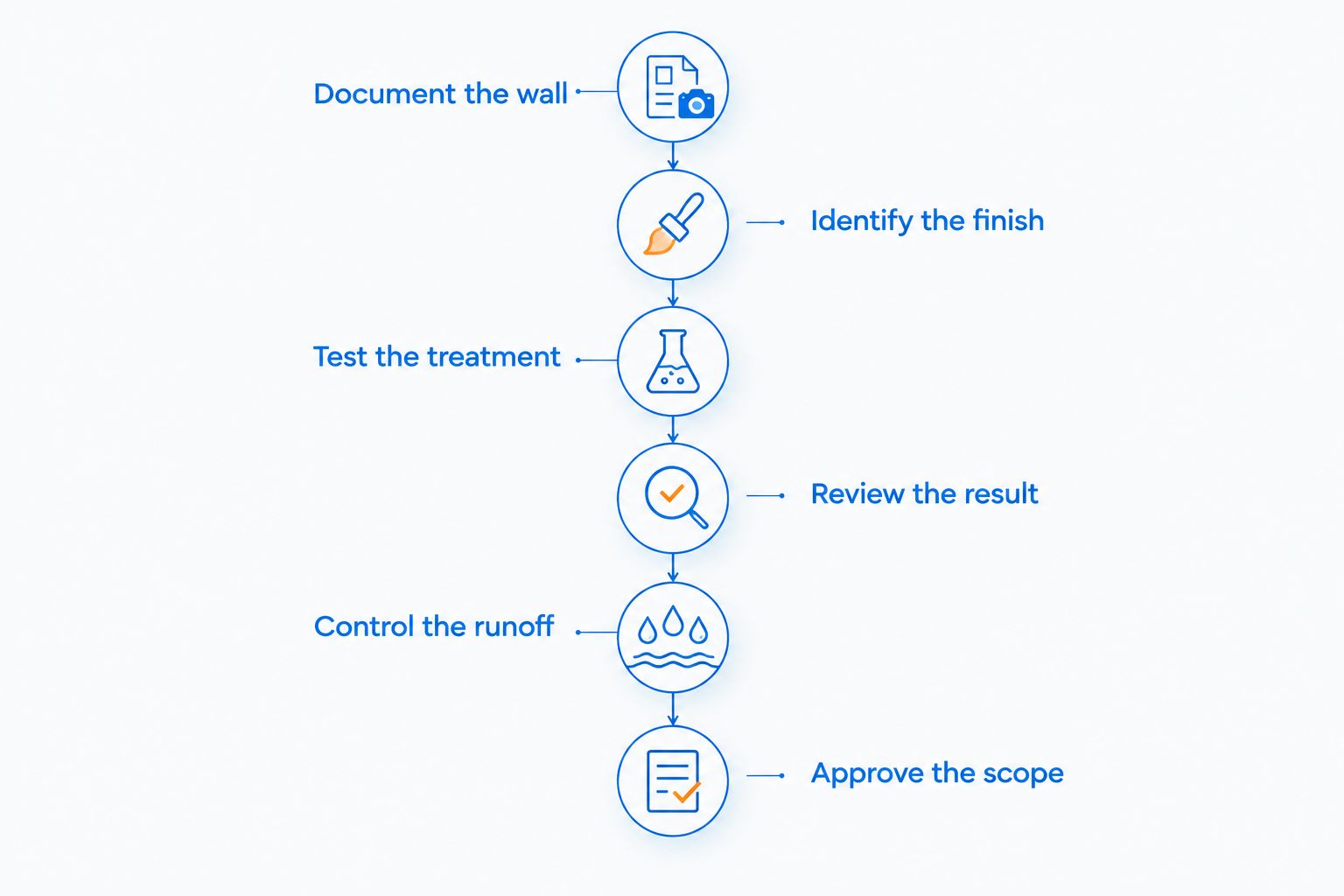
Use this sequence before approving treatment. Each step should resolve a question that would otherwise become a problem during the job.
- Document the wall. Take an overall view and close-up photographs of the graffiti, finish, cracks, joints, and adjacent fixtures. Keep the images in the maintenance record.
- Identify the finish. Check building records for paint, sealer, or protective coating information. Flag any uncertainty before a cleaner is selected.
- Test the treatment. Use a small, representative area to evaluate removal and surface compatibility. Keep customers and staff outside the work area.
- Review the result. Let the test area dry before judging color, texture, remaining pigment, and finish loss. Wet surfaces can conceal differences.
- Control the runoff. Establish how wash water, loosened paint, and treatment residue will be collected and handled. Protect nearby drainage routes.
- Approve the scope. Confirm the method, work boundaries, access arrangements, stopping criteria, and response to any remaining shadow or damaged finish.
The test should represent the job you intend to approve. If the graffiti crosses different materials, evaluate each material separately rather than extending the first result to the entire facade.
Keep the completion criteria in the same work order as the photographs. Your 2026 maintenance record should show what was approved, what changed during treatment, and whether any repainting or coating renewal remains outstanding.
What should a commercial graffiti removal quote include?
Ask for a scope you can evaluate, not just a promise to wash the wall. The document should identify the tagged surfaces, proposed treatment, test procedure, and areas excluded from the work. It should also distinguish removal from any later painting or repair.
Make these points explicit:
- Who approves the test result before the full wall is treated.
- How doors, signs, windows, landscaping, and pedestrian access will be protected.
- How wastewater and removed material will be collected and handled.
- What happens if pigment remains after the approved treatment.
- Whether coating renewal, repainting, or surface repair is included or separate.
Socalemm is a commercial exterior-cleaning option for Newport Beach and Orange County businesses seeking local service. Confirm graffiti-specific treatment and site requirements before booking; general pressure washing coverage does not establish that every graffiti removal method is included.
Keep commercial access requirements separate from residential cleaning questions. A business entrance needs a plan for staff, deliveries, and customers, even when the affected wall is small.
Can you pressure wash graffiti off without chemicals?
Sometimes, but only a controlled test can establish whether water alone works on that mark and surface. If the paint stays bonded, repeated passes can damage the wall without solving the problem. Do not make stronger pressure the automatic next step.
Water-only cleaning also produces contaminated runoff when it removes paint or other material. Skipping a chemical treatment does not remove the need for collection and appropriate disposal.
Will graffiti removal leave a shadow on the building?
Graffiti removal can leave a shadow when pigment remains in a porous surface or the underlying finish has changed. Inspect the dry test patch before approving the full treatment. A wet wall is not a dependable preview of the final appearance.
Ask whether the remaining outline is removable pigment, a stain, or finish damage. Those are different problems, and another pressure-washing pass is not the answer to all of them.
Is repainting better than pressure washing a tagged wall?
Repainting is the better choice when selective removal damages the original paint or leaves an unacceptable mark. It is not a substitute for preparing the surface properly. The coating instructions should determine cleaning, drying, and repainting requirements.
Compare the appearance of a small touch-up with repainting a defined wall section. Record that decision before work so the accepted outcome is clear.
FAQ
Can pressure washing remove spray paint from a commercial building?
Yes, pressure washing can remove spray paint when the treatment suits the surface, but water alone is not reliable for every coating. Approve a representative test patch before treating the full area.
Can you remove graffiti from brick without damaging it?
Graffiti removal from brick requires a method that preserves both the brick face and mortar. Test first and stop if the surface erodes, flakes, or changes texture.
Is high-pressure washing safe for a painted storefront?
High-pressure washing can strip or damage a painted storefront. Use a finish-compatible test treatment rather than assuming that more pressure will remove only the graffiti.
Does soft washing remove graffiti?
Soft washing is not automatically a graffiti removal treatment. Low pressure describes part of the application method; it does not establish that the cleaning product will remove paint or marker.
Should graffiti wash water go into a storm drain?
Do not direct graffiti wash water into a storm drain. Plan collection and appropriate disposal for water containing removed paint, cleaner, and other residues, and confirm applicable local requirements.
What should I send when requesting a graffiti removal quote?
Send overall and close-up photographs, the wall material, any known coating information, and details about access and nearby drains. Ask the contractor to confirm a test area and the proposed treatment boundaries.
Does Socalemm provide commercial exterior cleaning in Orange County?
Socalemm provides commercial pressure washing and related exterior cleaning in Newport Beach and Orange County. Confirm whether the specific graffiti removal treatment and wastewater requirements fit the proposed service.
One last thing
Judge the dry wall, not the wet photograph. Water can temporarily hide a remaining outline or a change in finish. Build a dry inspection into your 2026 acceptance checklist, and photograph the result from the same position as the original damage.
If removing the last trace requires damaging the wall, stop. Preserving the building is more important than forcing a clean-looking result that needs a larger repair.