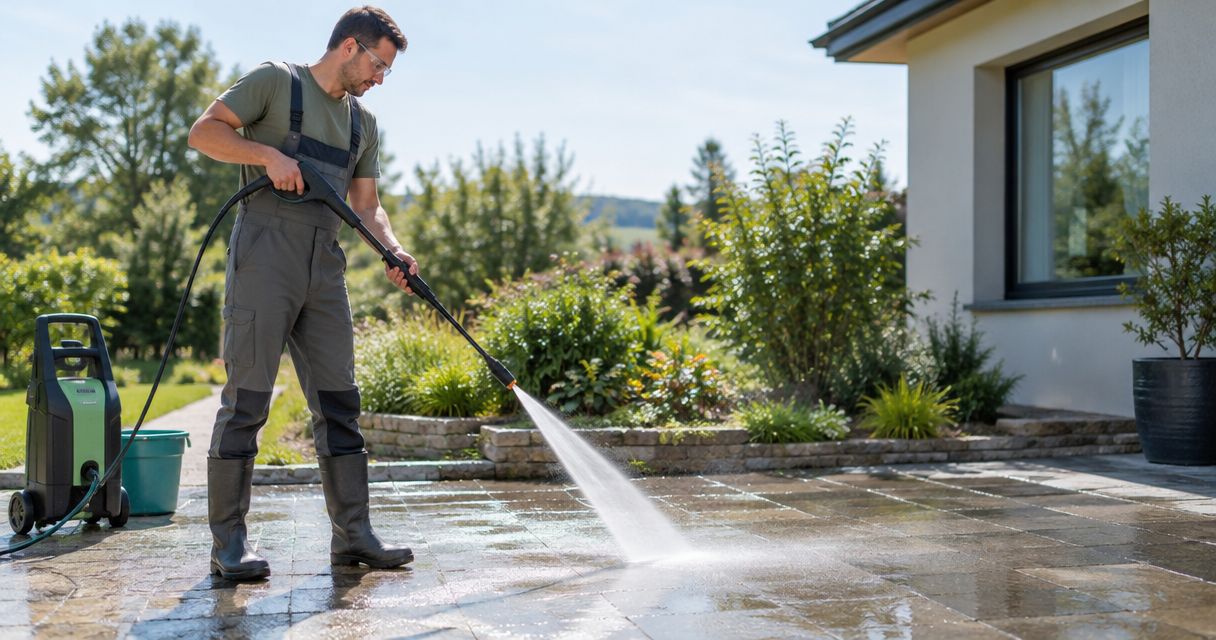
Eco-friendly pressure washing can be as effective as traditional cleaning when the cleaner, equipment, and technique match the surface and stain. The label alone does not establish cleaning performance or environmental safety: removing loose dirt is different from treating embedded oil, and even biodegradable detergent requires careful handling of wash water.
- Is eco friendly pressure washing as effective as traditional? Yes, with the right surface-specific method and stain treatment.
- Biodegradable detergent does not make contaminated wash water suitable for a storm drain.
- Compare stain removal, surface condition, and runoff handling—not just cleaning-product labels.
- Socalemm provides pressure washing and exterior cleaning in Newport Beach and Orange County; ask about the proposed cleaning method.
Why this matters
A clean driveway and a protected garden are separate requirements. A product described as environmentally preferable still needs suitable application, controlled rinsing, and a plan for the dirt and contaminants removed from your property.
When comparing exterior-cleaning proposals in 2026, ask what the contractor will use and why. A clear explanation of the process is more useful than an unexplained green claim.
Socalemm provides residential and commercial exterior cleaning in Newport Beach and Orange County. Socalemm is a fit for local homeowners seeking pressure washing, house washing, or roof soft washing. Confirm the proposed products and runoff practices before booking; those details determine whether a particular job meets your environmental priorities.
Is eco-friendly pressure washing as effective as traditional?
Yes, but neither “eco-friendly” nor “traditional” describes a complete cleaning method. Both approaches can involve pressure, detergents, agitation, and rinsing. The meaningful comparison is whether each proposed method removes the same contamination without damaging the same surface.
Use this table to compare approaches, rather than assuming every environmentally marketed service follows the same process.
| Approach | Best for | Main advantage | Main limitation |
|---|---|---|---|
| Water-only pressure washing | Loose dirt on suitable, durable surfaces | Avoids adding detergent | Water alone does not address every oily or biological stain |
| Detergent-assisted pressure washing | Surface-compatible treatment of attached grime | A suitable cleaner helps loosen contamination | Product selection, exposure, and runoff still require control |
| Lower-pressure chemical cleaning | Delicate surfaces where manufacturer guidance supports the method | Reduces reliance on force | Lower pressure does not make the cleaning solution harmless |
| Targeted stain treatment | Localized oil, rust, or mineral staining | Treats the specific deposit rather than washing everything more aggressively | Compatibility and achievable results depend on the stain and material |
For a fair comparison, describe the same surface, stain, and expected finish to each contractor. Removing visible grime, disinfecting a surface, and restoring stained material are different outcomes. Do not accept one as proof of another.
In 2026, treat “eco-friendly” as the start of your questions, not the answer to them. Ask for product names, the reason for using them, and the wash-water plan.
Water-only cleaning: best for loose surface dirt
Water-only washing avoids introducing a cleaning detergent. On suitable hard surfaces, controlled pressure can remove loose dirt and accumulated debris.
Its limitation is stain chemistry. Grease, absorbed oil, mineral deposits, and attached biological growth do not all respond to water in the same way. Repeated passes with more pressure are not a reliable substitute for the right treatment.
Choose water-only cleaning when the contamination and surface support it—not simply because no detergent sounds safer. Excessive pressure can still damage a surface, and dirty rinse water still carries whatever the washing removes.
For a homeowner, that means identifying whether a patio looks dusty, greasy, green, or mineral-stained before deciding how to clean it. Those descriptions help define the job more clearly than asking for the strongest wash available.
Detergent-assisted cleaning: best for attached grime
A compatible detergent helps separate contamination from the surface. That can make cleaning less dependent on mechanical force, provided the product is suitable for the material and used according to its label.
The drawback is that detergent introduces another substance to manage. Biodegradability describes breakdown under particular conditions; it does not establish immediate safety for plants, pets, waterways, or every building material.
Ask what the product is intended to remove and whether it needs to remain wet during application. Follow its instructions rather than a generic dwell-time recommendation: products, surfaces, and weather conditions differ.
A targeted detergent used correctly is a more defensible choice than an unspecified product marketed as green. Do not mix cleaning chemicals or substitute household recipes for product instructions.
Lower-pressure cleaning: best for sensitive surfaces
Lower-pressure cleaning shifts more of the cleaning work to an appropriate solution rather than force. It is a method to evaluate for surfaces where aggressive pressure would risk damage, subject to the material manufacturer's guidance.
Its advantage is reduced reliance on high-pressure impact. Its limitation is that chemical compatibility, application, rinsing, and surrounding vegetation still matter.
House washing and roof cleaning also require different decisions from driveway cleaning. Do not use a successful concrete-cleaning method as evidence that the same pressure, nozzle, or cleaner belongs on stucco, siding, roof coverings, or nearby fixtures.
For a 2026 home-maintenance plan, record the surface material and any known coating or repair before requesting a cleaning method. A contractor needs those details more than a general request for maximum cleaning strength.
Why eco-friendly cleaning results vary
The same environmental description can cover very different jobs. These factors explain why a method that works on one part of your property does not automatically suit another:
- Surface material: Concrete, painted finishes, wood, stucco, and roofing have different tolerances. Follow manufacturer guidance and account for existing deterioration.
- Stain type: Loose dust, oily residue, rust, mineral deposits, and biological growth need different treatment decisions.
- Stain penetration: Surface residue is different from contamination absorbed into porous material. Complete removal is not assured merely because visible dirt washes away.
- Product compatibility: The cleaner must suit both the deposit and the underlying surface. A cleaning claim does not establish compatibility with every coating or sealant.
- Application conditions: Product instructions govern dilution, application, contact, and rinsing. Sun, wind, and drying affect how the work must be managed.
- Wash-water handling: The cleaning process must address the contaminants it releases, not just the detergent it adds.
Judge effectiveness by the finished surface and the work method together. An aggressive wash that removes grime but damages the finish is not a successful result.
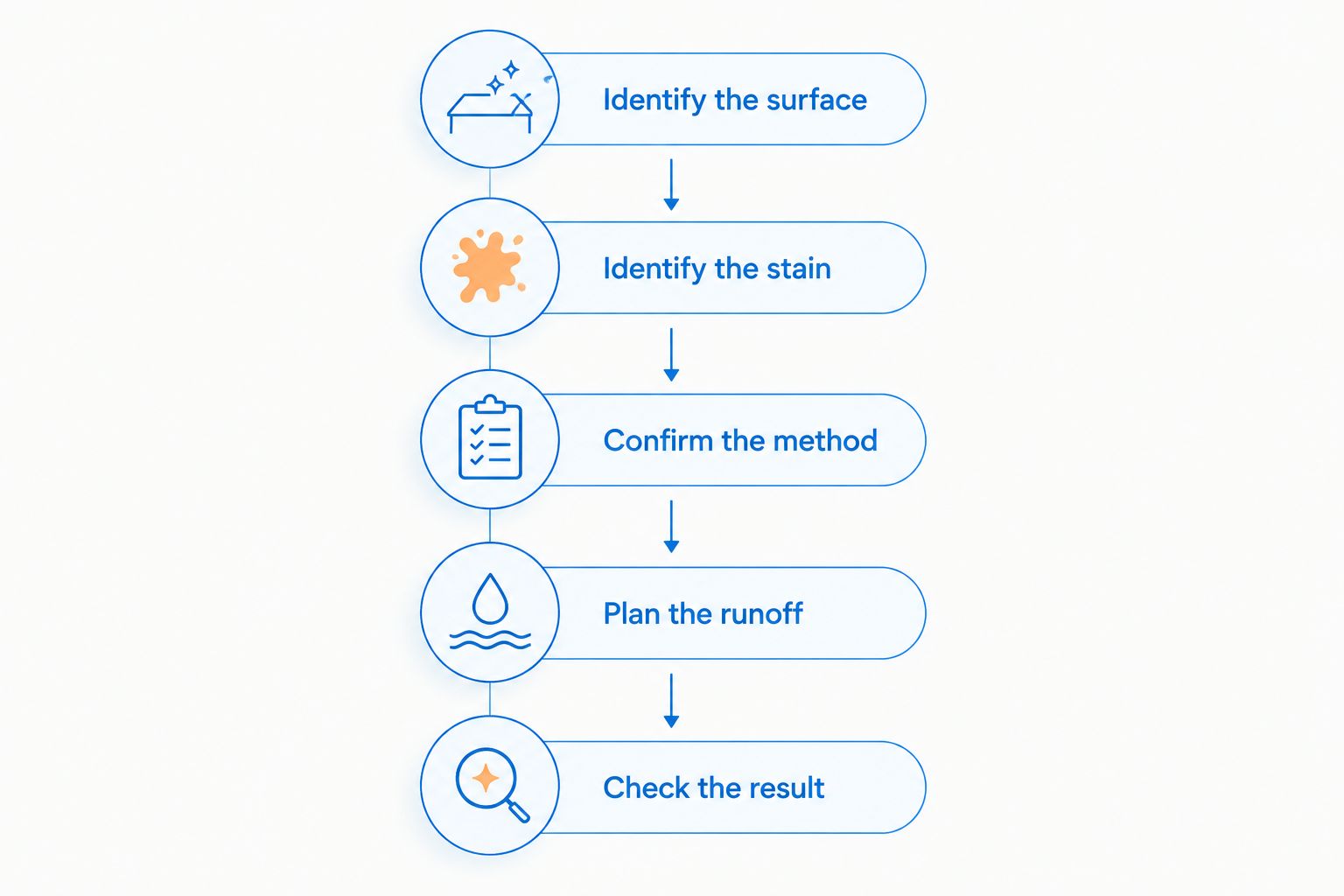
How do you compare two cleaning proposals fairly?
Use the same sequence for each proposal. Ask for a plain-language explanation rather than accepting a product label as the entire cleaning plan.
- Identify the surface. Specify the material, coating, visible damage, and nearby sensitive features. Tell the contractor about previous sealing, repairs, or cleaning problems you know about.
- Identify the stain. Separate general grime from oil, rust, mineral deposits, or growth. Point out areas where appearance matters most.
- Confirm the method. Ask which areas receive pressure, which need lower-pressure treatment, and what cleaner is proposed. Request the reason for that choice.
- Plan the runoff. Ask where wash water will travel and how it will be controlled. Include drains, planting areas, neighboring property, and any visible contaminants in the discussion.
- Check the result. Agree on a suitable test area and discuss realistic limits before treating the full surface. Evaluate appearance and surface condition after the area dries.
This process separates a cleaning outcome from a marketing description. It also gives you a useful basis for discussing areas that need additional treatment rather than repeated aggressive washing.
A test area is useful for checking compatibility and appearance, but it does not prove environmental safety. Product information and wash-water planning remain separate parts of your decision.
Does biodegradable detergent make runoff safe?
No. Biodegradable detergent does not make pressure-washing runoff suitable for a storm drain. The water can also contain oil, sediment, paint particles, cleaning residues, and other material removed from the surface.
Before work begins, locate nearby drains and establish where the rinse water would flow. Do not assume routing it into a lawn, gutter, or street is acceptable; the contaminants and applicable local requirements determine suitable handling.
For a 2026 project in Newport Beach or elsewhere in Orange County, check the relevant city's current wash-water requirements. Ask the contractor to explain containment, collection, and disposal where the job requires them, rather than relying on a biodegradable label.
Can an eco-friendly method remove old oil stains completely?
An eco-friendly method does not guarantee complete removal of old oil stains. Oil absorbed into porous concrete presents a different problem from fresh residue sitting on the surface.
Ask whether the proposed work targets surface buildup, deeper discoloration, or both. A suitable test area helps establish expectations; increasing pressure after the stain stops responding risks trading discoloration for surface damage.
Should homeowners and businesses use the same cleaning plan?
The basic principles are the same, but the work scope should remain separate. Your home-maintenance request should focus on the driveway, patio, house exterior, roof, or other specific residential area that needs attention.
For homeowners, explain nearby landscaping, outdoor furniture, pets, exterior outlets, and any fragile or deteriorated finishes. Ask what you should move or protect and when the cleaned area can be used again under the chosen product's instructions.
Commercial requests need their own site discussion. Identify pedestrian access, customer entrances, work areas, drainage, and the type of contamination present; do not treat a storefront or other business property as simply a larger residential driveway.
When requesting Socalemm pressure washing or exterior cleaning, specify whether the property is residential or commercial. Use the quote request to describe the surface and problem, and ask for the proposed cleaning and runoff approach without assuming an environmental certification or particular chemical system.
FAQ
Is eco friendly pressure washing as effective as traditional cleaning?
Yes, eco-friendly pressure washing can be as effective when the cleaner, equipment, and technique match the surface and contamination. The environmental label alone does not establish performance, surface safety, or suitable runoff handling.
Does eco-friendly pressure washing mean no chemicals?
No, eco-friendly pressure washing does not necessarily mean chemical-free cleaning. Ask whether the proposed method uses water alone, detergent, or a targeted treatment and request the product name.
Is biodegradable pressure-washing soap safe for my garden?
A biodegradable label does not establish that a cleaning product is safe for your garden. Plant protection depends on the product instructions, concentration, exposure, and control of spray and runoff.
Can I let pressure-washing water run into the street?
Do not assume pressure-washing water can run into the street or a storm drain. Check the applicable local requirements and account for the detergent and contaminants carried in the water.
Is using more pressure better than using detergent?
More pressure is not automatically better than a compatible detergent. Excessive pressure can damage a surface, while an appropriate cleaner helps address contamination that water alone does not remove.
Can eco-friendly cleaning remove every driveway stain?
No cleaning label guarantees removal of every driveway stain. Absorbed oil, rust, mineral deposits, and existing surface damage require separate assessment and realistic expectations.
Does Socalemm offer exterior cleaning in Orange County?
Socalemm provides residential and commercial pressure washing, house washing, roof soft washing, and related exterior cleaning in Newport Beach and Orange County. Ask which products and wash-water practices are proposed for your specific property.
One last thing
The material coming off your property can matter as much as the cleaner going onto it. Even water-only washing creates runoff containing the dirt and contaminants it removes.
Before approving a 2026 cleaning proposal, ask one final question: where will the dirty water go? A useful answer explains the actual route and handling plan, not just the wording on the detergent container.