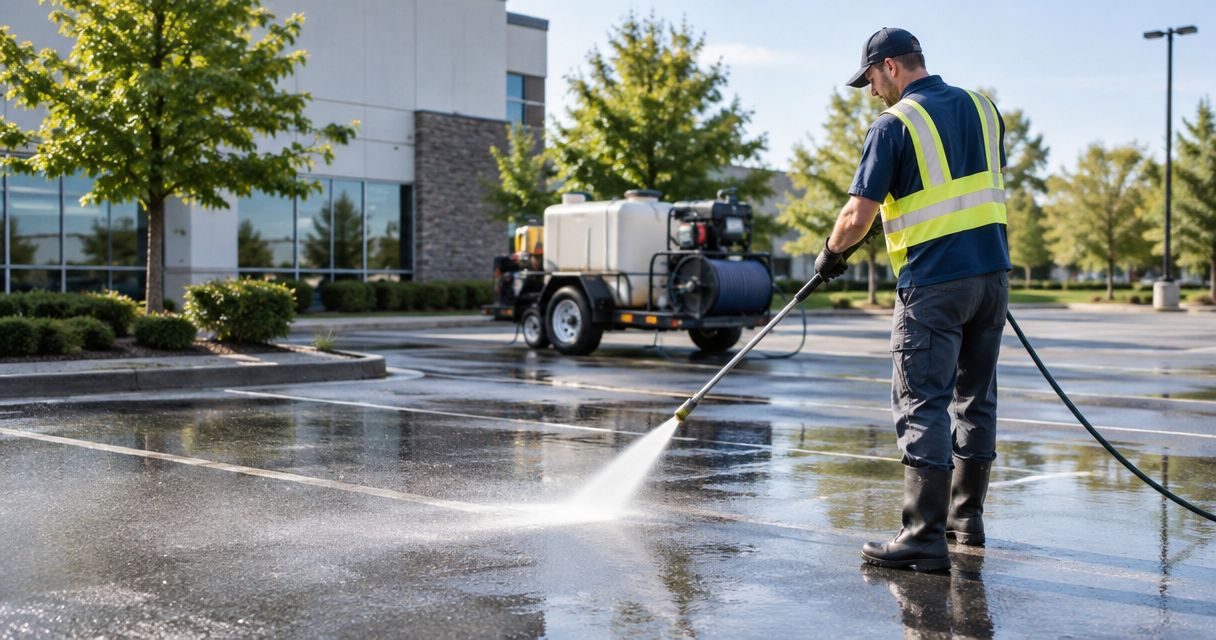
Commercial parking lot cleaning cost depends on the area being washed, pavement condition, stain treatment, access, and wash-water handling; get a site-specific written quote rather than applying a generic rate. Check whether that quote includes preparation, parking restrictions, and cleanup, because a pavement wash and a complete parking-area cleaning scope are not the same job.
- Commercial parking lot cleaning cost is only comparable when quotes cover the same surfaces, stains, access, and cleanup.
- Separate routine pavement washing from targeted oil treatment and adjacent sidewalk cleaning.
- SoCal EMM provides commercial exterior cleaning for businesses in Newport Beach and Orange County.
- For a 2026 maintenance budget, request a written scope before approving parking lot cleaning.
Why this matters
A short description such as parking lot cleaning leaves room for different interpretations. You might expect parking stalls, drive aisles, curbs, and entrance walkways, while a contractor has allowed only for the open pavement.
Compare the work included before comparing the total. When you request a quote, describe the surface, the boundaries, and the stains you want addressed. That gives the contractor a defined job and gives you a useful basis for approval.
For your 2026 budget, keep commercial parking-area work separate from residential driveway cleaning. Shared vehicle access, tenant schedules, delivery routes, and drainage all belong in the commercial scope.
How much does commercial parking lot cleaning cost?
The amount you pay should correspond to a defined cleaning area and a documented treatment plan. A useful quote explains what will be cleaned, what needs separate treatment, and what remains outside the agreement.
Ask the contractor to break down the proposed work using these categories. These are scope items to confirm, not a statement that every parking lot needs every service.
| Scope item | Best for | What to confirm | Limitation |
|---|---|---|---|
| General pavement washing | Broad areas of surface dirt | Parking stalls, drive aisles, and exact boundaries | Does not establish a stain-removal commitment |
| Targeted stain treatment | Identified oil or other marked spots | Locations, treatment method, and expected result | Discoloration can remain after cleaning |
| Adjacent walkway cleaning | Pedestrian routes beside parking | Entrances, curb edges, ramps, and sidewalks included | Adds work beyond vehicle pavement |
| Phased cleaning | Properties that need continued access | Section sequence and reopening arrangements | Requires coordination with occupants |
| Recurring maintenance | Properties with a continuing cleaning need | Repeat scope, condition checks, and scheduling | Does not replace repairs or resolve ongoing leaks |
Do not accept a broad label as a substitute for these details. A quote that clearly excludes sidewalks is easier to evaluate than one that leaves sidewalks unmentioned.
Also ask how changes will be approved. If additional staining or damaged pavement becomes apparent during the visit, you need a clear decision process rather than an assumption that extra work is authorized.
General pavement washing: define the boundaries
General washing starts with identifying the actual surfaces to clean. Mark the parking stalls and drive aisles, then decide whether entrances, perimeter edges, and areas behind parked vehicles belong in the same scope.
The benefit of a defined pavement wash is coverage you can inspect afterward. The limitation is that washing alone does not promise uniform color or removal of every embedded mark.
Tell the contractor whether the lot contains concrete, asphalt, pavers, painted markings, or a mixture. Do not approve a cleaning method based only on the word pavement. Ask how the method will account for the surface and its condition.
A parking lot cleaning quote should also distinguish dirt from deterioration. Cracks, worn striping, loose material, and damaged coatings need to be identified before washing, not treated as cleaning failures afterward.
Targeted stain treatment: agree on the result
Oil spots and other concentrated stains deserve their own discussion. Mark their locations and explain any known source, such as a recurring vehicle leak, without assuming that ordinary washing will remove them completely.
Targeted treatment focuses attention on specific problem areas. Its limitation is that an old stain can remain visible even after removable contamination has been addressed.
Ask whether a test area makes sense before treating a prominent spot. Use that result to discuss a realistic finish, especially near an entrance where appearance matters.
Cleaning also does not repair the source of recurring contamination. If vehicles continue leaking in the same stalls, coordinate that issue separately rather than expecting a cleaning appointment to prevent new stains.
Why commercial parking lot cleaning cost varies
Different lots create different work requirements. Use these factors to explain your property accurately and to identify why competing scopes differ.
- Cleaning area: Define the pavement to be washed rather than giving only the total property size. Exclude landscaped islands, buildings, and areas outside the requested work.
- Surface condition: Identify damaged pavement, loose coatings, painted markings, and previous repairs. Ask the contractor how those conditions affect the proposed method.
- Stain treatment: Separate general dirt from marked oil spots and other concentrated contamination. Confirm whether targeted treatment is included or requires separate approval.
- Access restrictions: Explain occupied stalls, delivery windows, gates, and routes that must remain usable. Ask whether work requires sections to be closed in sequence.
- Water and drainage: Identify the proposed water source, nearby drains, and where wash water would travel. Require an explanation of collection and disposal arrangements appropriate to the job.
- Work boundaries: List sidewalks, curb edges, entrances, and other adjoining areas individually. Do not assume that proximity makes them part of the parking lot scope.
These factors belong in the written agreement, not just a phone conversation. For 2026 quote comparisons, send each contractor the same marked site image and description so the starting instructions match.
How do you get a useful parking lot cleaning quote?
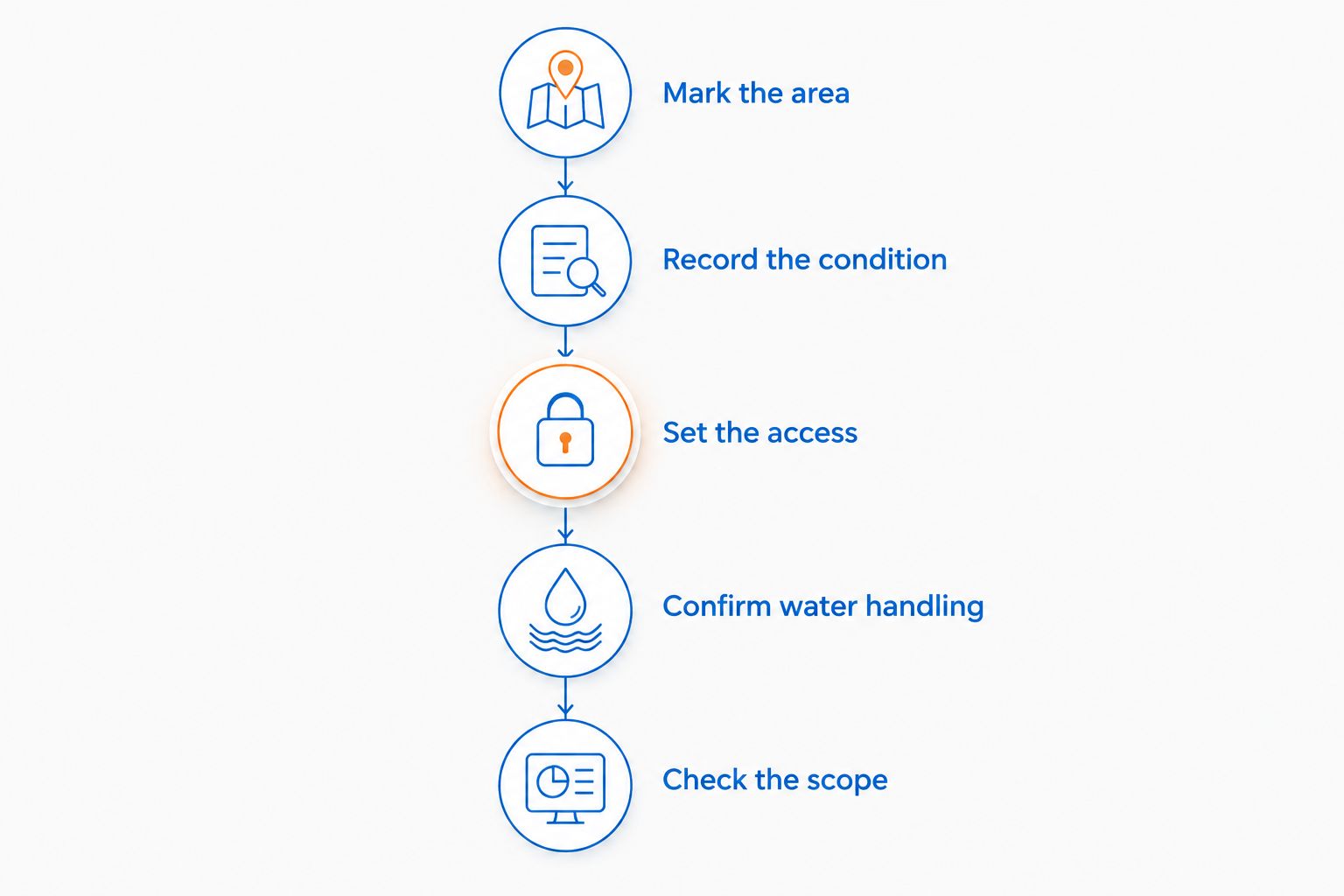
Prepare a short site brief before requesting proposals. You do not need a polished document; you need enough detail to show what the contractor is being asked to clean.
- Mark the area. Outline the parking stalls, drive aisles, and any adjoining surfaces included in the request. Label excluded areas so the boundary is clear.
- Record the condition. Take current overview photos and closer images of stains, damaged surfaces, and drainage points. Note where vehicles usually block access.
- Set the access. Describe business hours, delivery activity, and any route that must stay open. Identify who can authorize temporary parking restrictions.
- Confirm water handling. Ask about the water source, drain protection, and the proposed handling of dirty wash water. Get responsibilities in writing.
- Check the scope. Review included surfaces, exclusions, treatment expectations, and completion arrangements before approving the work.
Keep the same brief attached to the approved proposal. If the property layout or requested work changes, update the scope rather than relying on an earlier conversation.
SoCal EMM is a practical fit for Newport Beach and Orange County businesses seeking commercial exterior cleaning. For a parking-area request, describe the pavement and access conditions so suitability, method, and scope can be confirmed. General commercial exterior-cleaning experience is not a substitute for a site-specific plan.
Request a site-specific cleaning quote
Describe your parking area, surface condition, access restrictions, and adjoining surfaces.
How should you compare commercial cleaning proposals?
Read the scope line by line before reviewing the total. A shorter proposal is not automatically missing work, but every important responsibility needs a clear answer.
Start with coverage. Confirm that each proposal addresses the same marked area and treats adjacent walkways consistently. Then compare stain treatment and exclusions rather than assuming the word cleaning means the same result in every document.
Next, check operational responsibilities. Establish who moves vehicles, notifies tenants, provides access, and keeps people away from the active work area.
Finally, confirm the completion process. Ask how the cleaned area will be reviewed, how unresolved concerns should be reported, and who decides when restricted sections reopen. Do not infer a guarantee from general language about results.
Keep an approval record
Save the marked site image, the accepted scope, and any approved changes together. For a recurring arrangement, record what each visit actually covers instead of carrying forward a vague description.
A dated 2026 scope also helps when the property changes management. The next person can see whether the agreement concerns pavement washing alone or includes adjoining exterior surfaces.
Is recurring parking lot cleaning better than a single visit?
Recurring parking lot cleaning suits a property with an ongoing maintenance need; a single visit suits a defined cleanup. Neither arrangement automatically includes extra stain treatment, adjoining walkways, or unrestricted scheduling.
The benefit of recurring work is a repeatable scope you can coordinate with property operations. The drawback is committing to visits without first establishing what condition triggers cleaning and what each appointment includes.
A single visit gives you a defined starting project. Its limitation is that it does not establish a maintenance schedule or address the source of new contamination.
Choose the arrangement after reviewing how the lot is used and what happens between cleanings. Avoid selecting a fixed interval simply because another property uses it.
Does parking lot cleaning include sidewalks and storefronts?
Parking lot cleaning includes sidewalks and storefront areas only when the written scope names them. A vehicle pavement wash does not, by itself, define work on pedestrian entrances or building surfaces.
Keep those areas as separate line items, even when you request them during the same visit. That makes it easier to compare proposals and approve only the work the property needs.
For a shared commercial property, identify which areas belong to the owner’s maintenance responsibilities and which require tenant approval. Resolve that boundary before scheduling crews around customer entrances.
Should you get a site visit before approving the work?
A site visit is useful when photos do not clearly show drainage, surface damage, access restrictions, or the full cleaning boundary. Ask the contractor whether the available information is enough to define the work responsibly.
Photos are useful for initial discussion, but they do not resolve every question. If a proposal depends on assumptions about the property, have those assumptions confirmed before approval.
FAQ
How do I get an accurate commercial parking lot cleaning quote?
Provide a marked cleaning area, current photos, pavement details, and access restrictions. Ask for a written scope that identifies stain treatment, wash-water handling, adjoining surfaces, and exclusions.
Does commercial parking lot cleaning include oil stain removal?
Oil stain treatment is included only when the agreed scope says so. Identify the affected areas and discuss expected results, because visible discoloration can remain after treatment.
Can a parking lot be cleaned while my business stays open?
Keeping a business open requires an agreed access and work-area plan. Confirm whether sections can be isolated without blocking required routes, entrances, or deliveries.
Is pressure washing suitable for every parking lot surface?
Pressure washing should not be treated as suitable for every parking lot surface. Identify the pavement, coatings, markings, and damage, then ask the contractor to explain the proposed method.
Who handles the dirty water from parking lot washing?
Responsibility for dirty wash water needs to be stated in the cleaning agreement. Ask the contractor to explain the proposed collection, drain protection, and disposal arrangements before work begins.
Does SoCal EMM provide commercial exterior cleaning in Orange County?
SoCal EMM provides commercial exterior cleaning in Newport Beach and Orange County. Describe your parking-area project when requesting a quote so the surface, access, and proposed scope can be reviewed.
What should I review before renewing parking lot cleaning in 2026?
Before renewing parking lot cleaning in 2026, review the cleaning boundary, current pavement condition, access arrangements, and repeat scope. Update the agreement if property use or responsibilities have changed.
One last thing
Photograph the lot after vehicles have moved, before cleaning starts. Occupied stalls can hide both stains and existing pavement damage, leaving an incomplete record of the starting condition.
Approve a defined result, not just a visit. Agree on the surfaces to be cleaned, the treatment being attempted, and how completion will be checked. That is the most useful foundation for a parking lot cleaning budget.