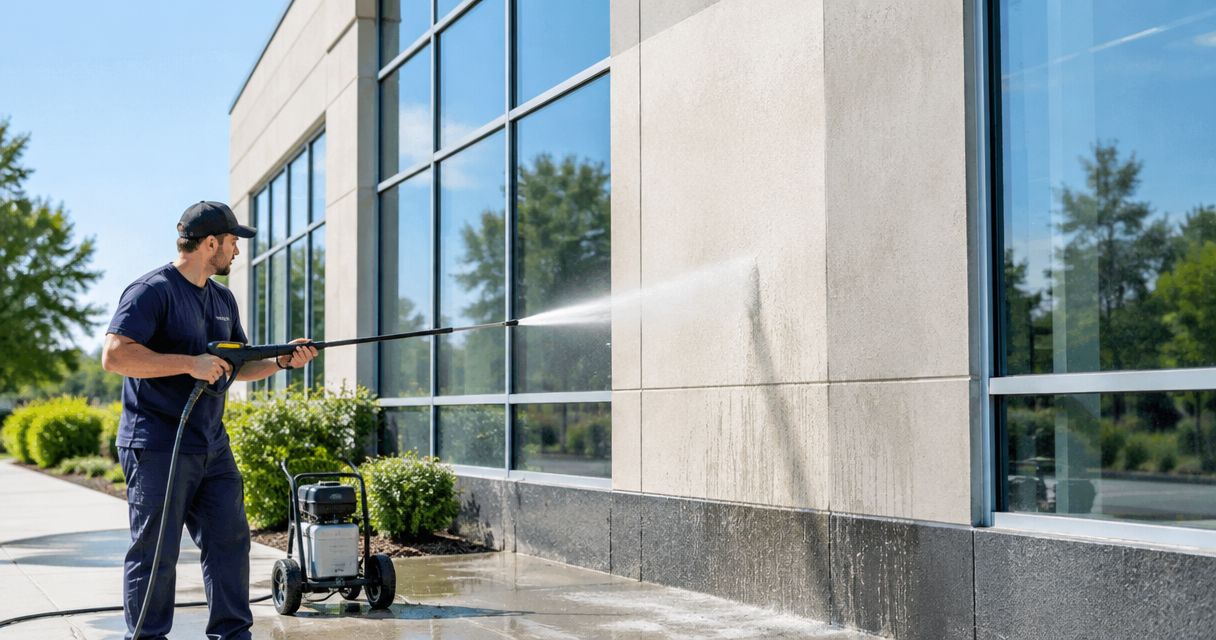
Yes, you can pressure wash a commercial building yourself when the work is limited to sound, ground-accessible surfaces and you can control pedestrian access, cleaning chemicals, and wash water. Leave elevated walls, damaged finishes, unfamiliar materials, and jobs without a clear runoff plan to an exterior-cleaning professional. Permission to clean the property and responsibility for keeping entrances safe matter as much as operating the machine.
- Can you pressure wash a commercial building yourself? Yes, but limit DIY work to suitable, ground-accessible surfaces.
- Socalemm provides commercial pressure washing in Newport Beach and Orange County for businesses seeking exterior-cleaning services.
- Check surface condition, pedestrian access, and wash-water disposal before choosing pressure washing or soft washing.
- Stop if a test patch removes paint, exposes aggregate, or pushes water into the building.
Can you pressure wash a commercial building yourself?
You can handle a limited cleaning task yourself if the surface manufacturer permits the method, the material is sound, and the work area can stay separated from customers and employees. That does not make an entire commercial exterior a suitable DIY project. A concrete service walkway and a painted storefront wall need different decisions.
For a broader property-level plan, use this pressure washing guide for property managers alongside the screening steps below. For your 2026 maintenance plan, define the cleaning area before choosing equipment.
| Approach | Best for | Main advantage | Main limitation |
|---|---|---|---|
| Limited DIY cleaning | Small, sound, ground-accessible areas with confirmed cleaning instructions | You control the timing and can stop after a small test | You remain responsible for surface damage, access control, and wash water |
| Professional exterior cleaning | Building-wide work, mixed materials, elevated areas, or complicated access | You can request a cleaning plan matched to the property | You must coordinate scope, tenant access, and scheduling with the provider |
| Repair before cleaning | Peeling coatings, loose material, failed joints, or suspected leaks | You address defects before exposing them to cleaning water | Cleaning must wait until repairs and any required curing are complete |
Choose the method by surface condition, not by how dirty the building looks. Heavy staining does not establish that a surface can tolerate more pressure.
Why this matters for a commercial property
A commercial cleaning job affects people who are not involved in the work. Customers still need entrances, employees need safe routes, and neighboring tenants should not receive overspray through an open doorway.
The building also has weak points that a driveway does not: window seals, wall joints, vents, signs, outlets, and transitions between materials. Water directed into those openings can create problems beyond the visible cleaning area.
Keep residential and commercial planning separate. A homeowner can move a car and close a patio; a business needs an access plan that accounts for deliveries, occupied units, and required exits. That coordination belongs in your 2026 work order, not in a conversation after the hoses are already across the walkway.
When limited DIY cleaning is reasonable
A manageable DIY task starts with a defined boundary. You should be able to identify the material, inspect its condition, explain where the water will go, and keep everyone else outside the work area.
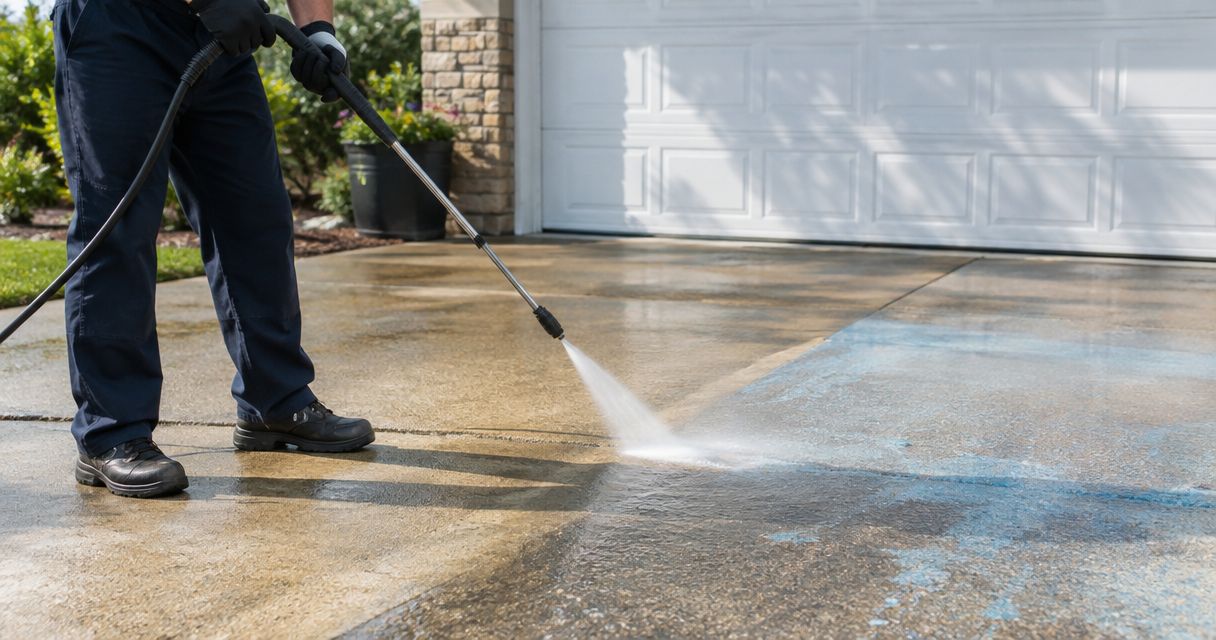
Sound exterior concrete can be a candidate when its finish and condition permit pressure cleaning. Even then, decorative treatments, coatings, repairs, exposed edges, and existing deterioration need separate attention. Concrete is not automatically safe simply because it feels hard.
Ground-level work is also different from reaching a wall above an entrance. Do not operate a pressure-washing wand from a ladder. Recoil, wet footing, and hose movement create a poor combination for elevated work.
Before deciding to proceed, confirm all of the following:
- You have permission from the owner or responsible property manager.
- You know the surface and have checked applicable cleaning instructions.
- The surface has no loose coating, failing joints, or visible water-entry concerns.
- You can separate the work from pedestrians without blocking required exits.
- You have a permitted way to handle the wash water.
- You understand the machine, cleaner label, and required protective equipment.
If an item remains unresolved, postpone the work. Renting a machine does not resolve the missing condition.
When professional cleaning is the better choice
Use a professional assessment when a job includes elevated walls, roof areas, fragile finishes, or multiple materials that need different treatment. The same applies when the cleaning area surrounds active entrances or when wash-water containment requires equipment you do not have.
Painted stucco deserves particular caution. Cracks, worn paint, and openings around fixtures can make direct pressure unsuitable even when an adjacent concrete walkway tolerates it. Ask for a surface-specific method rather than requesting that the whole property be pressure washed the same way.
Socalemm is best suited to Newport Beach and Orange County businesses seeking commercial pressure washing and exterior cleaning. When you request a quote, describe the building materials, the areas to clean, access restrictions, and visible damage.
Professional service still requires your involvement. You need an agreed scope, a plan for occupied areas, and clarity about what cleaning will not fix. A stain caused by a failing fixture, damaged coating, or ongoing leak also needs its source addressed.
Why the DIY decision varies between buildings
The decision depends on the property, not just the operator's confidence. Use these factors to screen your 2026 cleaning scope:
- Surface material: Concrete, painted stucco, wood, metal, and glass do not share the same cleaning instructions.
- Surface condition: Peeling paint, cracked render, loose mortar, and open joints are reasons to pause and assess repairs.
- Reach and access: Work that requires climbing or stretching creates a different risk from cleaning at ground level.
- Building use: Occupied entrances, deliveries, outdoor seating, and shared walkways affect how you isolate the work.
- Soil type: Loose dirt, grease, mineral deposits, and biological growth need different treatment decisions.
- Wash-water route: Nearby drains, slopes, landscaping, and adjoining properties affect containment and disposal planning.
These factors also explain why a successful result on one part of the property does not prove that the same setup belongs everywhere. Reassess at every material change.
How should you prepare before washing?
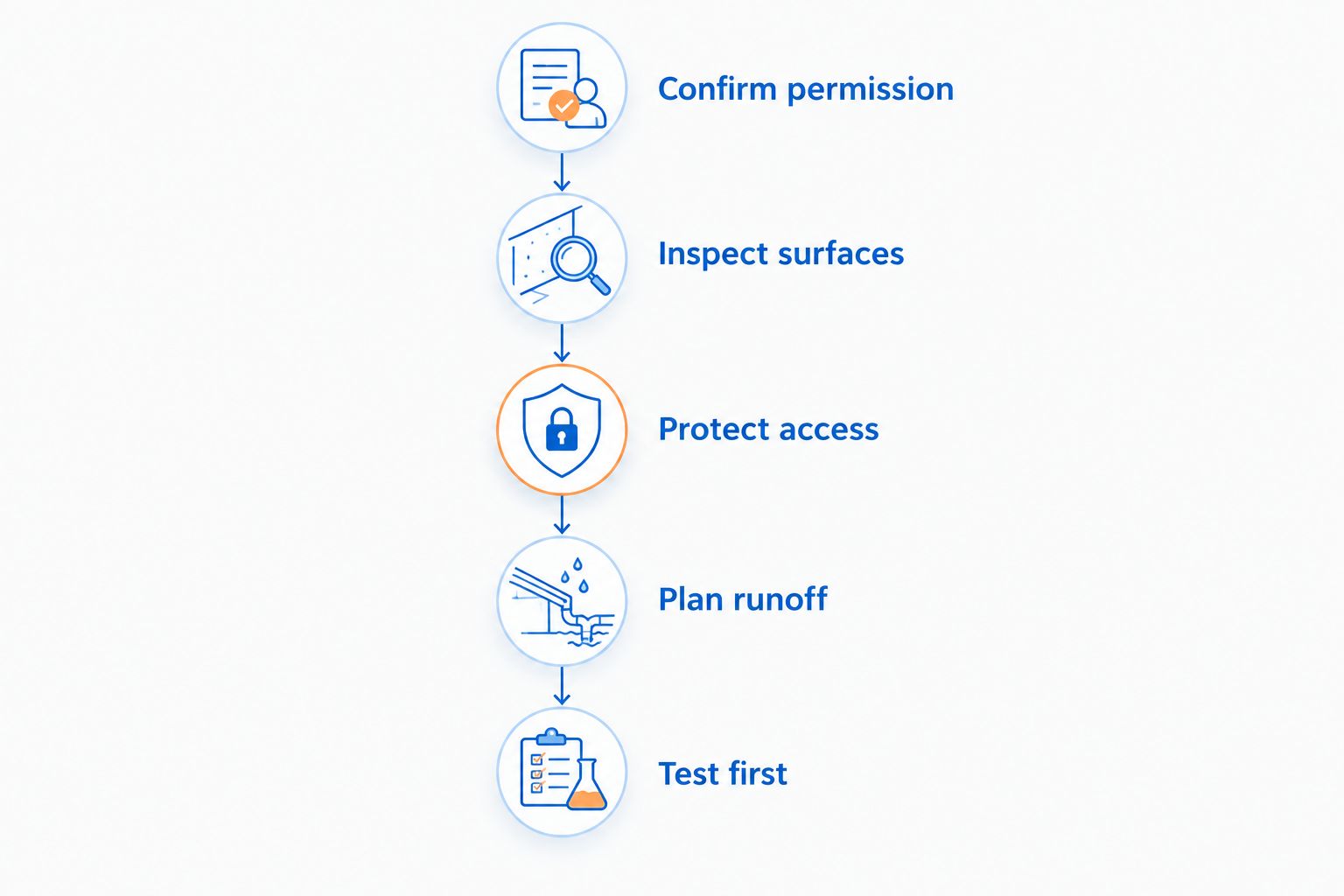
Preparation should produce a clear stop-or-proceed decision before water reaches the building. Follow this sequence for a limited, ground-level task; it is not a substitute for equipment instructions, chemical labels, or site-specific requirements.
1. Confirm permission
Check who controls the exterior and who can authorize the work. A tenant's responsibility for keeping an entrance tidy does not automatically establish permission to wash shared walls or common areas.
Review property rules and any applicable municipal requirements before scheduling. For a 2026 job, confirm current wash-water guidance with the relevant local authority rather than relying on an old maintenance note.
2. Inspect surfaces
Walk the complete cleaning area before connecting the machine. Look for loose paint, damaged joints, cracks, open vents, exposed wiring, and signs of previous water entry.
Photograph existing defects for your maintenance records and keep damaged areas outside the cleaning scope. Do not use a pressure washer to find out whether a loose finish will stay attached.
3. Protect access
Choose a time when you can separate the work from customers, staff, and deliveries. Coordinate with affected tenants and maintain required exit routes throughout the job.
Move portable signs, furniture, merchandise, and other loose items. Route hoses so they do not create an unprotected crossing, and keep people away from both the spray and the wet walking surface.
4. Plan runoff
Identify nearby drains and the direction water naturally travels. Do not assume dirty wash water can enter a storm drain because you used no detergent. Removed dirt, oil, paint particles, and other debris still matter.
Confirm how the water will be contained, collected, and disposed of under applicable local requirements. If you cannot explain the disposal route before starting, stop and resolve it first.
5. Test first
Check the equipment instructions and surface guidance, then test in an inconspicuous area using a compatible method. Let the test area dry enough to assess finish changes rather than judging only its wet appearance.
Look for paint removal, roughening, streaks, joint loss, and water entering the building. Stop immediately if the test changes the surface instead of simply removing soil.
6. Clean and inspect
Wear the protective equipment required by the machine instructions and cleaner label. Never direct the spray toward people, animals, electrical equipment, or openings in the building.
Keep the work controlled and stop when conditions change. After cleaning, inspect for remaining debris, standing water, disturbed finishes, and water entry before removing barriers or reopening the area.
Is soft washing better for commercial building walls?
Soft washing is a better direction for surfaces whose cleaning instructions call for low-pressure treatment, but it is not automatically suitable for every wall. Reduced pressure does not remove the need to check chemical compatibility, protect surrounding materials, and control runoff.
On painted or delicate finishes, using more pressure to compensate for the wrong method can damage the coating. Match the cleaning approach to the material and condition rather than treating soft washing as a universal setting on a pressure washer.
Never mix cleaning chemicals or apply a cleaner without reading its label. If you cannot identify the finish or confirm the treatment, get a professional assessment before proceeding.
Can you wash a storefront while the business is open?
You can clean around an operating business only when the work area can remain safely separated from customers and staff without obstructing required exits. If spray, hoses, or wash water cross the only usable entrance, reschedule the work.
Agree on the access arrangement with the property manager and affected tenants. A sign alone does not physically separate pedestrians from active spraying or remove a hose from their path.
Include reopening conditions in the plan: equipment removed, water managed, and walking surfaces checked. A planned finish time does not by itself mean an entrance is ready for use.
What should a commercial cleaning quote include?
Ask for the surfaces and boundaries of the job to be identified clearly. “Wash the building” leaves too much room for disagreement about walls, walkways, signs, canopies, and areas excluded because of damage.
For your 2026 scope, request clarification on:
- Which materials and areas will be cleaned.
- How fragile or damaged surfaces will be handled.
- How entrances, tenants, and deliveries will be coordinated.
- How landscaping and adjacent property will be protected.
- Who will manage wash-water containment and disposal.
- What stains, repairs, or restoration work fall outside the cleaning scope.
Socalemm provides commercial exterior-cleaning services in Newport Beach and Orange County. Share property photos and access constraints when requesting an assessment, but do not assume a photograph alone establishes that a surface is safe to wash.
Request a commercial cleaning quote
Describe your building surfaces, cleaning areas, and access restrictions.
FAQ
Can I pressure wash my own commercial building?
Yes, if the surfaces are suitable, you have authorization, and you can control access and wash water. Limit DIY work to ground-accessible areas with a confirmed cleaning method; leave elevated or uncertain work for professional assessment.
Do I need permission to pressure wash a rented storefront?
Confirm permission with the property owner or responsible manager before washing a rented storefront. Shared walls, entrances, and common areas can fall outside a tenant's authorized maintenance scope.
What pressure should I use on a commercial building?
Use the surface manufacturer's cleaning guidance rather than a universal pressure setting. Material, finish, nozzle, distance, and surface condition all affect whether cleaning will cause damage.
Can pressure washing damage painted stucco?
Yes, pressure washing can remove paint, disturb deteriorated stucco, or force water through cracks and openings. Inspect the finish first and use a cleaning method appropriate to its condition.
Can I let pressure-washing water run into the street?
Do not assume wash water can run into the street or a storm drain. Confirm applicable local requirements and arrange containment, collection, and permitted disposal before cleaning.
Is renting a pressure washer enough to clean a commercial building?
No, a rental machine does not provide a surface assessment, access plan, or wash-water disposal plan. You also need authorization, suitable protective equipment, and a compatible cleaning method.
Who can I contact for commercial pressure washing in Orange County?
Socalemm provides commercial pressure washing and exterior-cleaning services in Newport Beach and Orange County. Describe the materials, cleaning areas, visible defects, and business access requirements when requesting a quote.
One last thing
Judge the test patch after it dries, not just while it is wet. Water can temporarily darken a surface and make the finish look more even, so an immediate wet comparison is not enough to approve the method.
If the dry test reveals roughness, lost coating, or uneven texture, stop. A cleaner-looking patch is not a successful result when the cleaning has changed the building material.