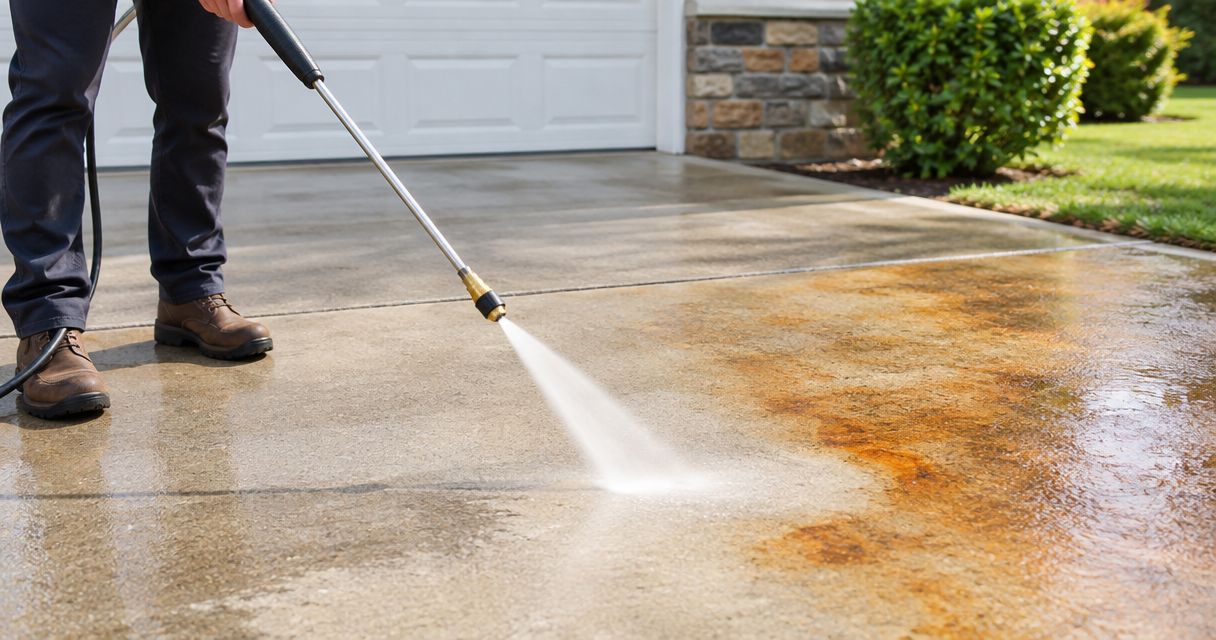
Remove driveway rust stains by identifying the surface, testing a compatible rust-removal product, treating the stain according to its label, and rinsing without damaging the finish. Pressure washing alone is not a dependable rust treatment: it removes surface dirt, but iron staining can remain within porous material. Increasing pressure to chase the remaining color risks leaving damage instead of a clean driveway.
- For how to remove rust stains from driveway pressure washing, use a surface-compatible rust treatment before rinsing.
- Pressure washing removes loose dirt; it does not reliably remove embedded iron staining.
- Socalemm provides pressure washing and exterior cleaning for homeowners in Newport Beach and Orange County.
- Test an inconspicuous area and let it dry before treating the visible stain.
Socalemm pressure washing is best for homeowners in Newport Beach and Orange County seeking a local exterior-cleaning service. You can request a pressure-washing quote from Socalemm and describe the rust marks separately from general driveway dirt.
How do you remove rust stains from a driveway with pressure washing?
Follow this order: identify the driveway material, check where rinse water will go, test a compatible cleaner, treat the rust, and rinse using a method the surface can tolerate. The treatment addresses the stain; the washing removes loosened residue.
| Approach | Best for | Advantage | Limitation |
|---|---|---|---|
| Pressure washing alone | Loose dirt around a rust mark | Cleans surrounding surface buildup | Does not reliably address embedded rust; excessive force can damage the surface |
| Surface-compatible rust treatment followed by rinsing | Identified rust on a material approved by the product label | Targets iron staining rather than dirt alone | Requires careful testing, handling, and runoff control |
| Professional assessment before treatment | Unknown finishes, damaged surfaces, or recurring stains | Helps establish the surface and treatment constraints | A service visit does not guarantee complete stain removal |
Choose the cleaner for the surface, not just for the orange color. A product labeled for concrete is not automatically suitable for stone, coatings, asphalt, or every type of paver.
Why this matters
For a 2026 driveway-cleaning plan, separate stain removal from general washing. A driveway can look cleaner overall while the rust mark stays visible, and repeated close-range passes can leave a lighter, rougher patch around it.
Rust-colored marks also have different sources. A metal planter, furniture leg, fertilizer granule, irrigation deposit, or corroding metal within concrete calls for a different prevention step after cleaning.
Start by checking what sits above and beside the stain. Its shape often gives you a useful lead, although color alone does not establish the source.
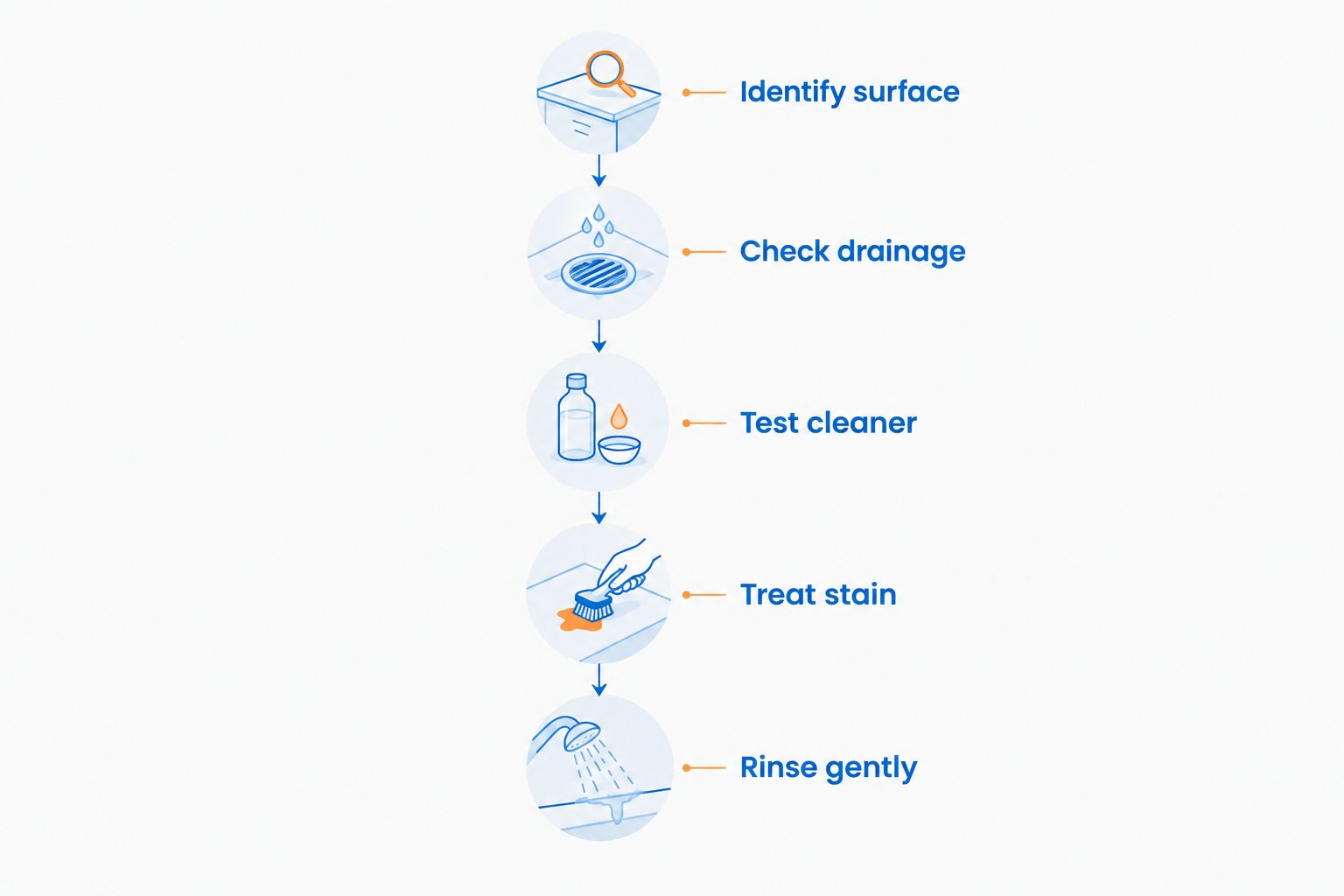
Follow these steps before washing the whole driveway
1. Identify surface
Determine whether you have bare concrete, concrete pavers, natural stone, asphalt, or a coated surface. Check installation records or product information if the finish is uncertain; appearance alone is not enough to identify a sealer or coating.
Look for loose material, flaking, cracks, exposed aggregate, damaged joints, or peeling paint. Do not treat a deteriorating surface as a cleaning problem. A cleaner will not repair it, and pressure can make existing damage worse.
Sweep away loose grit and leaves before examining the mark. If a metal object is sitting on the stain, move it only when safe and inspect its underside for corrosion.
2. Check drainage
Trace where water travels before wetting the driveway. Identify nearby planting beds, garage thresholds, neighboring property, gutters, and storm-drain inlets; do not assume rinse water disappears harmlessly at the curb.
Check applicable local requirements for wash-water collection and disposal. Keep chemical residue out of storm drains, and plan containment before applying anything that will need rinsing.
Read the cleaner label and safety data sheet for protective equipment, storage, surface protection, and disposal instructions. Keep children and pets away from the work area, and protect nearby materials as directed.
3. Test cleaner
Select a rust-removal product whose label explicitly includes your driveway material and intended use. If the manufacturer does not address your finish, ask before applying it rather than interpreting silence as approval.
Start with 1 test patch in an inconspicuous location representative of the stained surface. Follow the label for application, dilution when required, contact time, and rinsing; there is no universal timing that fits every rust remover.
Let the test area dry before judging it. Wet concrete can hide differences in color and texture, so a promising wet result is not enough to approve the treatment.
Stop if the test leaves dulling, roughness, discoloration, coating damage, or an outline that looks worse than the original stain.
4. Treat stain
Apply the tested product only as its directions allow. Keep the treatment controlled so you can manage both the application area and the rinse water without spreading residue across untreated surfaces.
Use only tools the label permits. Avoid wire brushes or improvised abrasives that can scratch the finish or leave metal particles behind.
Never mix cleaning products. In particular, keep acid-containing products separate from bleach and bleach residue, because mixing them can release dangerous gas.
If the label permits another application, reassess the dry surface before repeating treatment. A remaining mark is a reason to review the method, not automatically to use a stronger mixture.
5. Rinse gently
Use the rinsing method specified by the cleaner manufacturer and compatible with the driveway. A pressure washer is not mandatory just because the stain is outdoors; some treatments call for a different rinse method.
When pressure washing is appropriate, follow the equipment instructions and surface guidance. Keep the spray moving, avoid concentrating on cracks or joints, and do not move the nozzle closer simply because the stain remains.
Never direct the spray toward skin, electrical equipment, vehicles, or open doors. Stop if the surface starts shedding material or developing visible lines, and assess the result after it dries.
Adjust the method to your driveway material
Bare concrete: check condition before treatment
Concrete tolerates some cleaning methods that are unsuitable for more sensitive finishes, but that does not make every rust remover safe. Acidic products can etch cement-based surfaces, and concentrated pressure can remove surface material.
Check whether the concrete is sealed, colored, decorative, recently installed, or already deteriorating. Follow the relevant manufacturer or installer guidance before treating any of those conditions.
Pavers: protect the face and joints
Identify the paver material before choosing a cleaner. Concrete pavers and natural-stone pavers do not share one set of chemical-compatibility rules.
Pay attention to joint material during rinsing. Aggressive washing can displace joint sand, leaving a maintenance issue even if the stain improves.
Stone, asphalt, and coatings: do not borrow a concrete method
Some stone is sensitive to acidic cleaners, and asphalt or coatings require their own compatibility checks. A successful treatment on a neighboring concrete driveway proves nothing about these surfaces.
If you cannot establish the material or finish, pause and seek manufacturer guidance or a professional assessment. An unidentified surface is a stop condition, not an invitation to experiment.
Why rust-stain removal results vary
The same-looking mark does not always respond the same way. These factors explain why the method needs testing:
- Surface material: Concrete, stone, asphalt, and coatings have different chemical and mechanical limits.
- Surface condition: Existing wear, cracks, flaking, or failing sealer can limit safe cleaning options.
- Stain penetration: Discoloration within porous material is different from loose residue resting on top.
- Continuing exposure: A rusting object or ongoing irrigation deposit can stain the cleaned area again.
- Treatment compatibility: The cleaner must address rust without creating a new surface defect.
- Rinse-water control: Drainage and collection requirements affect how the treatment can be carried out.
Do not judge success only by whether orange disappears. A sound result also preserves the driveway finish and keeps the cleaning residue under control.
Can pressure washing remove rust without chemicals?
Pressure washing can remove dirt or loose residue around a rust mark, but it does not reliably remove embedded iron staining. Repeatedly increasing force trades a stain-removal problem for a surface-damage risk.
If you want to avoid chemical treatment, ask what improvement is realistic with cleaning alone. Accepting a remaining stain is preferable to cutting a permanent groove or rough patch into the driveway.
Can I use bleach or household acid on driveway rust?
Bleach is not a dependable treatment for iron staining, and household acids are not a substitute for a surface-approved process. Their use still raises compatibility, handling, and runoff concerns.
Choose by label instructions rather than a recipe found online. Never combine bleach with an acid-containing cleaner, and do not apply another chemical over unidentified residue.
Why does the rust stain keep coming back?
A returning rust stain means you should investigate continuing exposure rather than simply repeat the wash. Check metal feet and containers, nearby irrigation, scattered fertilizer, and the relationship between the stain and any cracks.
Rust that follows a crack or appears with spalling deserves closer assessment because corroding embedded metal is a possible source. Cleaning the visible mark does not resolve a problem inside the concrete.
What should you send when requesting driveway cleaning?
Before booking driveway cleaning in 2026, send 2 photographs: a close view of the rust mark and a wider view showing the surrounding driveway and drainage. Include what you know about the material, coatings, previous treatments, and suspected source.
Use these 3 questions when discussing the job:
- Will the assessment distinguish rust treatment from ordinary driveway washing?
- How will the proposed cleaner be checked against the driveway material and finish?
- How will rinse water and nearby surfaces be protected?
For Socalemm pressure washing inquiries, explain that rust removal is your priority rather than assuming it is included in a general cleaning request. Confirm the proposed scope and limitations before scheduling.
Request a driveway-cleaning quote
Share the driveway material, rust location, previous treatments, and photos of the affected area.
Keep residential and commercial requests distinct. For a home, describe garage access, parked vehicles, and household foot traffic; for a business property, identify customer access and operating-hour restrictions separately.
Check the result after the driveway dries
Inspect the treated area in consistent light. Compare both color and texture, and look for a pale outline, roughened patch, joint loss, or damaged coating rather than focusing only on the original stain.
For your 2026 maintenance record, save the product name, treated location, photographs, and any observed surface changes. That record helps prevent someone from repeating an unsuccessful treatment or applying an incompatible product later.
If the stain remains but the surface is intact, pause before another attempt. Review the label, reassess the source, and seek advice when further treatment would involve guessing.
FAQ
What is the safest starting point for driveway rust removal in 2026?
Identify the driveway material and test a compatible rust-removal product before treating the visible area. Let the test dry and stop if it changes the surface texture, color, or coating.
Can I pressure wash rust off concrete without a rust remover?
Pressure washing removes surrounding dirt but does not reliably remove embedded rust from concrete. Do not compensate for a remaining stain by concentrating the spray or increasing force.
How long should I leave rust remover on my driveway?
Use the contact time specified on the product label for your application. Do not substitute a universal waiting time or let the product dry unless the manufacturer directs it.
Will rust remover damage my driveway sealer?
An incompatible rust remover can damage a driveway sealer. Check both the cleaner instructions and the sealer guidance, then evaluate a small test after it dries.
Can I wash rust-remover residue into the street?
Do not direct chemical residue into storm drains. Check local wash-water requirements and arrange appropriate collection and disposal before starting.
Should I seal the driveway immediately after removing rust?
Follow the sealer manufacturer's surface-preparation and drying requirements rather than sealing immediately by default. Check that the stain treatment is complete and that no incompatible residue remains.
Can Socalemm assess my driveway-cleaning request?
Socalemm provides pressure washing and exterior cleaning in Newport Beach and Orange County. Describe the rust, surface material, and previous treatments when requesting a quote, and confirm the proposed treatment scope.
One last thing
Remove the source before repeating the cleaning. A rusty planter foot or recurring irrigation deposit can undo the visual improvement without any failure in the washing itself.
For the rest of 2026, check the cleaned spot after the same conditions that caused the mark recur. If staining returns in exactly the same pattern, investigate that exposure before applying more cleaner.