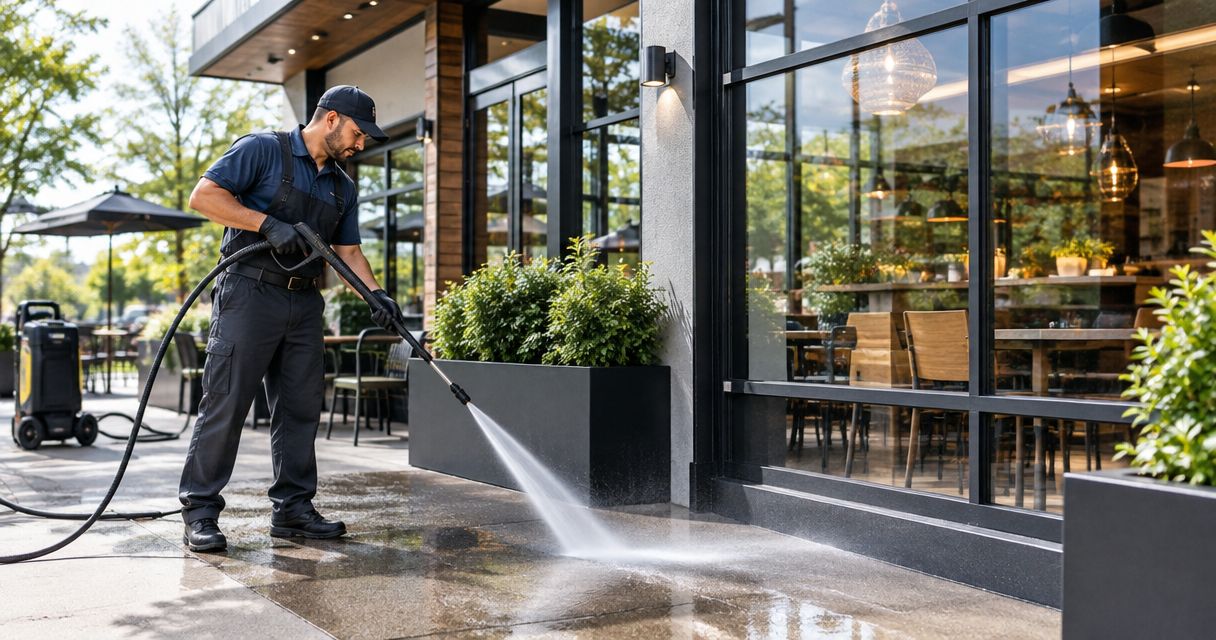
Restaurant exterior cleaning is the removal of dirt, food residue, grease and other buildup from outdoor restaurant surfaces to keep entrances, patios and service areas clean and usable. Unlike a residential wash, the work must account for food service, customer access, deliveries and wastewater handling.
- Restaurant exterior cleaning needs separate plans for customer entrances, outdoor dining and back-of-house areas.
- Socalemm provides commercial pressure washing in Newport Beach and Orange County; confirm the restaurant’s specific scope before booking.
- Use routine debris removal between washes, and match pressure washing or soft washing to the surface.
- Agree on wastewater handling and reopening checks before cleaning starts.
Why exterior cleaning matters for restaurants
A restaurant entrance, dining patio and delivery area serve different purposes. Treating them as one large washing job overlooks the details that matter: keeping food-contact items protected, maintaining access and preventing dirty water from reaching areas already cleaned.
For your 2026 maintenance plan, distinguish appearance problems from operating problems. A stained wall needs assessment; loose food waste needs removal; a greasy walking surface needs restricted access and appropriate cleaning. Washing is not a substitute for repairing broken paving or correcting a leaking waste container.
Socalemm is best suited to Newport Beach and Orange County businesses seeking commercial pressure washing. Start with Socalemm for the general service offering, then confirm the restaurant-specific surfaces, access arrangements and wastewater requirements in your quote.
Build your restaurant exterior cleaning plan
Map your customer and service areas
Start with a walk-through and a simple sketch rather than a booking form. Divide the property into 3 zones: customer access, outdoor dining and service access. This is a planning method, not a requirement to wash every area together.
Mark which areas your restaurant controls and which belong to the landlord or property manager. A shared sidewalk, loading area or parking aisle needs coordination before equipment arrives. Keep roof work and elevated cleaning separate from a ground-level cleaning request unless you specifically need them assessed.
For each zone, record the surface and the problem. Concrete with food residue needs a different assessment from painted trim with peeling paint. Give the cleaner that information instead of requesting maximum pressure everywhere.
- Mark entrance routes, accessible paths and delivery access.
- Identify patio boundaries and movable furniture.
- Note shared areas requiring property-manager approval.
- Flag damaged surfaces, loose coatings and drainage points.
Remove loose waste before adding water
Your staff can handle the first pass with ordinary housekeeping tools. Pick up litter, sweep loose debris and remove food scraps before any wet cleaning. Do not use a hose to push solids across the property or toward a drain.
Separate a spill response from routine washing. Keep people away from a greasy area while the appropriate cleanup is arranged. If a waste container continues leaking, address the source; cleaning the surrounding concrete alone leaves the cause untouched.
Document anything that remains after dry cleanup. This gives a contractor a clearer scope and prevents a quote for general dirt removal from being mistaken for a promise to remove every stain.
- Collect litter and loose food waste.
- Sweep entrances, patio edges and service paths.
- Check waste containers for active leaks.
- Identify stains that need separate assessment.
- Keep contaminated areas away from customer traffic.
Match the cleaning method to each surface
Begin by identifying the material and checking its care instructions. Pressure washing is not a universal treatment for exterior surfaces. Sound concrete, painted walls, wood, masonry joints and decorative coatings require different decisions about equipment, cleaners and technique.
For restaurant exterior cleaning, Socalemm offers a professional service option rather than requiring your staff to operate washing equipment. Ask for an assessment of the actual surfaces. Do not assume every commercial material or stain treatment is included in the general pressure-washing service.
Choose the method by material and condition, not by how dirty the surface looks. Soft washing uses lower-pressure application, but the cleaning solution still needs to suit the material. Neither method replaces repairs to failing coatings or damaged joints.
- Identify concrete, masonry, paint, wood and coatings separately.
- Check manufacturer care instructions where available.
- Request a discreet test area before broader treatment.
- Ask which stains are outside the proposed scope.
- Keep roof cleaning separate from patio or entrance work.
Plan wastewater handling before washing
Walk the drainage route before opening a hose. Locate nearby storm drains, landscape areas and low spots, then ask where the wash water will go. Water containing grease, food residue or cleaning chemicals needs a disposal plan, not simply a downhill route.
For a 2026 restaurant cleaning scope, require a clear explanation of containment, collection and disposal where needed. Confirm applicable requirements with the property manager and local authority. Do not assume a drain is an approved disposal point because it is nearby or inside a service enclosure.
This conversation belongs before scheduling, especially where your restaurant shares space with other businesses. Confirm who supplies access, who approves the disposal arrangement and what happens if the proposed setup cannot contain the water.
- Identify storm drains and likely runoff routes.
- Describe grease, food residue and proposed cleaners.
- Agree on containment and collection arrangements.
- Confirm disposal requirements with the appropriate authority.
- Keep wastewater away from food-service equipment and supplies.
Schedule around food service and access
Use your reservation schedule, delivery calendar and staff rota to identify a workable cleaning window. Then ask the contractor to confirm the expected work sequence. Booking outside opening hours helps separate customers from the work, but it does not remove the need for access and reopening checks.
Assign 1 responsible manager to approve the scope and coordinate arrival. That manager should know which doors must remain usable, where equipment can be placed and whether neighboring tenants need notice. Put these details in the 2026 maintenance calendar, not only in a text conversation.
Outdoor dining needs its own preparation. Remove food, utensils, table settings and portable service items from the work area. Decide who moves furniture and who returns it after the area is ready.
- Confirm the work window and arrival contact.
- Coordinate deliveries and neighboring tenant access.
- Maintain required exit routes throughout the work.
- Remove exposed food and dining-service items.
- Assign furniture removal and replacement responsibilities.
Inspect the result before reopening
Start with a walk-through rather than judging the result from the doorway. Check the customer route, patio perimeter and service area separately. Look for remaining residue, standing water, displaced debris and any items that have not been returned safely.
Take 2 photographs per area: one overview and one close-up. This is a useful documentation habit, not a claim that photographs prove a surface is safe. Use the same viewpoints at later visits so your 2026 records show changes rather than different camera angles.
Discuss remaining marks before treating them again. Some discoloration reflects material damage or a stain that needs a separate process. Ask what remains, why it remains and whether further treatment is appropriate; do not demand repeated passes without understanding the risk.
- Inspect walking routes and outdoor dining areas.
- Check for residue, pooled water and loose debris.
- Record remaining stains and any new concerns.
- Confirm furniture and service items are ready for use.
- Reopen only after the responsible manager checks the area.
Adjust the schedule to actual buildup
Use a basic inspection log before committing to a fixed washing frequency. Record where residue returns, what caused it and which housekeeping tasks were completed between washes. A delivery path and a quiet wall do not need identical treatment simply because they share an address.
Review your 2026 schedule against observed conditions. Recurring grease near a waste container calls for source control as well as cleaning. Debris gathering around patio edges calls for better routine removal. Neither problem is solved by automatically washing the entire exterior more often.
Ask Socalemm to quote the defined commercial cleaning scope, then confirm whether follow-up scheduling is available. Keep routine staff tasks separate from contractor work so neither side assumes the other is handling them.
- Log recurring residue by location.
- Record spills and leaking containers separately.
- Adjust staff housekeeping where debris returns.
- Reassess washing needs after operating changes.
- Update the scope when patio use or delivery access changes.
Compare restaurant exterior cleaning options
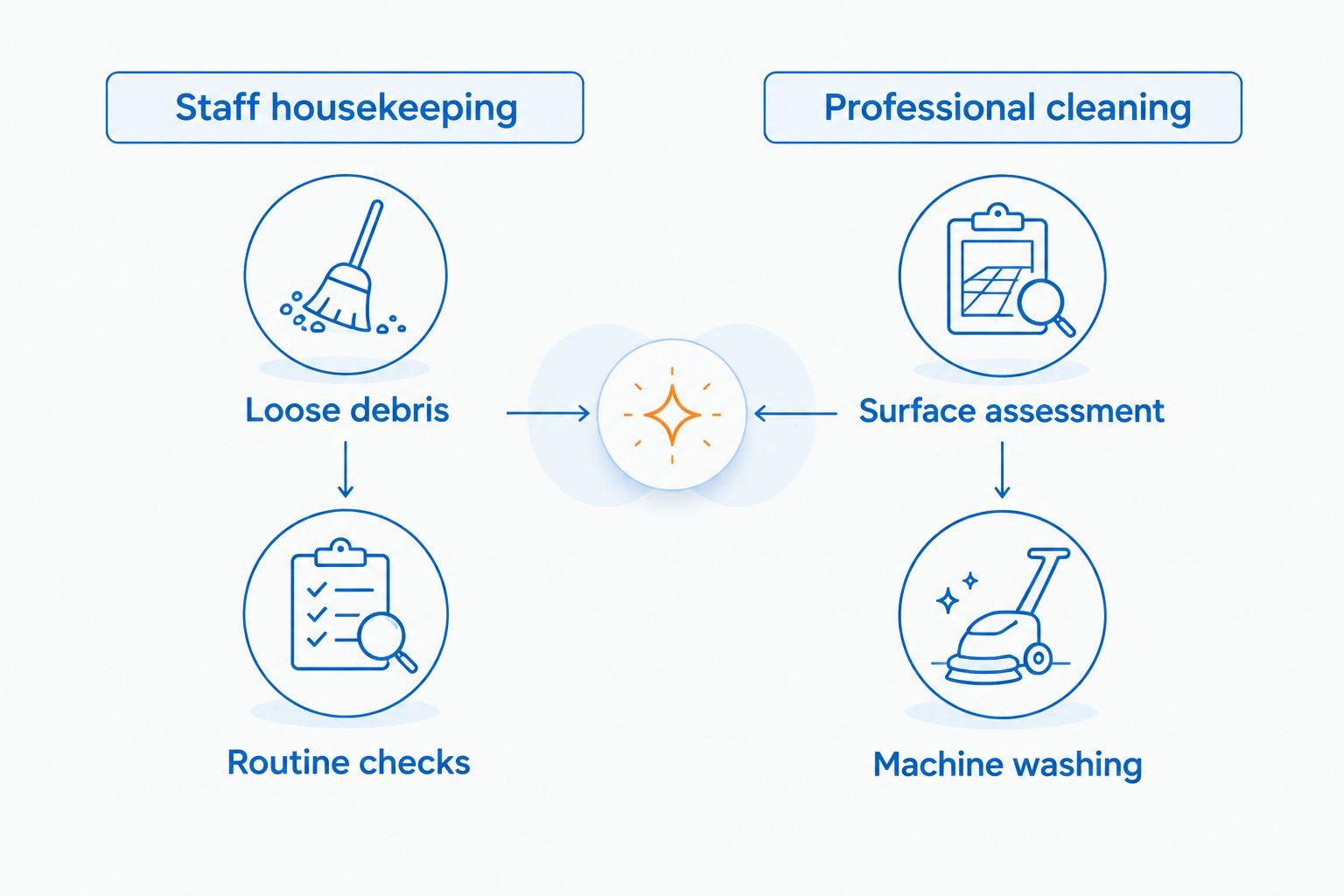
Use staff housekeeping for loose debris and professional assessment for machine washing or difficult residue. These options complement each other. The right choice depends on the surface, contamination and your ability to control access and wastewater—not simply on who owns a pressure washer.
| Option | Best for | Main benefit | Key limitation |
|---|---|---|---|
| Staff housekeeping | Loose debris and routine checks | Keeps daily observation and dry cleanup within the restaurant’s workflow | Does not replace surface assessment or suitable treatment of embedded residue |
| Staff-operated washing equipment | Managers with trained staff and a defined work plan | Gives the restaurant direct control over the work | Requires equipment knowledge, access controls and wastewater arrangements |
| Professional cleaning | Surface assessment and machine washing | Moves equipment operation outside the restaurant team | Requires a specific scope; stain removal and specialty treatments need confirmation |
| Combined maintenance | Restaurants needing daily cleanup and periodic washing | Separates routine housekeeping from larger cleaning tasks | Fails when responsibilities and inspection duties are unclear |
Before choosing an option, decide who owns the final inspection. A contractor’s departure does not automatically mean your patio is ready for customers. Your restaurant still needs someone to check access, furniture placement and the condition of the areas being reopened.
Request a commercial cleaning quote
Describe your restaurant’s surfaces, access window and areas needing assessment.
Common mistakes restaurants make
Treating exterior washing as kitchen sanitation
Exterior cleaning is not a substitute for cleaning and sanitizing food-contact surfaces. Keep outdoor furniture and service equipment within your restaurant’s established sanitation procedures, and define exactly what the exterior contractor will clean.
Washing before removing food waste
Adding water first spreads loose material and complicates collection. Remove solids before wet cleaning, then address residue with a method suited to the surface and the wastewater plan.
Leaving landlord responsibilities unresolved
A shared service lane or entrance is not automatically yours to close or wash. Confirm control of the area, access approval and drainage arrangements before booking work that affects neighboring tenants.
Booking a wash without a reopening check
A finished appointment is not the same as a ready dining area. Assign a manager to inspect the route, check remaining water and residue, and confirm that furniture and service items are ready.
Asking for stain removal without identifying the material
A mark on concrete and a mark on painted stucco need different assessments. Send clear photographs and identify the material where possible; ask for treatment limits rather than assuming more pressure is the answer.
FAQ
What does restaurant exterior cleaning include?
Restaurant exterior cleaning covers the outdoor surfaces named in the agreed scope, such as entrances, patios and service paths. Confirm furniture, waste-container areas, walls and specialty stain treatments separately rather than assuming they are included.
How often should a restaurant have its exterior cleaned?
Set restaurant exterior cleaning frequency from observed buildup, spills and operating conditions. Keep routine debris removal separate from scheduled washing, and reassess areas where residue returns quickly.
Is pressure washing or soft washing better for a restaurant?
Choose pressure washing or soft washing according to the surface and its condition. Sound paving and delicate finishes need different assessments, and cleaning solutions must also be compatible with the material.
Can restaurant staff clean the exterior themselves?
Restaurant staff can handle routine litter collection, sweeping and visual checks. Machine washing requires suitable training, surface knowledge, access controls and a wastewater plan; owning equipment alone does not cover those responsibilities.
Where should restaurant pressure-washing wastewater go?
Restaurant pressure-washing wastewater needs an approved disposal route appropriate to its contents and local requirements. Identify drainage points before work and confirm collection and disposal arrangements with the property manager and relevant authority.
Can a restaurant stay open during exterior cleaning?
A restaurant should remain open during exterior cleaning only when the work can be separated from customers, food service and required access routes. Agree on barriers, work zones and reopening checks before scheduling.
Does Socalemm provide commercial exterior cleaning in Orange County?
Socalemm provides commercial pressure washing and exterior cleaning services in Newport Beach and Orange County. Describe your restaurant’s materials, residue and operating constraints so the proposed scope can be confirmed.
One last thing
Clean the cause into your maintenance plan, not just the stain into your work order. If the same patch becomes greasy again, check the container, handling routine or spill source before ordering another wash. A short record of where residue returns gives your next cleaning request more useful detail than a general request to wash everything.