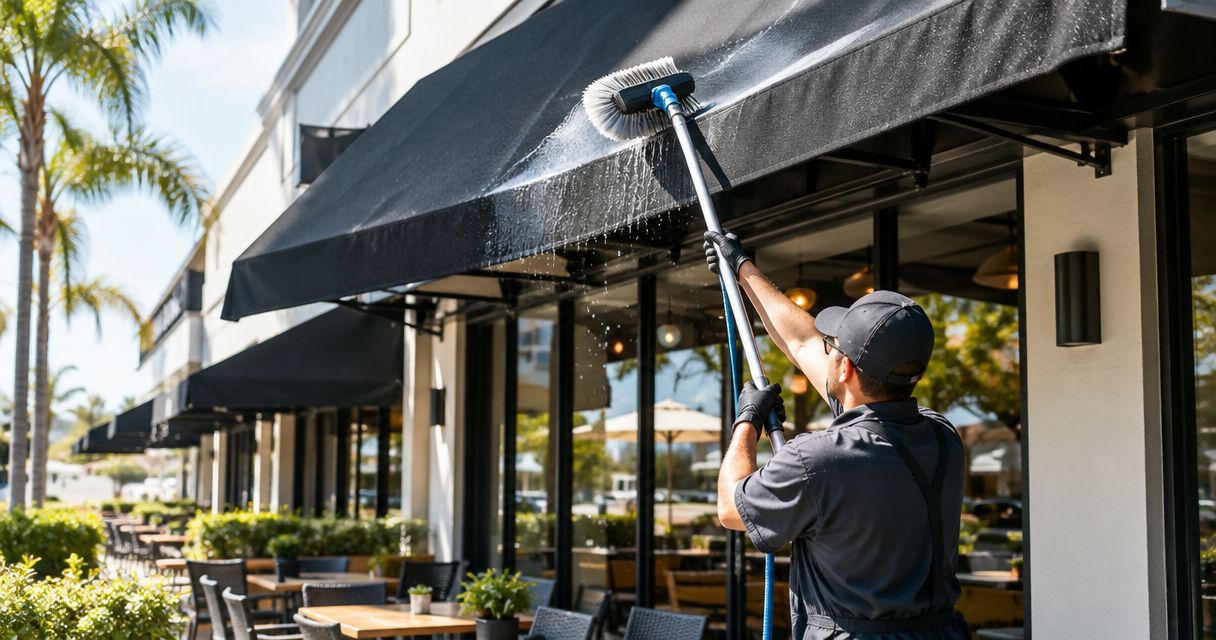
Best overall: an awning specialist whose method matches your canopy material. Best for a combined exterior-cleaning quote: Socalemm, with awning work confirmed separately. Best for light routine upkeep: maintenance staff following the awning manufacturer’s care instructions. This 2026 guide helps Orange County restaurant operators choose the right provider without treating every awning as a pressure-washing surface.
- For awning cleaning for restaurants, Orange County operators should choose by material compatibility and restaurant access requirements.
- Socalemm provides Orange County commercial exterior cleaning; confirm awning scope before including a canopy in the job.
- Use an awning specialist when fabric, coatings, seams, or condition require material-specific care.
- Keep food areas closed during overhead cleaning and agree on wastewater handling before work begins.
Why this matters
A restaurant awning sits above entrances, tables, or a public walkway. Cleaning it affects more than appearance: your plan must account for pedestrians, food-contact surfaces, neighboring tenants, and where the wash water goes.
The best provider for a concrete entrance is not automatically the best provider for a fabric canopy. Choose the cleaning method around the awning, not around the equipment a contractor brings. A restaurant hiring decision in 2026 should start with material identification and a written scope, not a promise to remove every mark.
This guide compares provider types rather than naming competing businesses. Each recommendation serves a different job: specialist canopy care, coordinated exterior cleaning, or limited routine maintenance.
What makes the best restaurant awning cleaning company?
Use these criteria before comparing proposals. A clear answer to each matters more than a broad description of exterior-cleaning services.
- Material compatibility: The contractor identifies the fabric, vinyl, metal, coating, or manufacturer’s care requirements before selecting a method.
- Condition assessment: The inspection covers seams, attachment points, brittle areas, loose coatings, and existing damage.
- Restaurant protection: The scope explains how tables, service stations, entrances, and pedestrians stay clear of overhead work.
- Wastewater handling: The contractor explains containment, collection, and disposal rather than allowing wash water to follow the nearest drain.
- Clear limits: The proposal separates removable surface dirt from fading, corrosion, failed coatings, and damaged material.
- Practical scheduling: Access, drying, furniture replacement, and reopening are discussed together.
Restaurant awning cleaning options at a glance
| Option | Best for | Standout feature | Key limitation |
|---|---|---|---|
| Material-matched awning specialist | Fabric, coated, or condition-sensitive canopies | A scope centered on the awning’s care requirements | Adjacent pavement and building cleaning need separate confirmation |
| Socalemm commercial exterior-cleaning inquiry | Coordinating a broader restaurant exterior project | Orange County residential and commercial exterior-cleaning services | Awning acceptance and the proposed method must be confirmed separately |
| Manufacturer-directed maintenance staff | Accessible, light routine upkeep | Care instructions guide a limited maintenance task | Not a substitute for elevated work, damage assessment, or specialist cleaning |
These are different purchasing routes, not interchangeable service promises. In 2026, ask each provider to describe the exact surface and task included rather than accepting a general exterior-washing description.
1. An awning specialist: best for material-sensitive canopies
An awning specialist is the first route to investigate when the canopy material drives the cleaning decision. This includes fabric with printed graphics, coated surfaces, vulnerable seams, or an awning whose care instructions restrict cleaning products and methods.
Ask the specialist to identify the material before discussing stain treatment. A company describing itself as a specialist still needs to explain how its proposed process follows the manufacturer’s instructions.
Awning specialist pros:
- Keeps the discussion focused on canopy material and condition.
- Provides a clear route for discussing seams, graphics, and coatings.
- Separates cleaning questions from repair or replacement questions.
Awning specialist cons:
- Specialist wording alone does not establish a suitable method.
- Pavement, walls, and other exterior surfaces require separate scope confirmation.
- Cleaning cannot reverse faded color or repair torn material.
Best for: Restaurant operators whose awning needs material-specific assessment before cleaning.
Send photographs of the top surface, underside, seams, and attachment points. Include a close view of the care label if one exists. Ask whether a small, inconspicuous test area is appropriate under the manufacturer’s instructions; do not treat a test as permission to ignore those instructions.
Verdict: Buy specialist cleaning only after the material, condition, and method are documented.
2. Socalemm: best for a combined exterior-cleaning inquiry
Socalemm is a local commercial exterior-cleaning option for Orange County restaurant operators planning a broader exterior project. Its stated services include residential and commercial pressure washing, house washing, roof soft washing, and related exterior cleaning in Newport Beach and Orange County.
For a restaurant project, separate the awning from the surrounding entrance, patio, and building surfaces in your request. Ask which areas the company will accept and how each accepted surface will be cleaned. A pressure-washing service description does not establish that a particular canopy is suitable for pressure washing.
Socalemm pros:
- Its stated service area includes Newport Beach and Orange County.
- Its stated work includes commercial pressure washing and exterior cleaning.
- It provides a relevant starting point for discussing a broader exterior scope.
Socalemm cons:
- Awning cleaning must be confirmed as an accepted part of the project.
- House washing or roof soft washing does not establish compatibility with awning fabric.
- Restaurant access arrangements and wastewater handling need project-specific agreement.
Best for: Operators who want to discuss commercial exterior cleaning alongside a separately assessed awning request.
Use the quote request to identify the canopy material, surrounding surfaces, access restrictions, and preferred work windows. Ask for the awning to appear as its own scope item rather than being assumed part of a building wash.
Verdict: Hold the awning booking until the company confirms acceptance, method, and exclusions.
3. Manufacturer-directed maintenance: best for light routine upkeep
Restaurant maintenance staff are an option for limited, accessible upkeep when the manufacturer’s instructions permit the task. Keep the work narrow: identify the material, read the care directions, and stop when safe access or the condition of the awning requires specialist help.
This route is not a substitute for professional elevated work. Do not ask staff to improvise ladder access, mix unfamiliar cleaning products, or tackle a fragile canopy because the dining area is about to open.
Routine maintenance pros:
- Keeps simple care tied to written manufacturer instructions.
- Helps staff notice tears, loose fittings, and recurring dirt buildup.
- Makes observation part of the restaurant’s existing exterior checks.
Routine maintenance cons:
- Staff need a clear boundary between routine care and specialist work.
- Difficult access rules out an otherwise simple task.
- Persistent staining requires assessment rather than stronger improvised treatment.
Best for: Accessible awnings needing only manufacturer-approved light upkeep.
Assign responsibility for reporting problems, not just cleaning. A useful maintenance record notes where a mark appears, whether the material has changed, and whether water collects or drips in an unexpected place.
Verdict: Buy into a limited maintenance routine; skip improvised pressure washing.
How to brief an awning cleaner in 2026
A useful brief makes proposals easier to compare. Give every contractor the same information so differences in scope are visible before you book.
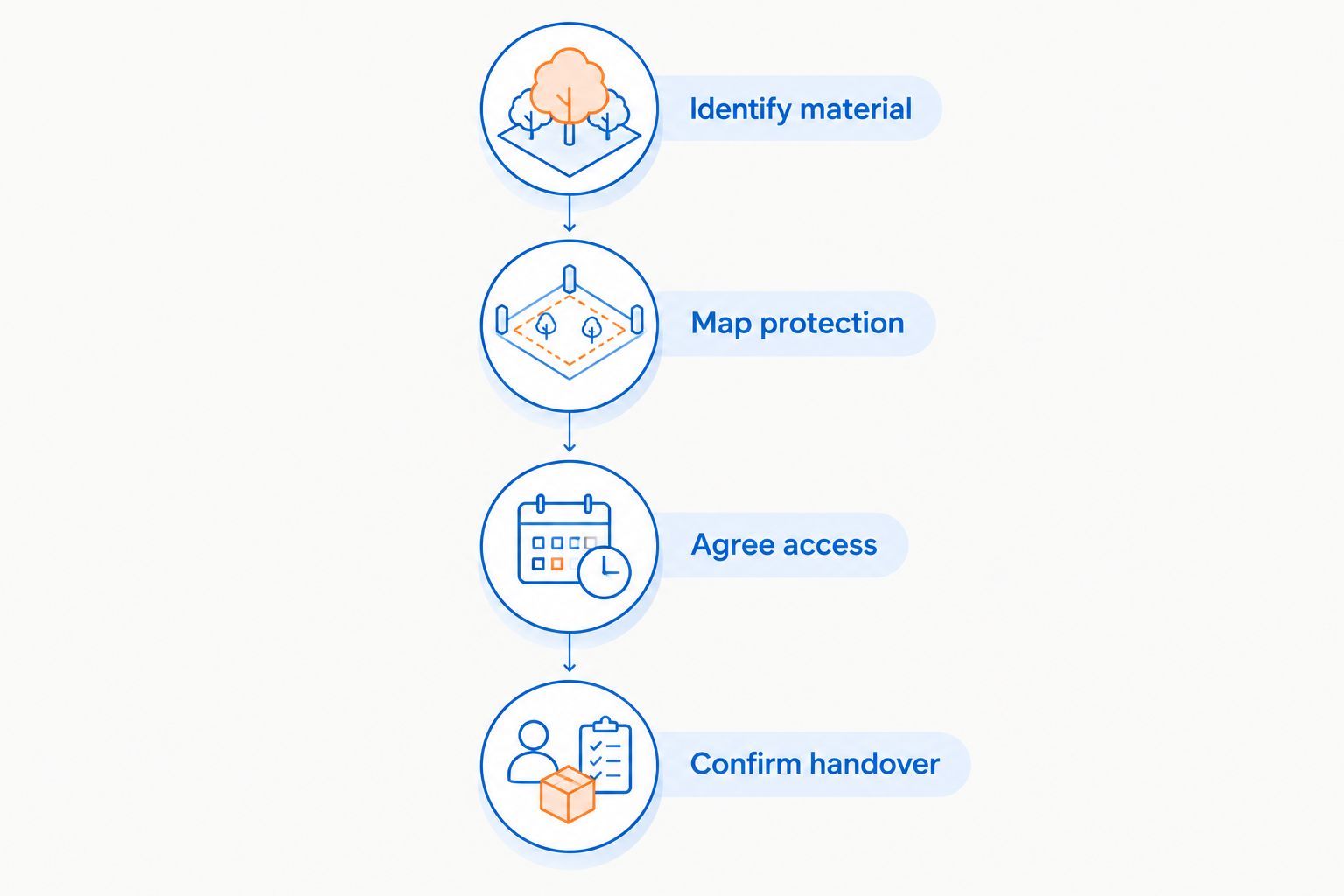
Identify material
Find the manufacturer’s label, installation paperwork, or landlord records. If the material is uncertain, request an assessment rather than describing every flexible canopy as canvas.
Provide 6 photographs as a practical starting point: the full awning, top surface, underside, seam detail, attachment detail, and the ground below. These are briefing suggestions, not a requirement to climb or reach unsafe areas.
Map protection
Identify 3 work zones: the awning, the area underneath, and the surrounding access route. List tables, chairs, menu boards, planters, lighting, electrical fixtures, and service items that need removal or protection.
Keep restaurant operations separate from residential cleaning assumptions. A commercial entrance needs an agreed pedestrian route; a dining patio needs an agreed closure and reopening plan.
Agree access
Offer 2 possible work windows and explain the operational constraints for each. Include deliveries, opening preparation, patio setup, and any shared entrance arrangements.
Do not choose a work window based only on when customers leave. Staff still need safe access, and nearby businesses or residents can be affected by equipment and blocked walkways.
Confirm handover
Agree who inspects the awning, who checks the surrounding area, and who authorizes reopening. Include furniture replacement and confirmation that food-contact surfaces are ready for use.
The cleaning job ends with a usable work area, not simply when spraying stops.
Questions that separate a clear proposal from a vague one
Ask for plain answers in writing. A useful 2026 proposal explains what happens at your restaurant rather than listing equipment without connecting it to the job.
- What material are you treating? The answer should identify the surface or explain how it will be identified before work.
- What instructions guide the method? Ask how the proposed cleaning product and application match the awning’s care requirements.
- What will remain afterward? Discuss fading, corrosion, worn coatings, old marks, and damaged seams separately from dirt.
- Where will wash water go? Ask about collection and disposal before anyone begins rinsing.
- What stays closed? Establish boundaries around doors, tables, and public access.
- What triggers a stop? Agree that unexpected deterioration or an unidentified material requires reassessment.
Avoid a proposal that promises the same result across every surface. Different materials and conditions need different decisions, even when the awnings look similar from the sidewalk.
How the recommendations are ordered
The order follows material compatibility, condition assessment, restaurant protection, wastewater handling, scope clarity, and scheduling. Material-specific assessment comes first because the wrong method can undermine the rest of the plan.
The broader exterior-cleaning route comes next when the restaurant has several surfaces to discuss. Routine maintenance has a narrower role: it supports care between appropriate cleaning visits without replacing specialist assessment.
Which awning cleaning option should you choose?
Choose a material-matched awning specialist when the canopy itself is the main problem. Choose a commercial exterior-cleaning inquiry when you also need surrounding surfaces assessed, and keep awning approval separate.
For your 2026 restaurant maintenance plan, record the material, agreed method, exclusions, and reopening responsibilities in one job brief. That document gives the next visit a useful starting point without assuming the awning’s condition will stay unchanged.
FAQ
What’s the best awning cleaning option for an Orange County restaurant?
The best option is a provider whose method matches the awning material and whose scope addresses restaurant access, protection, and wastewater handling. Start with an awning specialist when the canopy needs material-specific assessment.
Does commercial pressure washing include awning cleaning?
Commercial pressure washing does not automatically include awning cleaning. Ask the contractor to confirm acceptance of the canopy and document its cleaning method separately from pavement or building surfaces.
Can you pressure wash a restaurant’s fabric awning?
Do not assume a fabric awning is suitable for pressure washing. Follow its manufacturer’s care instructions and have the proposed method assessed before work starts.
Should a restaurant stay open during awning cleaning?
Keep the affected dining and access areas closed during overhead cleaning. If other parts of the restaurant remain open, agree on a separate safe route and protect food-service operations from the work.
Will cleaning remove every stain from an awning?
Cleaning does not repair faded color, torn fabric, corrosion, or failed coatings. Ask the contractor to distinguish removable dirt from permanent material changes before booking.
How often should a restaurant awning be cleaned?
Set the cleaning schedule using the manufacturer’s care instructions and the awning’s observed condition. Record dirt buildup, drainage issues, and material changes instead of applying the same interval to every canopy.
One last thing
Inspect the underside before approving the job. A canopy that looks dirty from the street can also have loose seams, damaged attachments, or staining underneath that changes the scope. Include those findings in the brief; a top-surface cleaning description should not stand in for an inspection of the whole awning.