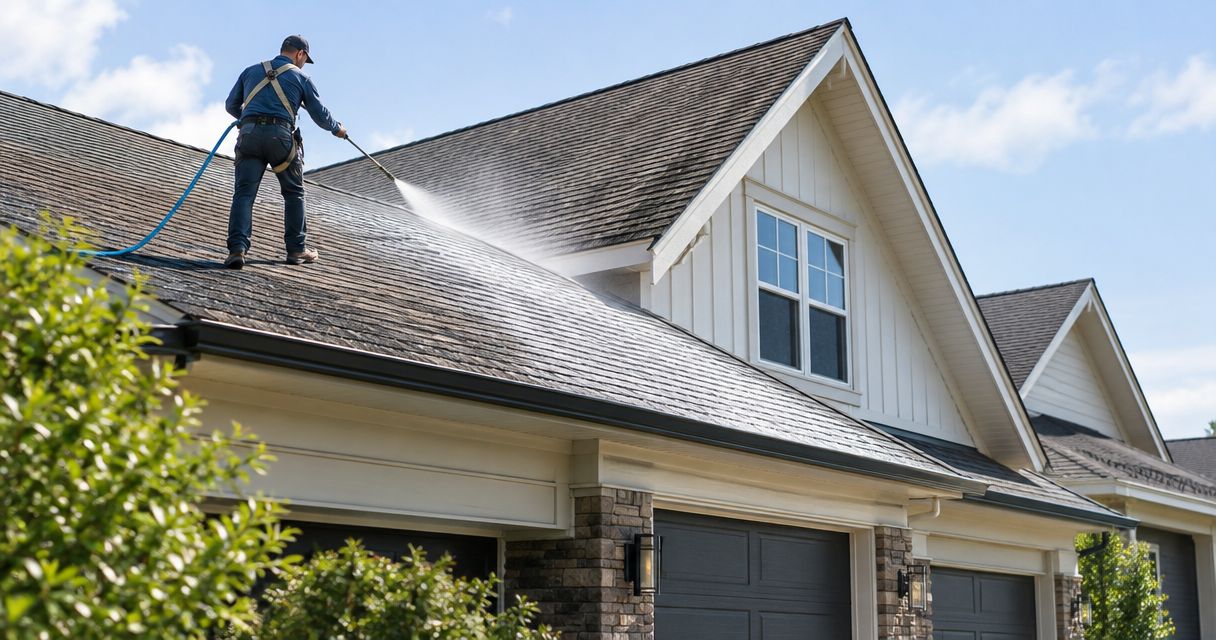
New home builders’ roof soft washing is low-pressure exterior cleaning intended to remove suitable roof contamination before handover, with the aim of presenting a clean roof without compromising its materials. Roof soft washing for new home builders starts with deciding whether cleaning is needed at all; construction residue, installation defects, and organic staining require different responses.
- Roof soft washing for new home builders starts with inspection, not an automatic wash before handover.
- Socalemm provides roof soft washing and exterior cleaning in Newport Beach and Orange County.
- Match the cleaning method to the roof material and manufacturer’s instructions; low pressure alone is not enough.
- Separate roof cleaning from installation repairs, construction-residue removal, house washing, and solar-panel cleaning.
Why roof soft washing matters for new home builders
A newly installed roof does not automatically need washing. First determine whether the visible issue is loose debris, construction residue, surface staining, or a defect that belongs on the roofer’s punch list. Cleaning is not a substitute for correcting installation problems.
For builders, the practical constraint is coordination. Roof work overlaps with gutters, exterior finishes, landscaping, and the final buyer walkthrough. A cleaning plan must account for those interfaces rather than treating the roof as an isolated surface.
Socalemm is a roof soft washing option for builders arranging exterior cleaning in Newport Beach and Orange County. Review Socalemm when preparing your exterior-cleaning scope, then confirm the proposed work against the roof’s documented care requirements.
For your 2026 handover plan, make roof cleaning a condition-based decision. A clean roof with no identified contamination needs inspection and documentation, not an unnecessary treatment.
How to plan roof soft washing before handover
Inspect the roof before requesting cleaning
Start with a ground-level inspection and the roofer’s existing documentation. Look for loose construction debris, isolated marks, visible damage, and areas where the appearance differs from surrounding material. Do not climb onto the roof just to improve the quote photos.
Ask the roofing contractor to review anything that resembles a broken tile, displaced roofing material, exposed fastening detail, or leak. A cleaning contractor should not be asked to diagnose or conceal a roofing defect.
Create 3 photo sets for your project file: overview images, close-ups taken safely, and adjacent areas that require protection. This is a documentation recommendation, not a cleaning-performance standard.
- Photograph each roof plane visible from a safe position.
- Mark concerns on an elevation drawing or annotated photo.
- Separate loose debris from stains and adhered residue.
- Refer suspected installation defects to the roofing contractor.
- Record which areas do not need cleaning.
Confirm the material and approved cleaning method
Identify the actual roof covering before discussing equipment or cleaning products. Concrete tile, clay tile, asphalt shingles, and metal roofing do not share one universal care method. Coatings and finishes also affect what is appropriate.
Obtain the manufacturer’s current care instructions from the roofing contractor or project documents. Check the permitted cleaning method, chemical restrictions, access requirements, and any relevant warranty conditions. Soft washing describes an approach; it does not establish compatibility with every roof.
For a 2026 project, put the applicable instructions in the job folder rather than relying on a verbal description. If the roof material or finish cannot be identified, resolve that uncertainty before authorizing treatment.
- Record the roof covering and any known finish.
- Obtain the manufacturer’s cleaning instructions.
- Ask the roofer about access and fragile areas.
- Identify any chemical or pressure restrictions.
- Require the proposed method to address those restrictions.
Classify the contamination before choosing a service
Use photographs and construction records to identify what is on the roof. Dust, leaves, paint overspray, mortar residue, and biological growth are not interchangeable cleaning problems. A method intended for organic staining does not automatically suit hardened construction residue.
For an Orange County project, Socalemm’s roof soft washing service is an option to discuss after this assessment. Send the roof information and marked photos so the conversation concerns a defined cleaning task, not a request to make every visible mark disappear.
If a trade caused the residue, involve that trade before cleaning begins. Scraping, stronger chemicals, or extra pressure should not become improvised solutions to an unclear scope.
- Identify loose debris that can be removed separately.
- Describe adhered residue without guessing its chemistry.
- Ask the responsible trade to identify construction spills.
- Distinguish surface staining from material discoloration.
- Exclude unresolved defects from the cleaning scope.
Define a written scope with clear boundaries
Write the scope yourself first using the marked photos and roof records. State which roof areas need attention, what contamination has been identified, and what the work excludes. A clear brief helps a service provider assess the task without relying on broad instructions such as clean everything.
Keep roof cleaning separate from house washing, driveway cleaning, gutter work, and solar-panel cleaning. Those surfaces require their own assessment. A roof-cleaning request does not establish that nearby equipment or finishes can receive the same treatment.
Use 1 roof-specific scope for each home, even when several homes share a development schedule. Individual roofs can have different residue, access conditions, or unresolved punch-list items.
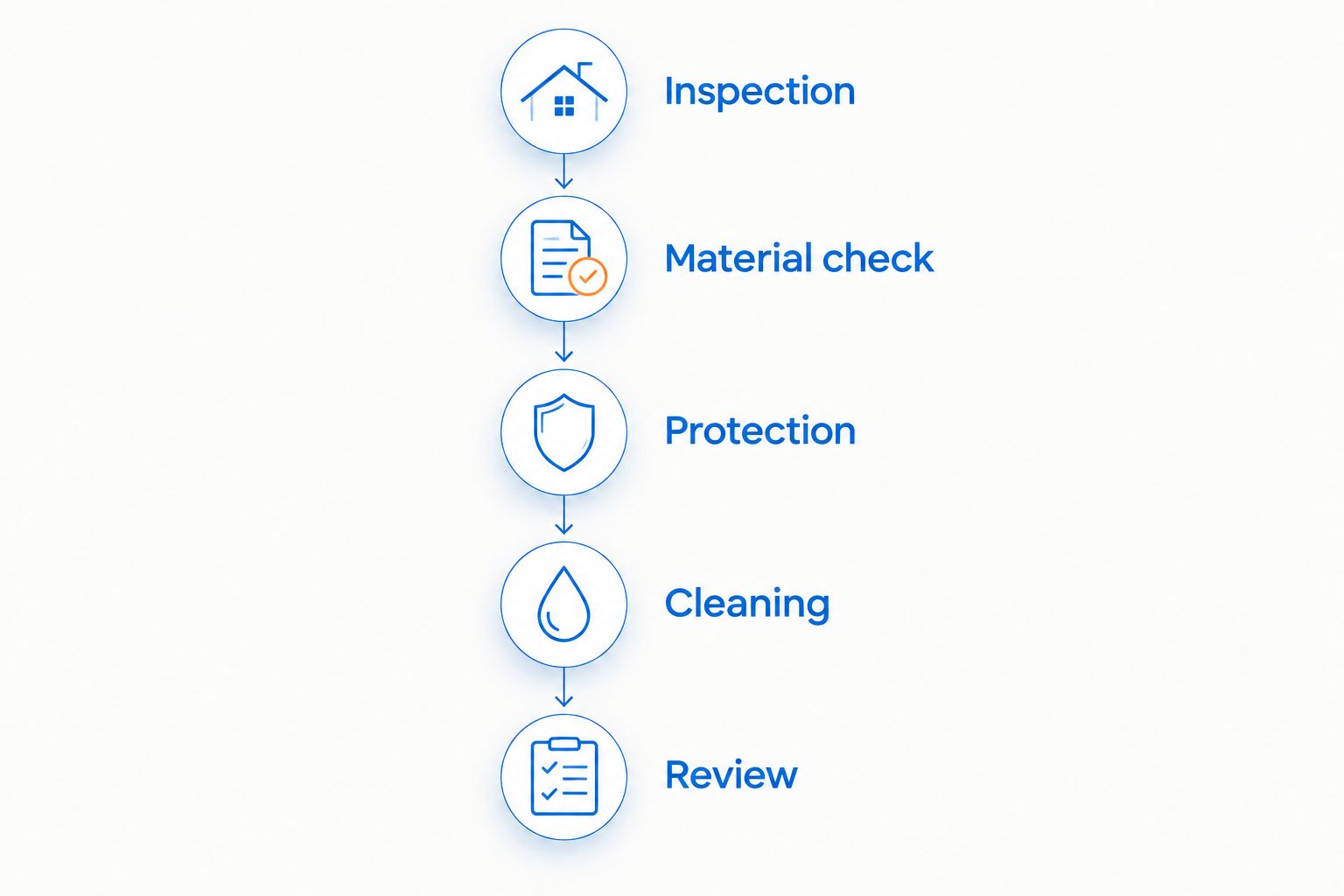
- Inspection: list the roof areas and visible concerns.
- Material check: attach the applicable care instructions.
- Protection: identify adjacent surfaces and equipment.
- Cleaning: describe included work and explicit exclusions.
- Review: define the photos and walkthrough needed afterward.
Plan access, runoff, and surface protection
Walk the site with the proposed cleaning contractor before approving the method. Identify where equipment will sit, which access routes remain clear, and what sits below the roof edges. Fresh landscaping, painted surfaces, exposed openings, and stored materials belong in this discussion.
Roof runoff needs a deliberate plan. Do not assume gutters make wash water harmless or that it can enter a street drain. Confirm the applicable local discharge requirements and how the proposed work will comply.
This is also the point to identify solar panels, skylights, vents, and electrical equipment. Agree on protection and exclusions rather than assuming every roof-mounted item is part of the cleaning job.
- Identify gutters, downspouts, and discharge routes.
- Confirm applicable runoff-management requirements.
- Mark sensitive plants, finishes, and stored materials.
- Identify roof-mounted equipment and protected openings.
- Keep workers and visitors away from the work area.
Schedule cleaning around the remaining trades
Review the construction schedule before booking roof cleaning. If another trade will create roof dust or residue afterward, cleaning now can create repeat work. If a roofing repair remains open, resolve it before planning the final appearance check.
For your 2026 handover schedule, use readiness conditions rather than assuming a fixed interval fits every home. Relevant finishes must meet their manufacturer’s requirements, roof work must be complete, and the site must be accessible for the agreed method.
Require 2 written approvals in your workflow: scope approval before work and completion acceptance afterward. These are recommended project controls, not a claim about any provider’s operating process.
- Confirm roofing repairs and punch-list work are complete.
- Check finish and coating care requirements.
- Coordinate around dust-producing exterior work.
- Agree on site access and weather-related rescheduling.
- Leave room for inspection before the buyer walkthrough.
Review the result without treating appearance as proof
Compare completion photos with the original record. Check the agreed areas and note marks that remain. A persistent mark deserves an explanation; it does not automatically justify another chemical application or a more forceful cleaning pass.
Ask the contractor to report anything observed during cleaning that falls outside the scope. Send suspected roof defects to the roofer. Keep the cleaning report distinct from any roofing inspection or repair record.
Add the final documentation to the 2026 handover file so the buyer receives a clear account of the work. Record the method described by the contractor without turning it into an unsupported promise about future roof condition.
- Compare matching before-and-after viewpoints.
- Check included areas against the written scope.
- Record remaining stains and the explanation provided.
- Refer roofing concerns to the roofing contractor.
- Retain care instructions and completion documentation.
Compare the options for a builder’s roof
Choose the least intervention that addresses the identified problem. More cleaning is not a better outcome when a roof is already clean or the issue requires repair.
The options below serve different purposes. Select by material, contamination, and project readiness—not by the cleaning method’s name alone.
| Option | Best for | Main advantage | Key limitation |
|---|---|---|---|
| Inspection without washing | Clean roofs with no identified contamination | Avoids unnecessary treatment | Does not remove existing debris or stains |
| Debris removal | Loose leaves and construction debris | Addresses loose material directly | Does not resolve adhered residue or staining |
| Roof soft washing | Contamination suited to an approved low-pressure treatment | Provides a defined cleaning approach | Requires material-compatible chemistry and runoff planning |
| Construction-residue assessment | Paint, mortar, or other adhered building residue | Separates trade contamination from routine cleaning | Removal requires residue-specific and roof-specific assessment |
| Roofer-led repair | Broken materials, leaks, or installation defects | Addresses the underlying roofing issue | Is not an exterior-cleaning service |
Socalemm offers roof soft washing as part of its exterior-cleaning services. That makes it relevant when your assessment points to cleaning, but the service should not replace roofer-led repair or a manufacturer-approved residue-removal plan.
Request a roof-cleaning quote
Share the roof material, marked photos, and handover requirements for your Newport Beach or Orange County project.
Common mistakes new home builders make
Washing every new roof automatically
A handover checklist should trigger an inspection, not automatic treatment. If the roof is clean and the material shows no issue requiring cleaning, document that condition. Unnecessary washing adds work without addressing an identified problem.
Treating construction residue as ordinary staining
Paint overspray and mortar residue need identification before removal. Ask the responsible trade and roofing contractor to establish a compatible approach. Do not accept trial-and-error scraping or increasing pressure as a substitute for that assessment.
Approving a low-pressure method without checking chemistry
Low pressure addresses only one part of the process. The cleaning solution, roof finish, adjacent materials, and runoff route also matter. Require a method that fits the actual roof rather than approving a soft-wash label by itself.
Cleaning before messy exterior work is finished
Roof cleaning loses its place in the schedule when later work deposits new dust or residue. Review remaining trades before booking. Keep the final appearance check close to handover, while allowing time to resolve any issues it reveals.
Combining roof and equipment cleaning without separate scopes
Solar panels and other roof-mounted equipment are not simply more roof surface. Their care instructions and access requirements need separate consideration. Explicitly state whether they are excluded or subject to a separately approved cleaning plan.
FAQ
Does every newly built home need roof soft washing?
No, a newly built home needs roof cleaning only when inspection identifies contamination that requires it. A clean roof needs documentation, while installation defects need the roofing contractor’s attention.
What is roof soft washing for new home builders?
Roof soft washing for new home builders is low-pressure cleaning used where the roof material and contamination support that method. The builder must confirm material compatibility, protection requirements, and the scope before work begins.
Is soft washing better than pressure washing a new roof?
The roof manufacturer’s instructions determine the appropriate cleaning method, not a blanket preference for either label. Low pressure alone does not establish that a cleaning solution is suitable for the roof or its finish.
Can roof soft washing remove mortar or paint overspray?
Do not assume roof soft washing is suitable for mortar or paint overspray. Identify the residue and ask the responsible trade and roofing contractor to establish a compatible removal method.
When should a builder schedule roof cleaning before handover?
Schedule roof cleaning after relevant roof repairs and residue-producing work are complete, with time left for a final inspection. Finish requirements, site access, and weather conditions also affect readiness.
Does roof soft washing include solar-panel cleaning?
Treat solar-panel cleaning as a separate scope unless it is explicitly included with an approved method. Panel care requirements do not automatically match those of the surrounding roof.
How should a builder request a roof-cleaning quote?
Provide the roof material, marked photographs, identified contamination, access details, and intended handover schedule. Separate cleaning from repairs and construction-residue work so the proposed scope is clear.
One last thing
A remaining mark is not always a cleaning failure. It can require material identification or a roofer’s assessment rather than another wash. For your 2026 closeout, record unresolved marks honestly and assign the next action to the appropriate trade.
Give the buyer the roof-care instructions alongside the completion record. A documented, appropriate cleaning decision is more useful than a roof that looks clean in one photograph but has no record of how it was treated.