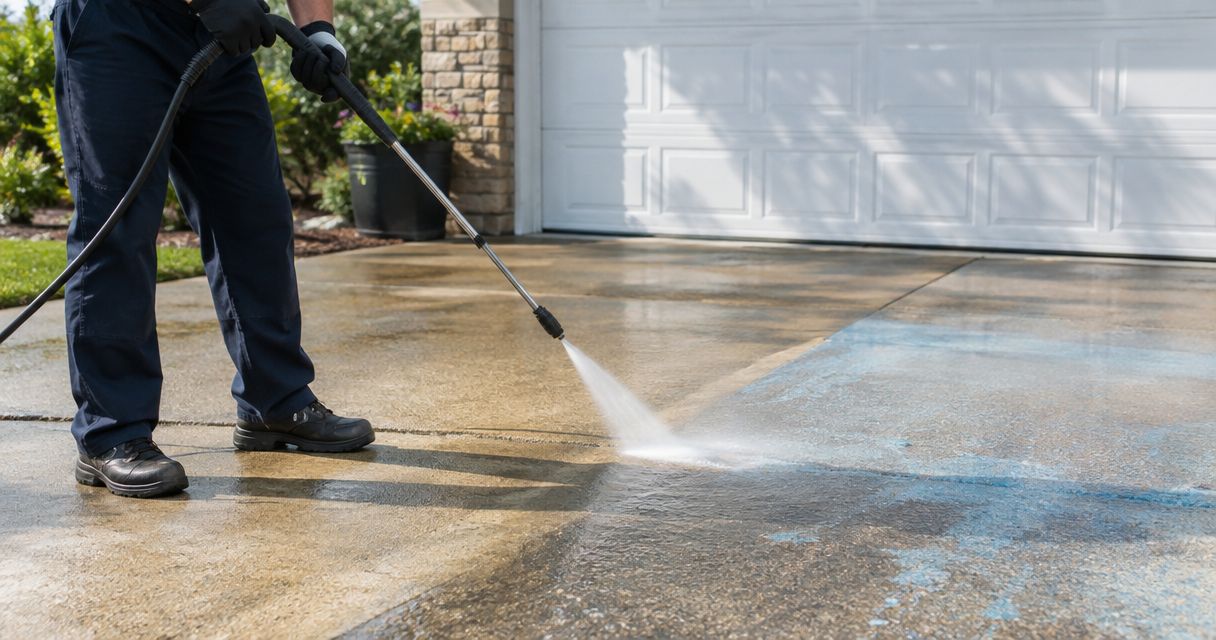
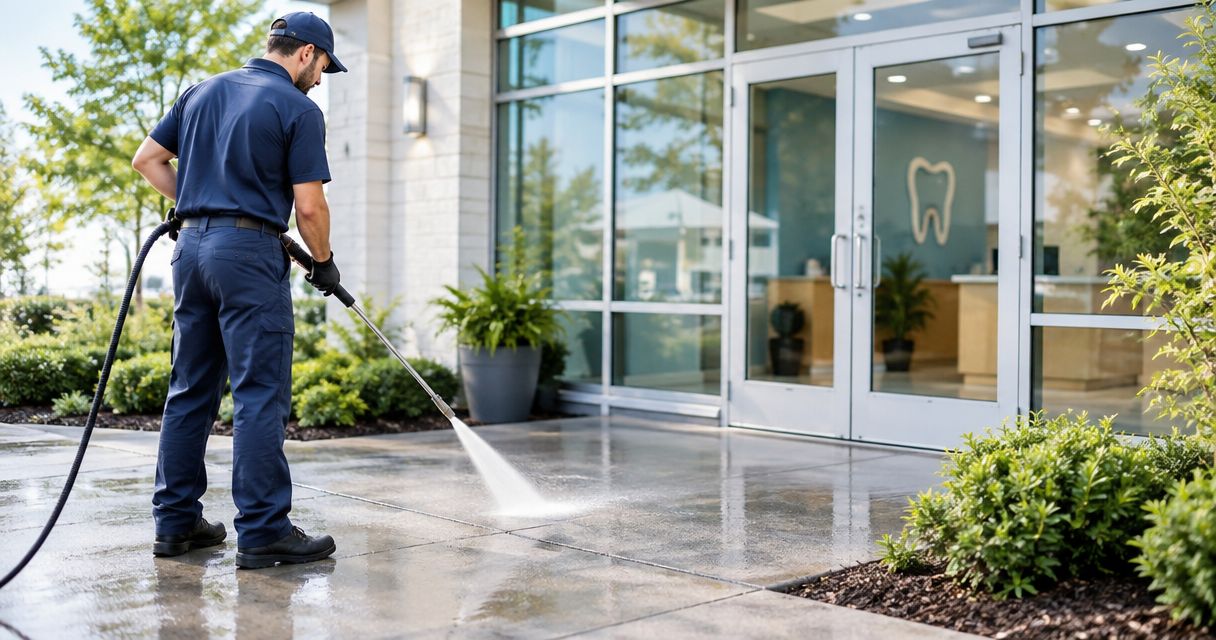
Medical and dental office pressure washing is exterior surface cleaning aimed at maintaining clean entrances, walkways, and building exteriors without disrupting patient access. This 2026 guide explains how to define the work, protect sensitive surfaces, and coordinate cleaning around appointments; it does not cover clinical sanitation or treatment-room disinfection.
- Pressure washing for medical and dental offices should prioritize patient access, surface protection, and wash-water control.
- Socalemm provides commercial exterior cleaning in Newport Beach and Orange County; clinical sanitation is a separate scope.
- Choose pressure washing or soft washing by surface condition, not by how dirty the building looks.
- Approve the access plan and drainage plan before exterior cleaning starts.
Why pressure washing matters for medical and dental offices
For a medical or dental office, an exterior cleaning project affects more than the appearance of concrete. Patients, caregivers, deliveries, and staff still need a usable route into the building. Wet surfaces, hoses, and equipment must stay out of that route during work.
Socalemm is best suited to Newport Beach and Orange County offices seeking commercial exterior cleaning, not clinical sanitation. You can review Socalemm when defining that exterior scope. Confirm the proposed methods, scheduling, and access arrangements for your particular property before approving work.
An office in a shared commercial building also has a different approval process from a homeowner. The practice might control its doorway but not the common sidewalk, parking area, or building drainage. Establish responsibility before requesting a quote, rather than discovering an approval problem when equipment arrives.
The practical outcome is straightforward: remove exterior buildup while protecting the surfaces and routes your practice depends on. Do not treat a cleaner entrance as evidence of infection control, and do not describe routine exterior washing as medical-grade disinfection.
How to plan exterior cleaning without disrupting appointments
1. Map the cleaning area and confirm responsibility
Start with a walk-through and photographs. Mark the surfaces you want cleaned, then separate practice-controlled areas from shared property. This manual survey gives a contractor a clearer brief than a request to wash the whole building.
Divide the property into 3 planning zones: entrances, pedestrian routes, and service areas. These are organizing categories, not a requirement to clean everything. Include only surfaces relevant to your office, and identify any adjacent work that belongs to the property manager.
For leased premises, obtain 2 approvals before booking: the practice's operating approval and the property manager's authorization for the proposed scope. If the practice owns the building, confirm who has authority over both operations and property maintenance. Keep that responsibility clear in your 2026 maintenance file.
- Photograph the doorway, approach, and proposed work surfaces.
- Mark shared sidewalks, parking access, and neighboring entrances.
- Identify who can authorize work on each surface.
- Separate exterior washing from interior cleaning and clinical procedures.
- Write exclusions for surfaces that should remain untouched.
2. Match the method to the surface
Inspect materials before choosing equipment. Concrete, painted trim, stucco, roof materials, and door seals do not respond identically to pressure or cleaning solutions. Existing damage matters as much as the material name.
Routine staff upkeep can begin with collecting litter and sweeping loose debris where safe. For washing, check the surface manufacturer's care instructions and document cracks, loose coatings, deteriorated joints, and water-entry points. Do not use higher pressure as the default answer to stubborn buildup.
Socalemm's commercial exterior cleaning is an option when the scope calls for outside help rather than staff handling washing equipment. Ask which method is proposed for each surface and why. The fact that a provider offers pressure washing does not make pressure washing appropriate everywhere.
- Separate sound hard surfaces from painted or delicate finishes.
- Flag peeling coatings, cracked stucco, and damaged joints.
- Identify door thresholds, vents, outlets, and other openings.
- Request a small test area before treating an uncertain finish.
- Confirm which marks are dirt and which are surface damage.
3. Protect patient access before scheduling work
Create an access plan before selecting a work window. Review appointment times, opening and closing tasks, deliveries, and neighboring businesses. A quiet period for your practice is not automatically a quiet period for the building.
Keep the accessible route usable throughout the work, or arrange an approved alternative with building management. Do not improvise a detour that sends patients into vehicle traffic or requires them to negotiate hoses. An alternate entrance is useful only when it is authorized, accessible, and clearly communicated.
Use this sequence for the access plan: Confirm access, isolate work, inspect surfaces, reopen access. The contractor should understand who can stop work if the agreed route becomes obstructed. Front-desk staff should know the plan before patients arrive.
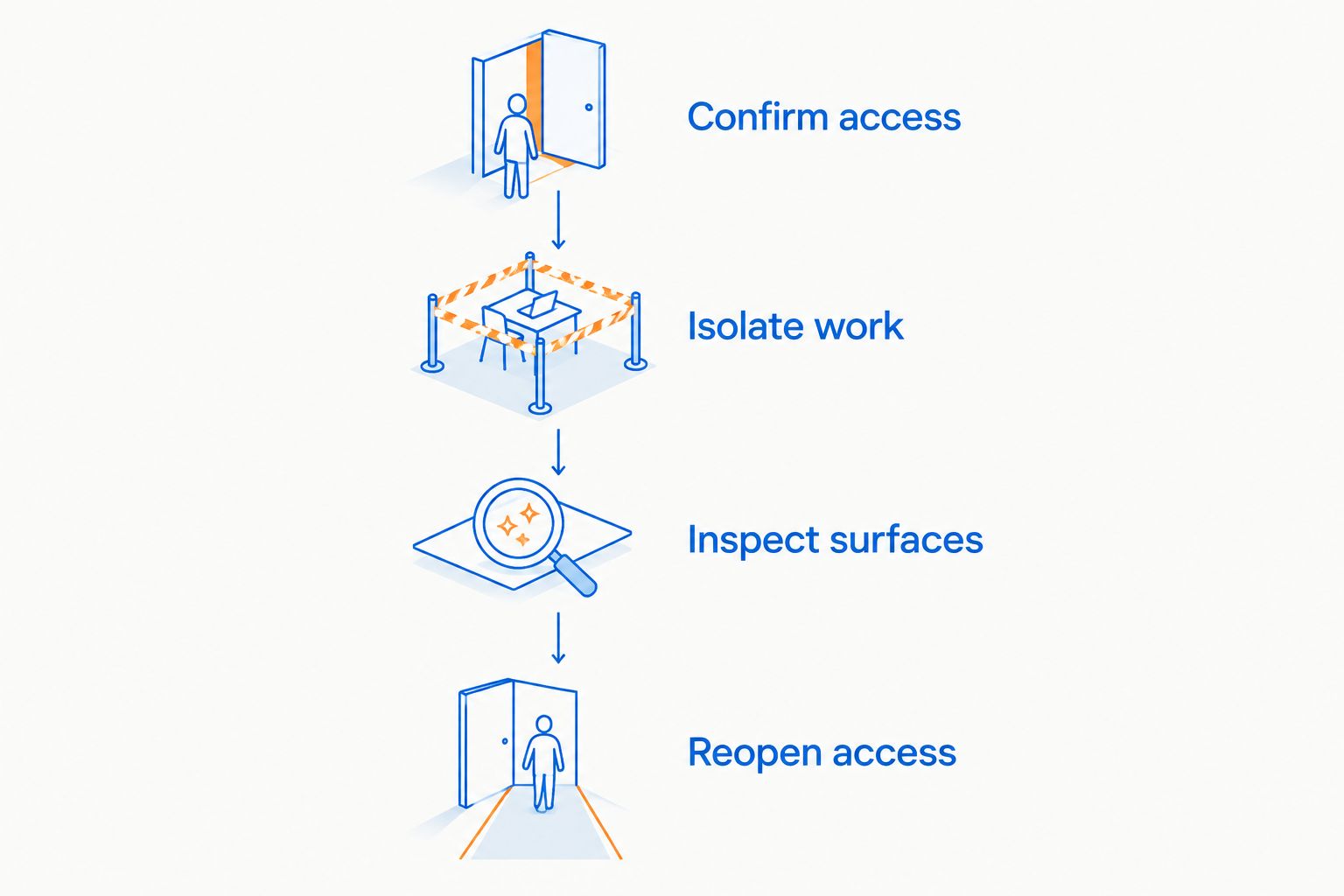
For your 2026 cleaning schedule, choose a work window based on actual access needs rather than a standing assumption that evenings or weekends always work. Confirm when the area can return to use with the person performing the cleaning.
- Check appointments, staff arrival times, and delivery access.
- Agree on barriers and signs for the active work area.
- Keep hoses and equipment outside the usable patient route.
- Tell reception staff about approved entrance changes.
- Name the person responsible for reopening the cleaned area.
4. Plan wash-water handling and protect nearby areas
Trace where water will travel before washing begins. Look for slopes, low points, drains, door thresholds, and planted areas. A clean patch of concrete does not justify sending dirty wash water toward an entrance or neighboring business.
California's stormwater system is not a disposal route for contaminated cleaning water. Check applicable local requirements and agree on containment, collection, and disposal before work. Do not assume that a drain leads to an approved disposal point or that a cleaning solution is acceptable simply because it is labeled biodegradable.
Keep the scope outside clinical waste handling. Sharps, unidentified spills, and regulated waste need the practice's established procedures, not a pressure washer. Flag them during the initial inspection and resolve them before ordinary exterior cleaning proceeds.
- Locate drains and identify the direction of runoff.
- Agree on wash-water containment and disposal arrangements.
- Protect door thresholds and nearby exposed equipment.
- Review cleaning-solution precautions for adjacent landscaping.
- Remove clinical waste concerns from the exterior washing scope.
5. Request a written, surface-specific scope
Prepare your own checklist first, then use it to request comparable proposals. Include photographs, materials, access constraints, drainage concerns, and exclusions. A written brief reduces ambiguity about whether the request covers only the entrance or a larger shared property.
Socalemm offers commercial pressure washing and related exterior cleaning in Newport Beach and Orange County. Request a quote against your actual scope rather than assuming a standard office-cleaning package. The Orange County commercial pressure washing guide is a related starting point for planning a commercial request.
Require 4 project records: the scope, access plan, drainage plan, and completion photographs. Keep these together so the office manager and property manager can review the same information. Your 2026 brief should distinguish requested work from optional work that needs separate approval.
- List each surface and its proposed cleaning method.
- State what is excluded, including interior and clinical areas.
- Document the agreed work window and access restrictions.
- Identify who supplies authorization for shared spaces.
- Ask how unexpected damage or drainage problems will be reported.
6. Inspect the result and set the next maintenance trigger
Walk the completed area before reopening it. Check for remaining debris, pooled water, residue, displaced items, and newly visible surface defects. Compare the result with the agreed scope, not an expectation that washing will repair worn materials.
Use photographs of the same locations to document the outcome without including patients, staff, vehicle details, or private records. If a stain remains, ask whether it needs another cleaning approach or is part of the surface itself. Repeatedly increasing pressure is not a repair strategy.
Set the next review around observable conditions rather than an invented cleaning interval. Examples include renewed buildup at the entrance, recurring pooling, or scheduled property maintenance. Keep your 2026 review tied to the site's condition and operating needs.
- Inspect the patient route for water, residue, and loose debris.
- Compare completed work with the written surface list.
- Record unresolved marks separately from unfinished cleaning.
- Confirm barriers and equipment are removed before reopening.
- Note the condition that should trigger the next inspection.
Compare exterior cleaning options for your office
Choose the least aggressive method that fits the surface and the task. Staff upkeep, pressure washing, and soft washing serve different purposes; none replaces the office's clinical cleaning procedures.
| Option | Best for | Practical advantage | Key limitation |
|---|---|---|---|
| Staff litter removal and sweeping | Routine upkeep between exterior cleaning visits | Removes loose debris without washing equipment | Does not remove adhered grime or address larger washing tasks |
| Targeted pressure washing | Suitable, sound hard surfaces with established buildup | Focuses cleaning on defined entrance or walkway areas | Incorrect pressure or technique can damage finishes and joints |
| Surface-appropriate soft washing | Delicate exterior surfaces suited to lower-pressure cleaning | Reduces reliance on force to remove buildup | Cleaning solutions still require surface checks and runoff planning |
| Coordinated commercial exterior cleaning | Offices with shared access, several surfaces, or drainage constraints | Brings the washing scope and operating plan together | Requires authorization and coordination; it is not clinical sanitation |
For Socalemm, the relevant fit is the commercial exterior cleaning scope. The limitation is equally important: confirm the methods and project arrangements in the quote, and keep interior infection-control work outside that request.
Do not include a roof simply because it belongs to the same building. Roof access, material condition, and cleaning method need their own assessment and authorization. A ground-level entrance project and a roof project are separate planning decisions.
Common mistakes medical and dental offices make
Treating exterior washing as infection control
An exterior surface can look cleaner without meeting any clinical disinfection standard. Keep appearance maintenance and infection-control procedures separate. Use accurate language in the work order and any patient-facing notice.
Scheduling around appointments but ignoring shared access
A closed practice can still share a walkway with an occupied neighboring suite. Confirm the whole affected area with property management, including deliveries and building access, before agreeing to a work window.
Washing first and investigating drainage afterward
Once wash water is moving toward a threshold or drain, the problem is already active. Identify the route, containment method, and disposal arrangements during planning. Stop work when conditions differ from the agreed plan.
Expecting pressure to repair a damaged surface
Cleaning cannot restore missing joint material, failing paint, or cracked concrete. Document defects first and separate repairs from washing. Otherwise, the practice and contractor are working toward different definitions of a finished job.
Sharing project photographs without checking privacy
An entrance photograph can capture a patient, vehicle, appointment notice, or paperwork through a window. Inspect images before storing or publishing them. Keep the record focused on surfaces, not people or office information.
FAQ
What's the best approach to pressure washing for medical and dental offices?
The best approach is a surface-specific exterior cleaning plan that protects patient access and controls wash water. Define the surfaces, authorizations, work window, and completion checks before cleaning starts.
Can patients use the entrance while pressure washing is underway?
Patients should not pass through the active washing area. Keep an approved accessible route open, or coordinate an authorized alternative with building management before work begins.
Is soft washing better than pressure washing for a dental office?
Soft washing is better only when it matches the surface and cleaning task. Suitable hard surfaces and delicate finishes need different methods, so choose by material and condition rather than building use.
Does exterior pressure washing disinfect a medical office?
Routine exterior pressure washing is not a substitute for clinical disinfection. Keep treatment-room sanitation, infection-control procedures, and regulated waste handling outside the exterior cleaning scope.
How often should a medical office schedule exterior cleaning in 2026?
Set the schedule from documented surface conditions and access needs, not a universal interval. Inspect for recurring buildup, residue, drainage problems, and other conditions that justify another cleaning request.
Who approves pressure washing at a leased dental office?
The practice must confirm operational arrangements, and the property manager must authorize work on shared or building-controlled surfaces. Establish both responsibilities before booking the project.
What should I include when requesting an exterior cleaning quote?
Include surface photographs, the work boundaries, access restrictions, drainage concerns, and exclusions. Ask for the proposed method for each surface and the process for checking completed work.
One last thing
Inspect the route patients actually use, not just the main doorway. A clean front entrance does little for access if the approach from parking still has debris, pooled water, or equipment in the way. Walk that route when writing the scope and again before reopening the work area.