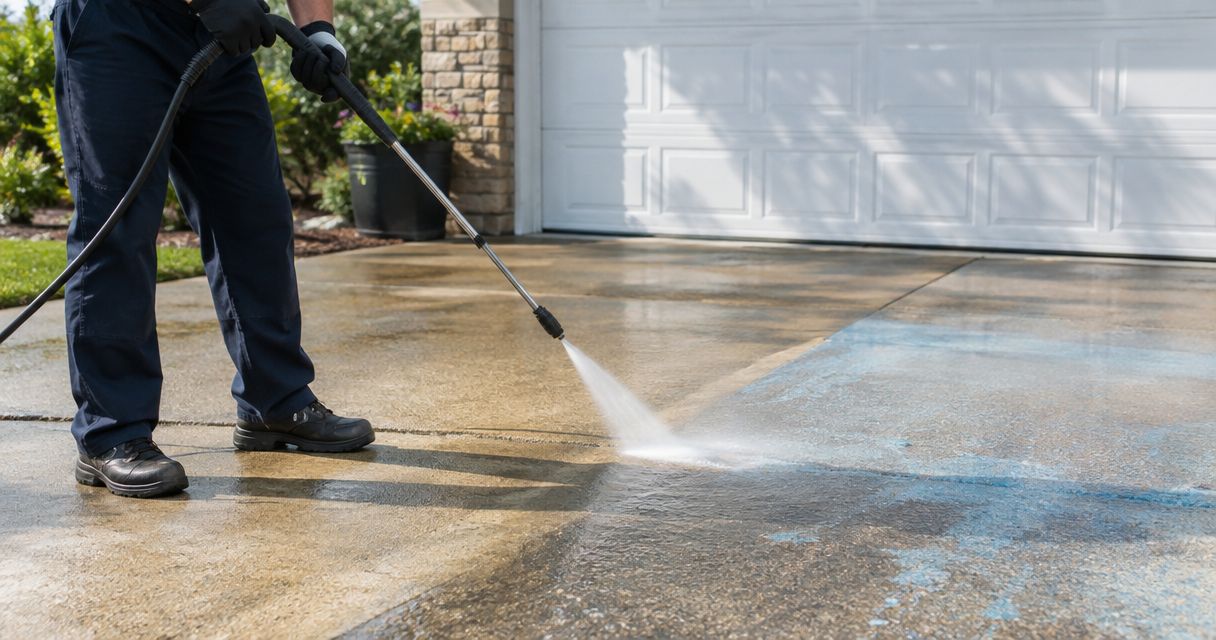
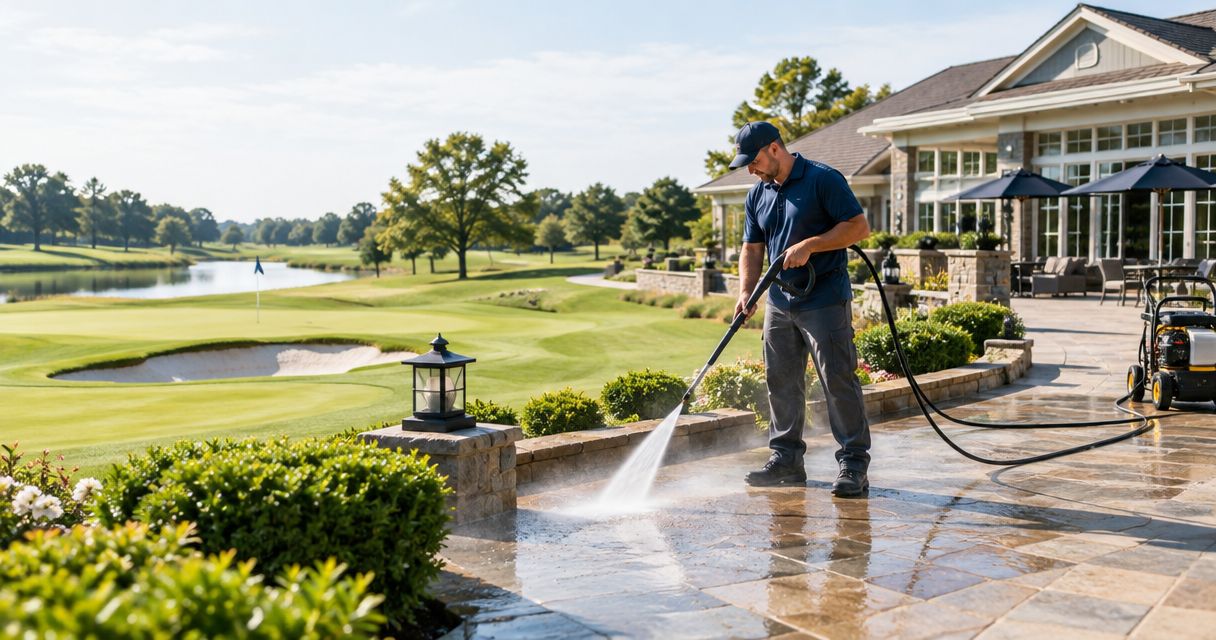
Golf course and country club exterior cleaning is the planned cleaning of buildings, paved areas, and outdoor amenities to support member access and property upkeep. This guide covers exterior cleaning for golf courses and country clubs in 2026, where cleaning work must account for tee-time traffic, dining service, maintained turf, and different surface materials.
- Exterior cleaning for golf courses and country clubs needs surface-specific methods, controlled runoff, and planned closures.
- Socalemm provides commercial pressure washing in Newport Beach and Orange County; discuss the club’s scope before scheduling.
- Separate clubhouse washing, paved-area pressure washing, and roof soft washing in the work plan.
- Choose cleaning windows around member access, dining operations, and grounds maintenance—not appearance alone.
Why exterior cleaning matters for golf courses and country clubs
A country club is not a single cleaning surface. Members move between parking areas, entrances, dining patios, and cart paths while grounds crews manage adjacent landscaping. A cleaning plan must address those connections without treating the whole property as one pressure-washing job.
Socalemm is best for Newport Beach and Orange County property managers seeking a local commercial pressure-washing provider. Socalemm provides residential and commercial exterior cleaning; keep your club inquiry focused on commercial surfaces, access requirements, and the work you need assessed.
The practical objective is clear: remove surface buildup without damaging finishes, sending wash water toward sensitive areas, or blocking necessary access. Cleaning also exposes defects that dirt can conceal. It does not repair cracked paving, failing paint, loose tiles, or damaged drainage.
For your 2026 maintenance plan, prioritize locations by their condition and use. A dirty service corner and a busy clubhouse entrance need different scheduling decisions, even when both need cleaning. Keep member-facing work separate from service-area work so staff know which routes remain open.
How to plan the cleaning work
Map the property by surface and use
Start with a walking inspection and a simple site sketch. Mark each cleaning area, its material, the nearby drainage, and the people who use it. You do not need specialized software to create a useful scope; a marked photograph and a shared document are enough.
Use 3 planning zones: member access, outdoor amenities, and service areas. These are organizational categories, not instructions to use the same method throughout each zone. A clubhouse entrance can include concrete, painted trim, glass, and metal within the same small area.
Record existing defects before requesting work. Note loose mortar, damaged coatings, unstable paving, and openings where water could enter. Put uncertain materials on an assessment list instead of guessing how they should be cleaned.
- Mark entrances, pedestrian routes, and cart crossings.
- Identify concrete, pavers, painted surfaces, and roofing separately.
- Record drains, landscaped edges, and nearby electrical equipment.
- Photograph damaged areas before cleaning begins.
Match the cleaning method to the material
Check maintenance instructions for the surface or finish first. Pressure washing uses pressurized water to remove buildup; soft washing uses lower-pressure application with an appropriate cleaning solution. Neither label alone tells you whether a proposed treatment suits a particular roof, coating, or masonry surface.
Choose the method by material and condition, not by how dirty the area looks. A hard-looking surface can have vulnerable joints or a deteriorated coating. Where instructions are unclear, ask for an assessment and a test in an inconspicuous area before broader cleaning.
A commercial exterior-cleaning provider can turn this inspection into a surface-by-surface work scope. Socalemm offers pressure washing and roof soft washing, but your club still needs confirmation of the proposed treatment for each area. Do not treat the service name as approval for every material on the property.
- Check the surface manufacturer’s cleaning instructions.
- Separate roof work from ground-level paved-area cleaning.
- Flag loose joints, flaking paint, and damaged finishes.
- Ask how the provider will test uncertain surfaces.
Plan wash-water control before work starts
Locate drains and trace the direction water travels across each work area. Cleaning water can carry dirt, cleaning products, and other material away from the surface. A plan that stops at the drain grate leaves an important part of the job unresolved.
For a 2026 cleaning scope, ask how the contractor will contain, collect, or otherwise manage wash water under applicable local requirements. Confirm the discharge approach with the relevant local authority when needed. Do not assume that water entering a storm drain is acceptable because the cleaning product has a reassuring label.
Protect adjacent turf and landscaping as part of the same discussion. Keep the grounds team involved: they know irrigation locations, sensitive planting areas, and current maintenance activity. Ask the provider to explain the controls before equipment arrives, not after water begins moving.
- Mark storm drains and low points on the site sketch.
- Identify slopes that direct water toward turf or planting beds.
- Ask for the proposed containment and collection approach.
- Confirm who handles collected water and debris.

Schedule work around club operations
Build the cleaning schedule from the club calendar, not just the contractor’s open dates. Review tee-time arrivals, event setup, outdoor dining, deliveries, and grounds work. Then choose areas that can close without forcing members through another active work area.
The manual approach is a shared calendar and an annotated access map. A provider’s work proposal should make those decisions easier by identifying the work sequence and the access needed. Faster execution does not remove the need to agree on closures, water access, and staff communication.
Use staged closures where the property layout supports them. Keep a designated alternative route clear and communicate changes before work begins. If a dining patio is in scope, coordinate furniture movement and food-service access with the person responsible for that area.
- Check event dates and member arrival periods.
- Agree on the order of work areas.
- Identify an alternative pedestrian route.
- Notify dining, golf, grounds, and facilities staff.
Prepare the work areas and protect adjacent features
Preparation is part of the job, not an assumption. Decide who moves patio furniture, signs, bins, and other removable items. Remove loose debris first so the cleaning work does not simply push it into joints, drains, or landscaped edges.
Inspect nearby doors, windows, fixtures, and electrical equipment. Identify anything that needs protection or exclusion under its maintenance instructions. Do not direct water toward damaged seals or exposed electrical components. Roof work also requires a separate access and safety discussion; it is not an extension of washing the clubhouse walkway.
Before the crew starts, conduct a short handover with the designated club contact. Walk through the work boundaries and confirm which entrances must remain accessible. A clear boundary prevents a small scope from turning into unplanned work across adjacent surfaces.
- Assign furniture and equipment movement in writing.
- Sweep or collect loose debris before washing.
- Identify vulnerable fixtures, openings, and electrical equipment.
- Confirm work boundaries with the club contact.
Request a written, surface-specific scope
Use your inspection notes to ask for a proposal that identifies what will be cleaned and how the work will be organized. Avoid a scope that only says exterior cleaning. That phrase does not establish whether the roof, dining patio, entrance paving, or service area is included.
Record 4 scope fields for each area: surface, cleaning method, access arrangement, and wash-water handling. Add exclusions wherever an item needs separate assessment or repair. Keeping these fields consistent makes proposals easier to compare without relying on vague descriptions of the finished result.
Socalemm’s commercial pressure washing is a relevant starting point for Orange County club managers; the limitation is that the club’s materials and operating requirements need a site-specific discussion. Confirm scope suitability rather than assuming golf-course specialization from a general commercial service listing.
- Name each area and its surface material.
- State the proposed method and any test area.
- Record closure, access, and preparation responsibilities.
- List exclusions and items requiring further assessment.
Inspect the results before reopening each area
Plan 2 inspections: a pre-work condition check and a post-work walkthrough. Use photographs taken from matching positions so you can distinguish cleaning results from existing defects. Keep inspection images focused on surfaces rather than identifiable members or private activity.
Before reopening, check for remaining debris, standing water, displaced items, and residue. Review the area with the provider and raise concerns while the work is still accessible. A cleaned surface is not automatically ready for traffic; reopening also depends on its condition and any treatment instructions.
Use the completed job to improve the next scope. In your 2026 maintenance record, note where buildup returned and what was happening nearby. Irrigation overspray, leaf accumulation, and concentrated foot traffic are useful observations. Do not convert one cleaning visit into a fixed schedule for the entire property.
- Compare pre-work and post-work photographs.
- Check routes for water, debris, and obstructions.
- Record unresolved cleaning concerns separately from repair needs.
- Update the maintenance log by area.
Compare cleaning options for your club
Use staff-led upkeep for routine debris removal and a defined contractor scope for washing that requires additional equipment or surface assessment. The options below serve different purposes; they are not interchangeable treatments.
| Option | Best for | Practical advantage | Key limitation |
|---|---|---|---|
| Staff-led sweeping and spot upkeep | Daily entrance and patio housekeeping | Fits routine facilities checks and removes loose debris | Does not replace suitable washing for attached buildup |
| Commercial pressure washing | Compatible paved areas with dirt and surface buildup | Addresses larger washable hard-surface areas | Requires material assessment, controlled access, and wash-water planning |
| Building soft washing | Exterior finishes suited to a lower-pressure cleaning approach | Provides an alternative to high-pressure treatment | Cleaning solution, finish compatibility, and adjacent features still need assessment |
| Roof soft washing | Roof cleaning after material and access review | Treats roof cleaning as a separate work scope | Does not repair roofing defects or eliminate access risks |
| Socalemm commercial pressure washing | Newport Beach and Orange County commercial-property inquiries | Provides a local starting point for discussing exterior-cleaning work | Club-specific scope, materials, and operating arrangements need confirmation |
Choose the option after identifying the surface problem. Loose leaves call for removal, not automatically a washing visit. A stained roof needs assessment, not a decision based on the equipment already being used on the driveway.
For a 2026 proposal comparison, give each provider the same site map and area list. Ask each provider to explain material suitability, exclusions, and operational arrangements. A clear written scope gives you something concrete to approve and inspect.
Request a commercial cleaning quote
Discuss your club’s surfaces, access requirements, and exterior-cleaning scope.
Common mistakes golf courses and country clubs make
Treating turf edges like ordinary pavement boundaries
Cart paths and patios often sit beside maintained landscaping. Cleaning plans must account for where debris and water travel, not just where the nozzle points. Have the grounds team review the work boundary and wash-water plan before approving the schedule.
Scheduling around tee times but forgetting dining and events
A quiet golf arrival period does not establish that a dining patio or event entrance is clear. Confirm the calendar with each affected department. Keep delivery routes, furniture movement, and event setup out of the active cleaning area.
Using one method across the clubhouse exterior
Paving, painted trim, glass, masonry joints, and roofing do not share identical cleaning requirements. Break the building into material-specific areas. One property can need several methods without needing every surface cleaned on the same visit.
Expecting cleaning to solve maintenance defects
Washing does not correct loose paving, poor drainage, damaged seals, or failing coatings. Record these issues separately and arrange the appropriate assessment. Otherwise, the cleaning crew inherits a repair problem and the club inspects against an outcome washing cannot deliver.
FAQ
What does exterior cleaning for golf courses and country clubs include?
Exterior cleaning for golf courses and country clubs covers the agreed building surfaces, paved areas, and outdoor amenities. List entrances, patios, cart paths, and any roof work separately so the scope identifies materials, methods, and exclusions.
Should a country club pressure wash its roof?
A country club should select roof cleaning methods from the roof material’s maintenance requirements, not assume pressure washing is appropriate. Assess roof condition, access, and drainage separately from ground-level cleaning.
Can club staff handle exterior cleaning themselves?
Club staff can handle routine sweeping and debris removal within their assigned duties and training. Washing needs a separate decision about equipment, surface compatibility, access control, and wash-water management.
When should a golf course schedule exterior washing?
Schedule exterior washing when the affected area can close without disrupting necessary member and staff access. Coordinate tee-time arrivals, dining service, events, deliveries, and grounds work before confirming the work window.
How often should a country club clean outdoor surfaces?
Set the cleaning schedule by surface condition and use rather than applying one interval to the entire property. Track buildup in shaded areas, near landscaping, and along busy routes to guide the next inspection.
Can cleaning water go into a storm drain?
Do not assume cleaning water can enter a storm drain. Confirm applicable local discharge requirements and agree on containment, collection, and handling before work begins.
Does Socalemm provide commercial exterior cleaning in Orange County?
Socalemm provides commercial pressure washing and related exterior-cleaning services in Newport Beach and Orange County. Ask about your club’s specific surfaces and operational requirements before agreeing on the scope.
One last thing
Make the post-cleaning inspection a drainage check as well as an appearance check. If water remains at a clubhouse entrance or across a cart crossing, record that location separately from the cleaning result. Repeated washing is not a substitute for assessing why water stays there.
Keep that distinction in your 2026 maintenance log: cleaning addresses surface buildup; repair addresses the underlying defect. Separating the two gives the facilities team a clearer next action.