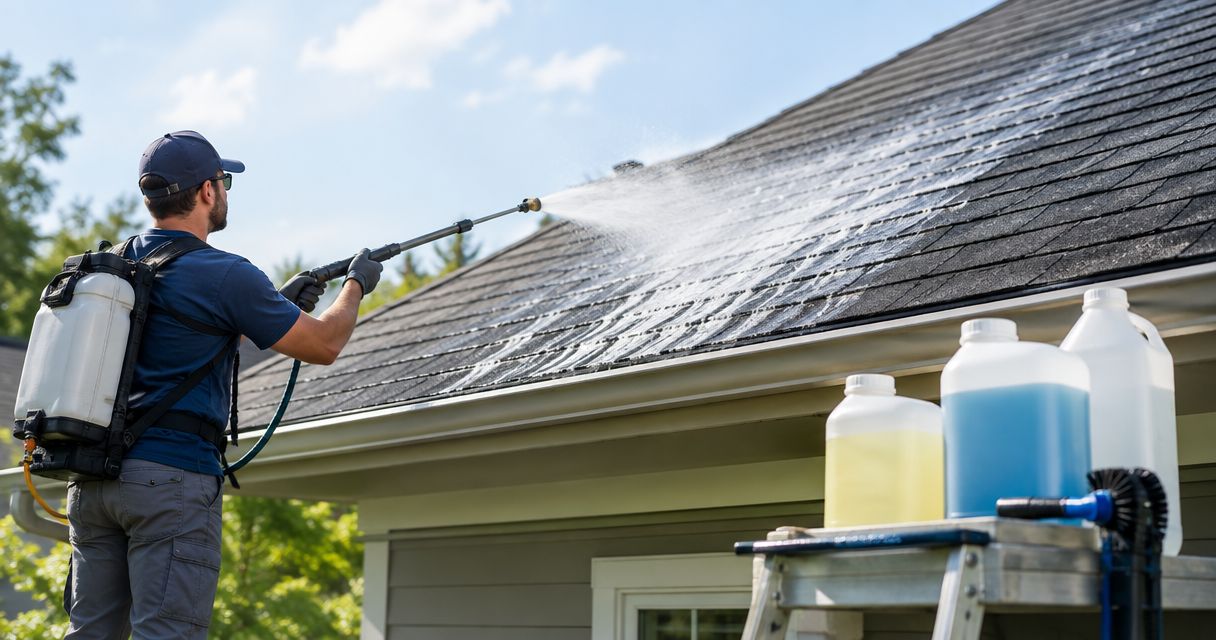
Best overall for algae staining on a compatible roof: a roof-labeled sodium hypochlorite soft-wash formulation. Best for a bleach-free option when the roof manufacturer permits it: a roof-labeled sodium percarbonate cleaner. Best for a targeted moss or algae treatment: a roof-labeled quaternary ammonium cleaner. The best soft wash chemicals for roof cleaning depend on the stain, roofing material and product label; none is a universal choice for every roof in 2026.
- The best soft wash chemicals for roof cleaning depend on the stain, roof material and product label.
- A roof-labeled sodium hypochlorite formulation is the default for algae staining on compatible roofs.
- Sodium percarbonate offers a bleach-free option only when its roof label and the roof manufacturer permit it.
- SoCal EMM provides roof soft washing in Newport Beach and Orange County for homeowners who want the work handled as a service.
Why the chemical choice matters
A dark roof stain, a patch of moss and loose dust are different cleaning problems. Choosing a chemical before identifying what is on the roof invites a poor result or an avoidable material risk. In 2026, start with the roofing manufacturer's cleaning instructions, then check that the cleaner's label names the roof material and the problem you want to treat.
SoCal EMM provides roof soft washing for Newport Beach and Orange County homeowners who prefer a cleaning service to handling roof chemicals themselves. That distinction matters here: this is a guide to cleaner types, not a claim that SoCal EMM sells any of the chemicals below or uses a particular formulation. You can find its exterior-cleaning services at SoCal EMM.
Keep roof soft washing separate from ordinary pressure washing. A chemical can be suitable for a particular stain while the application method is unsuitable for the roofing material. The roof maker's instructions and the cleaner's directions govern both choices. If either rules out the method, choose another approach rather than increasing pressure or changing the mixture yourself.
What makes the best roof soft wash chemical?
Use these criteria before comparing cleaner types. They matter more than a broad claim that one product works on every roof.
- Roof compatibility: The product label should identify the roofing material. Confirm that the roofing manufacturer permits the cleaner and application method, especially before treating asphalt shingles, tile or a coated roof.
- Stain match: Identify algae staining, moss, lichen or loose debris before selecting a treatment. A cleaner intended for one problem is not automatically the right choice for another.
- Application directions: Check the required dilution, contact time, rinsing and repeat-treatment instructions on the specific label. Do not borrow directions from a different product with the same active ingredient.
- Runoff control: Read the label's directions for nearby plants, drains and other surfaces. Plan how to protect them before applying anything to the roof.
- Worker safety: Roof access creates a hazard apart from chemical exposure. Check the product's safety directions and leave roof work to a qualified professional if you cannot carry it out safely.
- Practical limits: A bleach-free label does not mean no precautions, and a fast-acting ingredient does not mean a single treatment resolves every stain. Judge the actual product by its instructions.
Roof cleaning chemicals at a glance
The table ranks cleaner types, not individual products. A suitable label and roof-manufacturer approval are conditions for every entry in 2026.
| Cleaner type | Best for | Standout feature | Key limitation |
|---|---|---|---|
| Roof-labeled sodium hypochlorite formulation | Algae staining on compatible roofs | Direct treatment for organic staining | Bleach contact and runoff require careful control |
| Roof-labeled sodium percarbonate cleaner | A bleach-free cleaning option on permitted roof materials | Releases hydrogen peroxide when mixed with water | Not a substitute for a proven algae treatment on every roof |
| Roof-labeled quaternary ammonium cleaner | Targeted moss or algae treatment where the label permits it | Product-specific treatment directions for biological growth | Suitability and follow-up vary by formulation |
This order gives the first slot to the clearest general choice for compatible roofs with algae staining. It does not put bleach ahead of a roof manufacturer's prohibition. For a different stain or material, the right product changes. None of these entries is a recommendation to improvise a mixture or climb onto a roof.
1. Sodium hypochlorite: best roof cleaner for algae staining
Sodium hypochlorite is the active ingredient associated with bleach-based roof cleaning. For algae staining on a compatible roof, a roof-labeled sodium hypochlorite formulation is the default choice in this list. Follow the particular product's label and the roof maker's instructions rather than treating household bleach as an interchangeable roof-cleaning product.
The distinction between an ingredient and a usable product matters. A label supplies application directions and precautions for that formulation; the ingredient name alone does not tell you how to dilute, apply or rinse it. It also does not establish that your roofing material accepts the treatment.
Sodium hypochlorite pros:
- Fits the primary job of treating algae staining when the formulation is labeled for that roof.
- Gives you a clear first product category to check against the roof manufacturer's directions.
- Is commonly identified in roof-cleaning guidance for compatible asphalt shingles.
Sodium hypochlorite cons:
- Bleach can affect plants and other materials it contacts; overspray and runoff need a plan.
- Mixing bleach with ammonia, acids or other cleaners creates a serious hazard.
- A roof-labeled product is still unsuitable when the roof maker rules out its use.
Best for: Algae staining on a roof whose manufacturer permits the specific bleach-based treatment. Verdict: Buy only when the product label and roofing instructions agree; otherwise, skip it. For homeowners booking a service, ask which roof material and stain the proposed treatment addresses. You do not need to choose a chemical on the contractor's behalf.
2. Sodium percarbonate: best bleach-free option to check
Sodium percarbonate releases hydrogen peroxide when dissolved in water. A roof-labeled formulation gives you a bleach-free category to consider when sodium hypochlorite is not the preferred option. Bleach-free is a description of the ingredient choice, not proof that the cleaner is safe for every roof, plant or drainage route.
Read the label for the stain and surface it actually covers. If the roof maker or product label calls for agitation, consider what that means on the specific roofing material; scrubbing a roof is not an acceptable workaround simply because a cleaner needs more effort. Do not assume a sodium percarbonate product will deliver the same result as a bleach-based algae treatment.
Sodium percarbonate pros:
- Offers a bleach-free cleaner category for roofs that permit the specific product.
- Has product-specific instructions you can compare with the roof maker's guidance.
- Lets you evaluate a different treatment path without inventing a bleach mixture.
Sodium percarbonate cons:
- Effectiveness against a particular roof stain depends on the formulation and label.
- Contact and removal instructions can make the method impractical for a roof that should not be walked on or scrubbed.
- Bleach-free products still require attention to protective equipment, runoff and nearby surfaces.
Best for: Homeowners seeking a bleach-free option for a permitted roof material and a stain named on the product label. Verdict: Hold until the label confirms both the surface and the stain; skip products that require an unsuitable application method.
3. Quaternary ammonium cleaner: best targeted treatment to check
Quaternary ammonium compounds are active ingredients in some products intended to treat biological growth. This is the narrowest recommendation in the ranking: look at a specific roof-labeled formulation for moss or algae, then check its directions against the roof material. The ingredient category alone is not a roof-cleaning specification.
A treatment label can call for a different process from a wash intended to remove visible staining during the visit. Read what it says about application, follow-up and drainage before deciding that it fits your goal. If the label does not name your roof material or the growth you are treating, move on.
Quaternary ammonium cleaner pros:
- Provides a targeted product category to check when the problem is moss or algae.
- A specific label can tell you whether the product suits the surface and treatment goal.
- Avoids choosing a cleaner solely because it is described as bleach-free.
Quaternary ammonium cleaner cons:
- Directions vary across formulations, so the ingredient name does not establish application or follow-up steps.
- A product intended to treat growth is not necessarily the right choice for immediate stain removal.
- Drainage and nearby-surface precautions still apply.
Best for: Targeted moss or algae treatment where both the cleaner's label and roof maker permit it. Verdict: Hold until you confirm the exact product directions; skip a generic treatment with no clear roof-material guidance.
How to choose without guessing
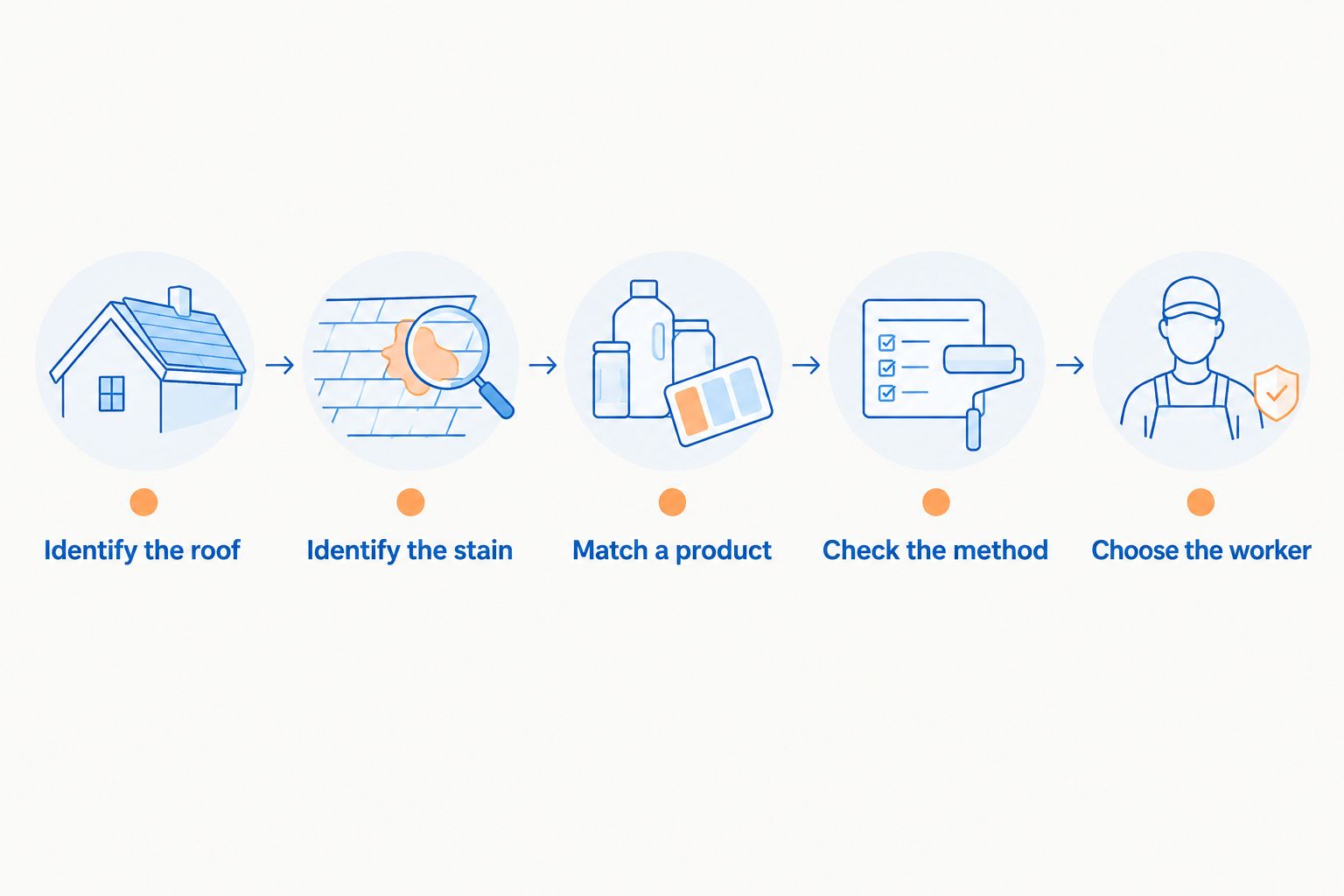
Start at the roof, not the cleaner shelf. The sequence below keeps the material, stain and application method connected. It applies whether you are reviewing a product label in 2026 or discussing a proposed treatment with a roof-cleaning service.
- Identify the roof material. Check the roof manufacturer's care instructions. Do not assume advice for asphalt shingles transfers to tile or a coated surface.
- Identify what needs removing. Note whether you see dark staining, raised moss, lichen or loose debris. If you cannot identify it, avoid choosing a treatment based on color alone.
- Match a labeled product to both. Read the surface and intended-use directions on the exact product, not just its active ingredient.
- Check the full method. Confirm application, rinsing, runoff precautions and any follow-up. Reject a method that conflicts with the roofing instructions.
- Decide who should do the work. Chemical selection does not resolve the risks of accessing and working on a roof.
For a Newport Beach homeowner, that final decision is often the most useful one. SoCal EMM offers roof soft washing as a residential exterior-cleaning service; the service discussion should establish the roof material and cleaning goal before settling on a treatment. A commercial property manager should keep the conversation tied to the building's roof instructions and site-specific access and drainage needs, rather than treating residential guidance as a work plan.
Chemical handling is not the same as roof safety
Never mix bleach-based products with ammonia, acids or other cleaners. Follow the product label for protective equipment and for protecting adjacent surfaces. Keep people away from the treatment area as directed by the product and the work plan. Those precautions address chemical handling, not the separate hazards of working at height.
Avoid an improvised stronger mixture when staining remains. The right next step is to check the label's follow-up directions and reassess whether the stain was identified correctly. Increasing concentration, changing contact time or adding another chemical without directions can turn a cleaning problem into a roof or exposure problem.
For roof work in Orange County in 2026, ask a service provider to explain the proposed method in plain terms: what is on the roof, what the roof maker allows, what product label applies and how nearby areas will be protected. SoCal EMM is a service option for homeowners and businesses seeking exterior cleaning, not a reason to bypass those checks.
How this ranking works
The order reflects how directly each cleaner type fits a stated roof-cleaning job, followed by the checks needed to use it. Sodium hypochlorite takes the default slot for algae staining only on compatible roofs. Sodium percarbonate earns a separate slot for a bleach-free product check, while quaternary ammonium cleaners earn a narrower slot for labeled biological-growth treatments. No product testing, brand comparison or claim of universal material safety is implied.
This ranking also separates a chemical's purpose from a finished roof-cleaning service. The cleaner must fit the stain; the entire method must fit the roof. If the two do not line up, the rank in a buying guide does not make the work appropriate.
Which roof cleaning chemical should you choose?
Choose a roof-labeled sodium hypochlorite formulation for algae staining only when the roofing manufacturer permits it. If you need a bleach-free route, check a roof-labeled sodium percarbonate product against the same roof and stain requirements. For a targeted moss or algae treatment, evaluate the exact quaternary ammonium product's label rather than buying by ingredient name. In every case, skip the product if the label and roofing instructions conflict.
If you would rather book roof soft washing than handle the chemicals and roof access yourself, SoCal EMM serves homeowners and businesses in Newport Beach and Orange County. Ask for the proposed cleaning method and how it matches your roof. The best decision in 2026 is the one that addresses the actual stain without overriding the roof maker's instructions.
FAQ
What are the best soft wash chemicals for roof cleaning in 2026?
A roof-labeled sodium hypochlorite formulation is the default option here for algae staining on a compatible roof. Sodium percarbonate and quaternary ammonium cleaners serve different labeled uses; the roof maker's instructions determine which products remain eligible.
Is sodium hypochlorite safe for every roof?
No. Use a specific roof-labeled product only when the roofing manufacturer permits its cleaner and application method. Protect nearby surfaces and follow the label's handling and runoff directions.
Is sodium percarbonate the same as bleach?
No. Sodium percarbonate releases hydrogen peroxide in water and is a bleach-free alternative to sodium hypochlorite. Check its label for your roof material and stain rather than assuming it works the same way.
Can I mix roof cleaning chemicals to remove stubborn stains?
No. Never mix bleach-based products with ammonia, acids or other cleaners. Recheck the stain and follow the specific product's directions instead of improvising a stronger treatment.
What cleaner should I use for moss on a roof?
Check a product explicitly labeled for moss and for your roofing material. Confirm that its application and follow-up directions also agree with the roof manufacturer's instructions.
Is soft washing the same as pressure washing a roof?
No. A chemical treatment and a pressure-washing method are separate decisions. Follow the roofing manufacturer's cleaning instructions rather than assuming a suitable chemical makes any application method suitable.
Should I clean my own roof or request a service?
Request a service if you cannot safely access and work on the roof. SoCal EMM provides roof soft washing in Newport Beach and Orange County; ask how the proposed treatment fits your roof material and stain.
One last thing
A bleach-free label is not a roof-compatibility label. Before choosing any cleaner in 2026, find the product directions that name your roof material and the stain you need to address. If that match is missing, stop there; a different ingredient will not fix missing instructions.